Laser cutting companies · Social media
Let a short clip of a clean cut sell the shop to the next fabricator.
Social media marketing for a laser cutting shop means showing the machine at work, the edge it leaves and the parts that go out, to the workshops and designers who follow trade pages. GullySales plans the posts, the shop-floor shots and the way a viewer sends a file.
Scope, fee, reporting and term are agreed in writing after we have read your brief and spoken to you.
What social media means
Social media is the ongoing posting your business does on platforms such as Instagram, Facebook and LinkedIn to stay visible to customers and prospects between purchases. GullySales plans a posting calendar, writes captions and designs the images so the page looks active and answers what a visitor would ask.
Last updated 14 Nov 2026.
For laser cutting companies
Where it usually goes wrong, and what we would do.
“The cut is easy to show”
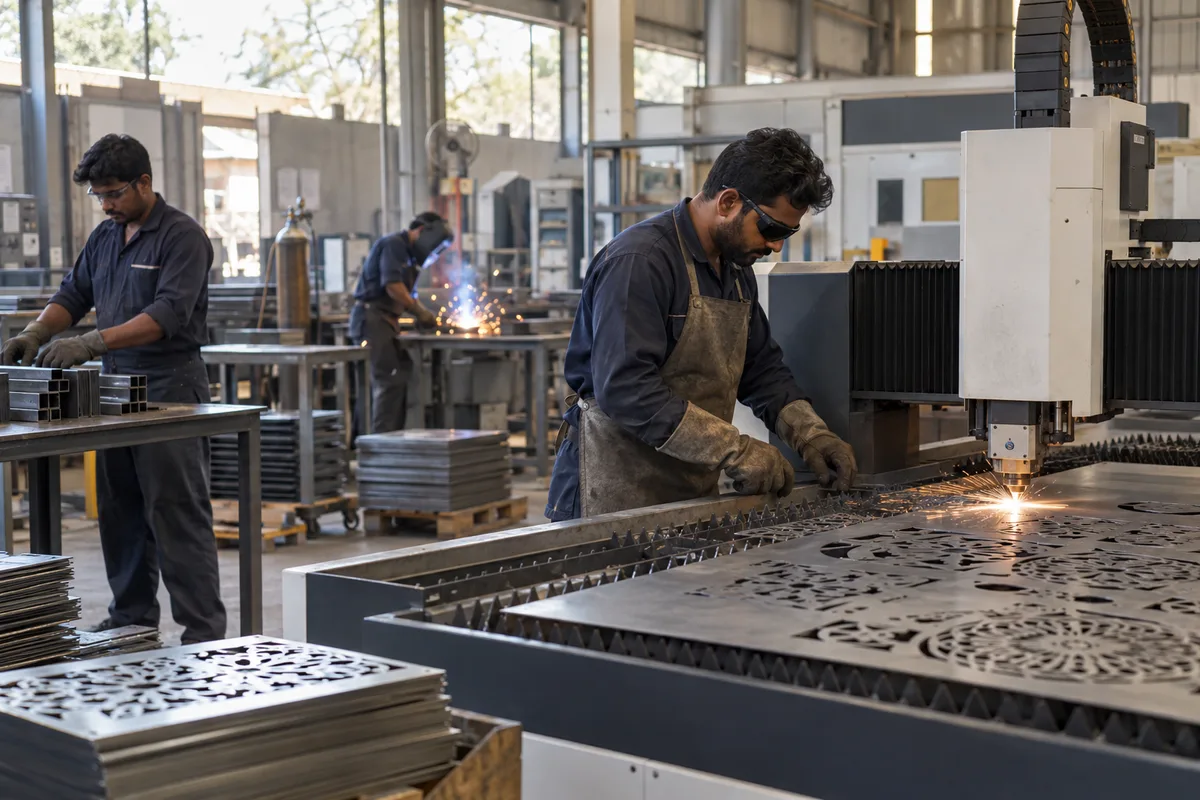
A beam running through sheet metal, a part lifted from the bed and a stack of nested pieces are things a viewer understands in seconds. Few trades have footage this clear, yet shops post a logo and a greeting on festival days.
“Fabricators watch for edge and finish”
A buyer judges burr, dross, taper and piercing marks from a close picture. A photograph taken at arm's length shows none of it. A steady close shot beside a coin or a scale gives the viewer something to compare.
“Designers follow different pages”
Interior firms and architects look for decorative panels on image-led platforms, while fabricators see trade groups and WhatsApp channels. One post sent to both audiences fits neither. Each group needs its own subject and its own caption.
“A post with no way to act wastes the view”
A viewer who likes a clip of a jali panel and finds no number, no form and no file instruction moves on. Every post needs one clear step, such as sending the drawing on WhatsApp.
What we do
What we deliver for laser cutting companies.
The work available for this need. We agree the deliverables and responsibilities for your engagement in writing.
A shop-floor shot list
A list of clips and photographs to take during normal jobs: the pierce, the cut, the part off the bed, the stacked output.
Result: A list the machine operator can follow without extra time.
A post plan by audience
Separate subjects for fabricators, kitchen equipment makers and designers, with the platform each one uses.
Result: A plan that says who each post is for.
Captions that name material and thickness
Short captions stating metal, gauge, bed size and the job type, so the post doubles as a capability note.
Result: Captions a buyer can use to judge fit.
A file-sending call to action
A single line and a business WhatsApp link on each post, telling the viewer how to send a drawing.
Result: A route from view to file on every post.
Profile set-up
Bio, link, highlights and a pinned post on the platforms you choose, matched to the rate sheet and machine page.
Result: Profiles that look the same as the website.
How the result is measured
- Posts published
- Engagement rate
- Enquiries from social profiles
Recorded as a baseline before work starts, so every later report has an honest comparison.
Posts and pieces to plan
Plan posts around the cut, the sheet and the finished part, with no buyer drawing in view.
- A clean edge on stainless steel
- A close video of the cut, with the material and thickness named in the caption and no buyer drawing in the frame.
- Nesting a sheet to waste less
- A short clip showing the nested layout on screen and the sheet after cutting, with an explanation of the offcut.
- From DXF to finished part
- A sequence of file, nested sheet, cutting and parts on a rack, ending with how to send the file.
- Decorative panel cutting
- A post for designers and interior contractors showing a pattern cut, the sheet size and the finishing options handled.
- Tube cutting for frames
- A video of the tube machine on a furniture section, only if the shop has one, with the sections handled named.
- What we need from your drawing
- A carousel on closed contours, layers and units, aimed at the buyer who sends a messy file.
Who it is for
This is written for these laser cutting companies.
- Fibre laser job-work shops serving local fabricators
- Stainless steel kitchen and equipment makers' cutting partners
- Signage, nameplate and letter cutting shops
- Decorative jali and facade panel cutters
- Tube laser cutting shops for furniture and frames
- Laser cutting shops attached to a fabrication unit
- Panel and enclosure sheet cutting units for electrical makers
- Laser shops serving elevator, bus body and trailer builders
Before you decide
When this may not be the right fit.
- You have no drawings you may show, and until buyers allow it every post would have to use your own samples.
- Nobody on the floor can shoot a clean video, and shaky posts do not carry a precision trade.
- Your machine capacity cannot take on new buyers, so a visible account would only bring enquiries you decline.
Before you decide
Agree the work. Know how to judge it.
Social media marketing for laser cutting shops: use these checks to prepare, choose the scope, and review what changes.
Bring the right evidence
Review the posts that produced useful conversations, not only the ones with the most views. Gather buyer questions and decide which team member can contribute credible material.
Make the scope clear
Choose the audience and channel before setting a posting volume. Agree who supplies material, approves posts, and handles messages, including complaints or questions the agency cannot answer.
Check the work in use
Follow a post through to the profile, website, and response. A useful report explains the quality of conversations and enquiries, alongside reach and engagement.
Know when to change course
If publishing takes time away from unanswered buyer messages, fix the response routine first. Do not expand to another channel without a clear reason for being there.
These are discussion points, not a fixed package. GullySales confirms the deliverables, responsibilities, fee, and term in writing after reading your brief and speaking with you.
Before we start
What to have ready before the work starts.
The records, access and decisions this work needs from laser cutting companies. Anything missing is noted in the written scope, with who will supply it.
- A safe, tidy corner of the shop to film
- A place where the operator can work with a phone or tripod nearby without breaking a safety rule. If the shed is too crowded to film, posts use still pictures of finished parts.
- Operator time for an explained cut
- An operator who can say, in a sentence, what is being cut and why the edge looks as it does. You must release them from the machine briefly. Without this, captions are general and carry less trust.
- Written consent for any customer's part
- A message from the buyer allowing a part to be shown. Fabricators protect designs. Without consent we film offcuts, test shapes and the machine alone.
- Admin access to the social accounts
- Logins held by the owner, with a recovery number. If accounts sit with a former agency, they must be recovered. Without them, we draft posts that you publish yourselves.
- A quote desk reply for each message type
- A decision on what the desk replies to a file, to a rate question and to a price comparison. If the desk has no rule, social leads wait and the post earns nothing.
How it works
How the social media work runs
The work itself, in order. How an engagement starts, from your brief to a written scope, is set out on our method page.
- 1
Look at the pages workshops already follow
We spend time on the pages your buyers actually watch, such as fabricators, signage makers and designers, and note what holds attention: edges, speed, finished parts. You tell us which platforms the quote desk hears about. We do not choose a platform because it is popular elsewhere.
- 2
Make a shot list on the shop floor
With the machine operator we list what can be filmed safely: the beam on sheet, the cut edge up close, a part lifted from the bed, a nested sheet and a finished batch. You rule out anything that shows a customer's design or exposes a safety lapse. We agree who holds the phone.
- 3
Shoot a first batch with the operators
We spend a session at the machine, filming short clips and stills in different materials. The operator explains each cut in a sentence we can use as a caption. You see the raw material and remove anything you do not want public, before any edit is made.
- 4
Write captions that name material and thickness
We write each caption with the material, thickness and the kind of part, so a fabricator knows at a glance whether the shop fits. Separate posts speak to designers and signage buyers. You approve the wording on tolerance, finish and speed, which the machine and the operator must support, and you tell us if a claim should wait until a sample has been cut and measured.
- 5
Set the file-sending route and the profile
We set up the profile so a viewer taps once to send a file by WhatsApp or form, and write the reply the quote desk sends. You name who answers messages from the social pages. A post with no way to act is rewritten before it goes out.
- 6
Match files received to the posts that ran
We record which posts produced messages and files, against the number of enquiries before the plan began. You see which material and type of cut drew a response and which clips were only watched, and decide what to film next.
Where this fits
Three pieces of sales work, in this order.
This work sits inside sales process design, at stage 0, foundation. The audit comes before it, and sales management keeps it running.
Step 1
Sales audit
Find where deals are being lost and what to fix first.
Start here if you cannot say where orders are lost.
Step 2 · you are here
Sales process design
One written way to sell, from first enquiry to repeat order.
Start here if every salesperson sells differently.
Step 3
Sales management
A target, a review routine and someone who owns the number.
Start here if the team has targets and no routine.
FAQ
Questions owners ask before they call.
Not here? More answers, or ask on WhatsApp.
Which platform suits a laser cutting shop?
Do we need a person on camera?
Will posts bring jobs on their own?
Is it safe to show a customer's part on our page?
Do we need someone on camera?
Will posts bring jobs without any other work?
How much does it cost?
How long is the contract?
How soon will we see results?
Who will actually do the work?
More for laser cutting companies
Related work to consider.
Closest to this: content and social
Also for laser cutting companies
Or start from the overview: sales and marketing for laser cutting companies.
Your next practical step
Tell us what you are trying to grow, and we will read it before we call.
Eight short steps, mostly taps. Skip anything you would rather answer on the call.