Laser cutting companies · Website
Build a site that answers the buyer's first three questions before the phone rings.
A website for a laser cutting shop is a small set of pages that state the machine, the material and thickness range, the rate rules and how to send a file. GullySales plans and writes those pages so a workshop can judge fit without calling.
Scope, fee, reporting and term are agreed in writing after we have read your brief and spoken to you.
What website means
A website is the page a customer lands on after searching, clicking an advert or scanning a code, and it decides whether they call or leave. GullySales builds and maintains sites that load quickly, explain the offer plainly and make the enquiry form or phone number easy to find.
Last updated 14 Nov 2026.
For laser cutting companies
Where it usually goes wrong, and what we would do.
“The first question is whether you can cut it”
A buyer with a sheet in hand wants to know material, thickness and bed size. If the site buries these in a paragraph about quality and service, the buyer leaves. A table near the top answers the question in one look.
“The second is how to send the file”
Fabricators want to attach a DXF and move on. A site with only a contact form and a long enquiry page adds work. A WhatsApp link, an email route and a short list of what to include make the step simple.
“The third is how you price”
Buyers do not expect a final rate on a page. They do want to know whether you quote by metre, by sheet or by part, and who keeps the offcut. Stating that builds trust before the first quote.
“Photographs of real parts outweigh stock images”
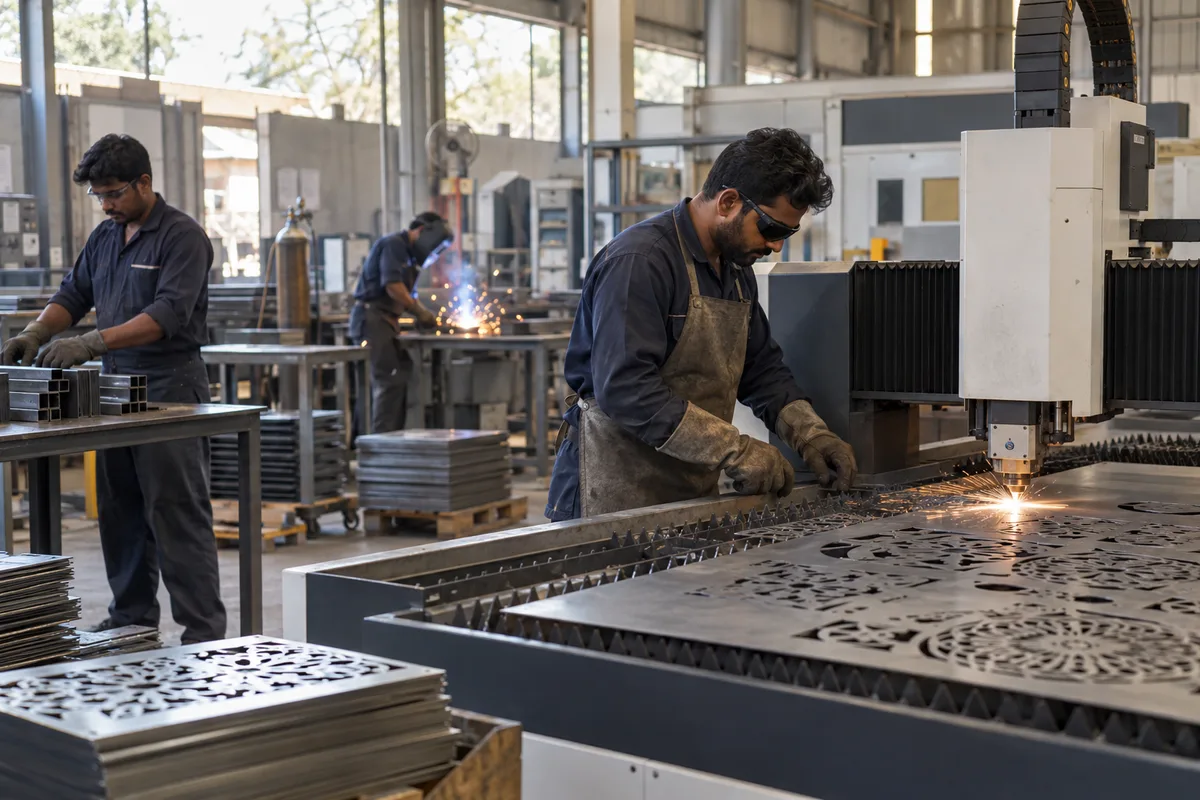
A stock picture of a laser beam says nothing about your machine. A photograph of your cut edge, your nested sheet and your parts shows capability. It also gives search something unique to read.
What we do
What we deliver for laser cutting companies.
The work available for this need. We agree the deliverables and responsibilities for your engagement in writing.
A capacity table
Metals, thickness range, bed size and laser power laid out in one table near the top of the page.
Result: A table a buyer can read in seconds.
A file route
A clear block showing how to send a DXF or DWG, what to include and the formats accepted.
Result: A step the buyer can complete without a call.
A pricing and offcut page
How you quote, how wastage and offcuts are handled, and the difference between supplied and bought sheets.
Result: A page that settles the questions buyers argue about later.
Work and decorative pages
Photographs of finished parts, jali panels, nameplates and tube work, each with material and thickness.
Result: Pages of real work that suit both fabricators and designers.
Mobile layout and speed check
The pages checked on a phone, since most buyers open them from a chat or a listing.
Result: A site that reads well on the screen buyers use.
How the result is measured
- Page load time
- Bounce rate
- Enquiries from the website
Recorded as a baseline before work starts, so every later report has an honest comparison.
Searches your buyers type
Answer the three questions a workshop asks before it sends a file.
- laser cutting capacity thickness
- A capacity table listing materials, thickness range and bed size, stated from what the machine has cut.
- how to send DXF for laser cutting
- A file route with accepted formats, a checklist and a button that opens the chat or form.
- laser cutting rate calculation
- A page explaining the factors behind a rate, such as material, cut length and quantity, without a fixed price.
- laser cutting samples near me
- A work page with photographs of real parts, with permission for each, and decorative panels on a page of their own.
- laser cutting shop address and contact
- Address, map pin, hours and a phone button on every page.
- offcut and sheet supply policy
- A short page on who supplies the sheet and what happens to offcuts.
Who it is for
This is written for these laser cutting companies.
- Fibre laser job-work shops serving local fabricators
- Stainless steel kitchen and equipment makers' cutting partners
- Signage, nameplate and letter cutting shops
- Decorative jali and facade panel cutters
- Tube laser cutting shops for furniture and frames
- Laser cutting shops attached to a fabrication unit
- Panel and enclosure sheet cutting units for electrical makers
- Laser shops serving elevator, bus body and trailer builders
Before you decide
When this may not be the right fit.
- Your machine range is changing, and a capacity table written now would soon be wrong.
- You have no photographs of finished parts, and a site without them cannot prove the cut.
- Nobody reads the form on working days, so a site would collect enquiries that go cold.
Before you decide
Agree the work. Know how to judge it.
Website for laser cutting shops: use these checks to prepare, choose the scope, and review what changes.
Bring the right evidence
List the pages that support a buying decision and the actions visitors must complete. Keep examples of failed forms, unclear product information, and questions your team answers repeatedly.
Make the scope clear
Agree the page list, content ownership, integrations, and who controls the domain and hosting. Include redirects and existing search traffic in a redesign brief, before changing addresses.
Check the work in use
Complete a real enquiry journey on a phone and a laptop. Check that the confirmation appears, the enquiry reaches the right person, and tracking records the action once.
Know when to change course
If visitors can enquire but the team does not follow up, start with the sales handover. A larger website will not resolve that delay.
These are discussion points, not a fixed package. GullySales confirms the deliverables, responsibilities, fee, and term in writing after reading your brief and speaking with you.
Before we start
What to have ready before the work starts.
The records, access and decisions this work needs from laser cutting companies. Anything missing is noted in the written scope, with who will supply it.
- The machine data sheet and bed dimensions
- A document that states power, bed size and cutting range. The capacity table uses it. Without it, the operator states the range from experience and every figure is checked by you.
- Owner-held logins for the domain and hosting
- Access to the web address and hosting. If a former vendor holds them, a transfer must start first. Without control of the domain, we build on a temporary address.
- A decision on file uploads
- Whether buyers can upload drawings through the site or must send by WhatsApp or email. Large files and confidentiality both matter. Without a decision, the site links to WhatsApp and the form takes details only.
- Photographs of real parts and the shed
- Pictures taken in daylight of finished work and the machine, with permission for any customer part. A stock image of a laser says nothing about your edge.
- A statement of how you price
- A plain description of whether you price by the metre, the machine minute or the part, and what changes it. Only you can state it. Without one, the pricing page stays short and invites a call, and the explanation of offcuts and supplied sheet is held back until you have decided what to say about them.
How it works
How the website work runs
The work itself, in order. How an engagement starts, from your brief to a written scope, is set out on our method page.
- 1
List what a workshop must see before calling
We write down the questions a fabricator asks before ringing: can you cut my thickness, how do I send the file, how are you paid, where are you. You add the questions you hear. The site is planned around these, and a page that answers none of them is not built.
- 2
Gather the machine data and the access to domain
We collect the machine data sheet, the domain and hosting logins, the logo, the shop address and the work photographs. You tell us who holds each. Anything held by a former vendor is recovered first, since a site on borrowed access can vanish.
- 3
Draw the capacity table and the file route
We lay out the table of materials, thickness range, bed size and file types, and the route a buyer follows to send a drawing by form or WhatsApp. You check each number against the machine. The table is the first thing a workshop reads, so it must be exact, including the thickness at which you cut cleanly and the thickness at which you cut with a rougher edge, and how the page says so.
- 4
Write the pricing, offcut and work pages
We write the page that explains how a job is priced and who keeps the offcuts, and pages for decorative, signage and tube work if you do them. You decide how much of the pricing method to publish. Photographs of real parts replace stock images wherever possible, shot against a plain background with a scale in frame, so a fabricator can judge burr, kerf and finish from the picture without a call.
- 5
Test the upload, the forms and the phone view
We place the pages on a test site and send test files through the form and the WhatsApp link, and open every page on a mid-range phone. The quote desk confirms files arrive readable. You approve the pages and we fix slow images and broken links, and we try a drawing exported from the software your programmer uses to be sure the upload does not strip the file.
- 6
Go live and read the site against the start
We move the site to the real address, connect search and tracking, and hand over every login. Against the visits, calls and files recorded before the launch, we read what changed. You see which pages bring files, which forms are abandoned halfway and which phone numbers are tapped, and you decide what to add, whether that is a page for a material buyers ask about or a clearer route for sending a drawing.
Where this fits
Three pieces of sales work, in this order.
This work sits inside sales process design, at stage 1, prospecting and lead generation. The audit comes before it, and sales management keeps it running.
Step 1
Sales audit
Find where deals are being lost and what to fix first.
Start here if you cannot say where orders are lost.
Step 2 · you are here
Sales process design
One written way to sell, from first enquiry to repeat order.
Start here if every salesperson sells differently.
Step 3
Sales management
A target, a review routine and someone who owns the number.
Start here if the team has targets and no routine.
FAQ
Questions owners ask before they call.
Not here? More answers, or ask on WhatsApp.
How many pages does the site need?
Do we need to show prices?
Can the site connect to WhatsApp?
Should the site take file uploads?
Who writes the capacity table?
What do we need from our operators for the site?
How long is the contract?
How soon will we see results?
Who will actually do the work?
What if we are not happy with the work?
More for laser cutting companies
Related work to consider.
Closest to this: search and visibility
Also for laser cutting companies
Or start from the overview: sales and marketing for laser cutting companies.
Your next practical step
Tell us what you are trying to grow, and we will read it before we call.
Eight short steps, mostly taps. Skip anything you would rather answer on the call.