Printing businesses · Content marketing
Write down what you explain to every customer about paper and files.
Content marketing for a print shop turns the explanations your team repeats daily, about GSM, finishes and artwork files, into pages buyers find and read. GullySales writes those pages with your press team, so the enquiries arrive better prepared and the wrong files stop coming in.
Scope, fee, reporting and term are agreed in writing after we have read your brief and spoken to you.
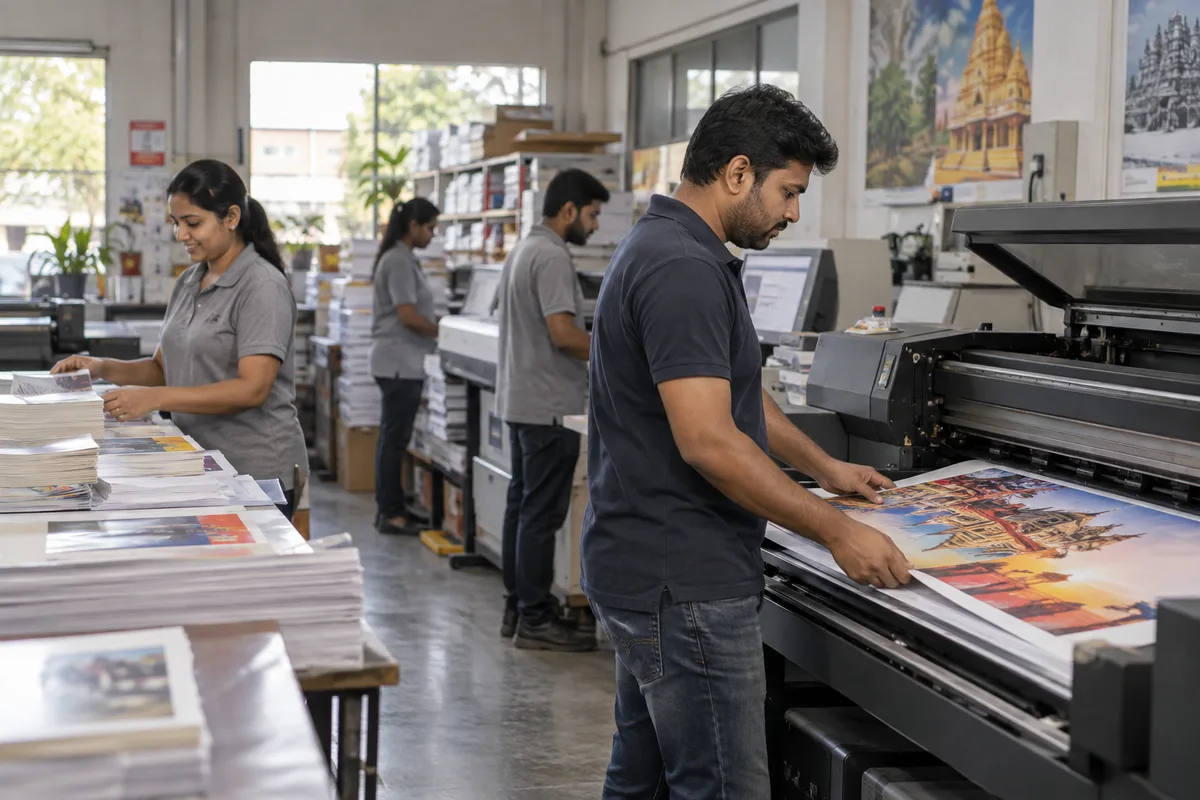
What content marketing means
Content marketing is writing articles, guides and pages that answer the questions buyers search before they are ready to enquire. This makes your business visible and trusted before the first call. GullySales plans this content from the first conversation onward, choosing topics that match real search demand rather than guesses.
Also for printing businesses
- Social media marketing for printing businesses
- SEO for printing businesses
- PPC ads for printing businesses
- Lead generation for printing businesses
- Digital marketing for printing businesses
- Reputation management for printing businesses
- Local SEO for printing businesses
- Branding and identity for printing businesses
Sales and marketing for printing businesses, the overview.
Last updated 5 Oct 2026.
For printing businesses
Where it usually goes wrong, and what we would do.
“The artwork explanation is worth a page on its own”
Bleed, resolution, colour mode and outlined fonts are explained on the phone every week, and a page saying it once saves an hour a day.
“Buyers search the choice, not the shop”
Questions like which GSM for a visiting card, or offset or digital for 500 copies, are typed by the person about to place an order.
“A written specification prevents the argument later”
Publishing what each finish does and what it costs in time means a buyer chooses knowingly, and a proof dispute becomes far less likely.
What we do
What we deliver for printing businesses.
Every deliverable, what it covers for you, and the result it is there to produce. Nothing here is an extra.
An artwork requirements page
Bleed, resolution, colour mode, fonts and accepted file formats set out plainly, with a downloadable template for your common sizes.
Result: Files arrive ready and jobs start on time.
Choice guides for paper and finish
Short guides on GSM, board types, lamination, foiling and spot UV, written for a buyer rather than a printer.
Result: A buyer picks a specification before calling.
Offset against digital explained by quantity
A plain page on which process suits which quantity, and why the price behaves the way it does.
Result: Fewer buyers argue that your rate should match an online price.
Job-type checklists
A checklist for each job type covering what you need from the buyer, from a wedding invitation to a monocarton.
Result: Nothing is missing when the job is booked.
A record of which pages brought enquiries
Search visits and enquiries traced to each guide, against the figures noted before publishing.
Result: Writing time goes to the guides buyers actually use.
How the result is measured
- Pages published
- Organic traffic
- Enquiries from content pages
Recorded as a baseline before work starts, so every later report has an honest comparison.
Questions buyers ask first
The questions a customer asks before ordering print, and the page that answers each.
- What file do I send, and at what resolution?
- An artwork requirements page. State PDF format, bleed, safe margin, colour mode, resolution, fonts outlined, and what you do when a file is wrong. Offer a free file check, if you do.
- What paper and GSM should I choose for cards, brochures and flyers?
- A paper guide by job. Compare art paper, matt, uncoated and board in GSM, and how each feels and holds ink. Show real swatches photographed side by side.
- Offset or digital for my quantity?
- A page that explains the difference by quantity and job. Describe set-up cost, colour matching and press time in general terms, and say where the crossover usually falls for your shop.
- What is lamination, spot UV, foil or embossing, and what does it add?
- A finishes page with close-up photographs. Say what each does, the paper it needs, and what it adds to the rate, so a customer understands why one quote is higher.
- Will the colour on my screen match the print?
- A colour page. Explain RGB against CMYK, why a screen differs from paper, how Pantone colours are matched and what a printed proof or a hard proof shows before the full run.
- What details do I give to get a correct quote?
- A quote checklist per job type: size, quantity, paper, colours, finish, delivery location. Say what happens if the artwork changes after approval, so the customer knows before the press starts.
Who it is for
This is written for these printing businesses.
- Commercial offset printing businesses
- Digital and quick-print shops
- Packaging and label printing businesses
- Large format and signage printers
- Wedding and event stationery printers
- Corporate stationery and print suppliers
- Textile and garment printing businesses
- Print-on-demand and personalised merchandise printers
Not for
It is not the right fit if.
- You want a guaranteed Google ranking or a guaranteed number of leads. Nobody honest can promise either.
- You need enquiries by next week and have nobody to answer them.
- You want posts and reach reported, not enquiries and orders.
How it works
From your first message to the first report.
No open-ended retainer. Every step gives you something in writing.
First
Your brief
You tell us what you need in a few short steps: your business, what you want, where enquiries come from and how they are handled.
After the brief
A conversation and a written scope
We read it, then talk with whoever handles your enquiries. If you want our help, the scope, the fee and the reporting come in writing, and nothing starts before you have read them.
Before work starts
Baseline recorded
Enquiries by source, reply time, conversion and cost per order, written down so every later report has an honest comparison.
After the baseline
The first fix goes live
The fix we agreed to start with is put in place and measured against the baseline, whether that is reply time, a follow-up sequence, the page buyers land on or the handover between marketing and sales.
As agreed
Report against the baseline
What moved, what did not, and what changes next, in plain words. How often you get it is set in writing before work starts.
At renewal
Renew on the numbers
The term ends and you decide whether to continue from the results. The length is agreed in writing before anything starts.
How the content marketing work runs
- 1
Confirm the plan
Topics and formats for the coming month are confirmed against the content strategy.
- 2
Produce and review
Content is written or filmed, then reviewed by someone who knows your trade before it goes out.
- 3
Publish and distribute
Finished content is published to the site and pushed through the channels your buyers actually use.
- 4
Track enquiries
Enquiries are traced back to content where a direct line exists, and reported honestly where it does not.
- 5
Report and adjust
We report results and adjust the next topics based on what actually worked.
Why us
Why owners pick GullySales over an agency.
Marketing and sales, as one job
Most agencies stop at the enquiry. We also fix what happens after it: the reply, the follow-up, the quote and the CRM.
The person on the first call does the work
No account managers in between. You are never handed to someone you have not met.
A baseline before anything starts
Your numbers are written down on day one, so every later report compares against something honest.
The fee in writing, split three ways
Our time, your media spend and production on separate lines. You always see what goes to us.
No guarantees we cannot keep
The term is agreed in writing and never a default twelve months. We never promise a ranking or a lead count, because nobody controls those.
One office, and we say so
Nagarbhavi, Bengaluru. We work across India by call and WhatsApp and travel when a session needs to be in person.
#257, 3rd floor, Sri Nanjundeshwara Complex, Nagarbhavi 8th Block, Outer Ring Road. How we work.
Your brief
Tell us what you need, and we will read it before we call.
Eight short steps about your business, what you want and who decides. Most questions are a tap, and you can skip any you would rather answer on the call.
FAQ
Questions owners ask before they call.
Not here? More answers, or ask on WhatsApp.
Will explaining this lose us work to online printers?
Who writes it, and how long does it take?
Should we show sample photographs of customer jobs?
Do we write for businesses or for families?
Do we need to advertise?
Should we check the label text a food brand sends us?
How much does it cost?
How long is the contract?
Who will actually do the work?
What do you need from us?
From the blog
Further reading for printing businesses.
 6 min read · 18 Aug 2026Why your business is growing but profit is notRevenue rising while profit stays flat usually means discounts, the wrong customers or an uncalculated acquisition cost, all visible in your own records.
 7 min read · 18 Aug 2026How to get printing orders that repeat every monthPrinting orders come from local searches, corporate and institutional buyers who reorder, and fast quotes. Pick the jobs you print best, show prices, and chase the reorder before the customer runs out.
 6 min read · 8 Apr 2025How to create a sales process for a small businessA sales process is the stages a real order already passes through, each with what must be true before a deal can leave it, reviewed weekly.
More for printing businesses
Everything else we would do for you.
Closest to this: content and social
Also for printing businesses
- SEO for printing businesses
- PPC ads for printing businesses
- Lead generation for printing businesses
- Digital marketing for printing businesses
- Reputation management for printing businesses
- Local SEO for printing businesses
- Branding and identity for printing businesses
- Email marketing for printing businesses
- Buyer journey mapping for printing businesses
- Follow-up systems for printing businesses
- CRM for printing businesses
- Review generation for printing businesses
- Customer retention for printing businesses
- Referral marketing for printing businesses
- WhatsApp marketing for printing businesses
Or start from the overview: sales and marketing for printing businesses.
Your next practical step
Tell us what you are trying to grow, and we will read it before we call.
Eight short steps, mostly taps. Skip anything you would rather answer on the call.