Window manufacturers · Lead generation
Bring in window enquiries from people who are building, renovating or buying in bulk.
Lead generation for a window manufacturer means finding the homeowners, builders, architects and fabricators who are about to specify or replace windows, and giving each a route to ask. GullySales works on the pages, forms and records that turn those asks into measurements and site visits.
Scope, fee, reporting and term are agreed in writing after we have read your brief and spoken to you.
What lead generation means
Lead generation is the combined work of every channel that brings in a new enquiry, whether from search, adverts, referrals or a stall at an exhibition. GullySales runs these channels together and reports the number of enquiries each one produced, not the activity behind it.
Also for window manufacturers
- CRM for window manufacturers
- Follow-up systems for window manufacturers
- SEO for window manufacturers
- Local SEO for window manufacturers
- Social media marketing for window manufacturers
- Content marketing for window manufacturers
- Buyer personas for window manufacturers
- WhatsApp marketing for window manufacturers
Sales and marketing for window manufacturers, the overview.
Plan the next part of the work
Last updated 21 Nov 2026.
For window manufacturers
Where it usually goes wrong, and what we would do.
“The buyer has a deadline set by the wall”
A family with a half-built house needs window sizes before plastering is finished, and a replacement buyer wants the old frames out before the rains. Reaching them at that moment matters more than reaching a large crowd who will not buy this year.
“A builder enquiry and a homeowner enquiry are different leads”
The homeowner wants a price for a handful of openings and a visit. The developer asks about floor-wise lots, a sample window and payment stages. One form that treats both the same sends the wrong reply to each.
“A lead without the opening details wastes the first visit”
A caller who says only that they need windows gives you nothing to quote. Room, opening count, wall type and the problem they want solved, such as noise or heat, decide who goes to the site and what they carry.
“Architects and fabricators are leads that arrive slowly”
A studio drawing a section or a fabricator weighing a profile system does not fill a form on the first visit. They download a drawing, compare, and return when a project needs it, so the record has to remember them.
What we do
What we deliver for window manufacturers.
The work available for this need. We agree the deliverables and responsibilities for your engagement in writing.
Separate enquiry routes by buyer
A homeowner form, a builder supply form and a fabricator partnership form, each asking the questions that buyer can answer.
Result: Each enquiry reaches your team already marked as home, builder, architect or fabricator.
Opening details at the first ask
A short block on the form for rooms, approximate openings, new build or replacement, and the main worry.
Result: The person who calls back knows what the buyer wants before dialling.
Landing pages by need
Pages for noise from a main road, heat in a west-facing room, new-home window lists and apartment replacement, each with its own enquiry form.
Result: You can read which need brought each enquiry in.
Specification download with a contact step
Section drawings and profile sheets offered for download, with a name, practice and phone number asked in return.
Result: Architects who take a drawing are listed by name for a follow-up call.
Source tag on every record
Search, Maps, Instagram, showroom walk-in, dealer and referral are tagged when the enquiry is entered.
Result: You can see which source brought site visits and which only brought calls.
How the result is measured
- Relevant enquiries by source
- Duplicate and unsuitable enquiries
- Time to the first response
- Accepted enquiries reaching an agreed next step
Recorded as a baseline before work starts, so every later report has an honest comparison.
What to capture or send
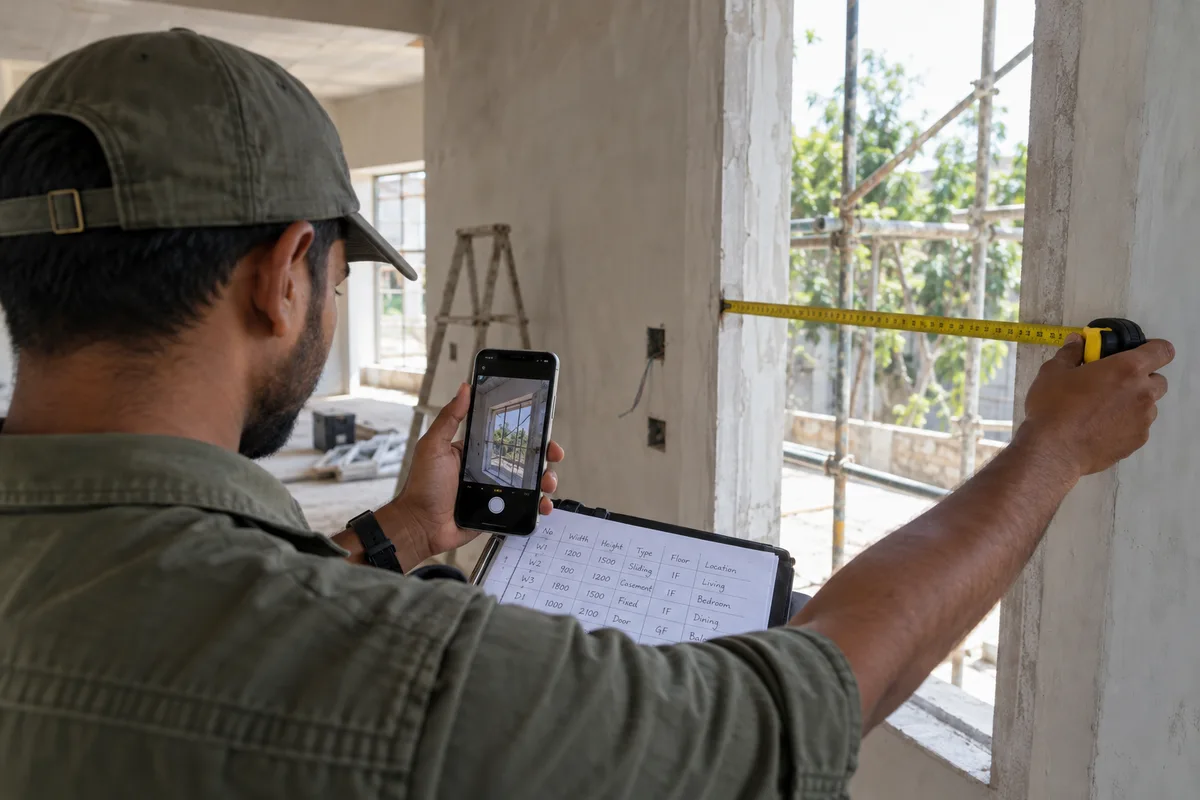
What a window maker records at the first enquiry so the site visit is worth the trip.
- Number and size of openings
- Taken on the first call or from a photograph of the wall. It tells the measurer whether this is a bedroom or a whole block and who should go.
- Stage of the building
- Record whether it is a finished flat, a house under construction or a renovation. Brickwork not yet plastered changes the frame, the fitting and the date a measurement can be taken.
- Material and glass preference
- Note whether the buyer asked for uPVC, aluminium or wood and for noise or heat control. It sets which sample the showroom shows first.
- Buyer type and who approves
- Mark homeowner, builder, architect or fabricator. A builder's purchase head and a family each need a different quote and a different next call.
- Location and pin code
- Check it against the area you install. An honest early answer on a town you do not serve saves a wasted call for both sides.
Who it is for
This is written for these window manufacturers.
- uPVC window manufacturers
- Aluminium window and sliding door makers
- Aluminium extrusion system suppliers to fabricators
- Wooden window and teak frame makers
- Fixed glass, curtain wall and structural glazing fabricators
- Fire and acoustic window specialists
- Mosquito mesh and safety grille window makers
- Manufacturers with their own dealer and installer network
Before you decide
When this may not be the right fit.
- Your measurement team is booked on installations and cannot visit a new site, so more enquiries would only add buyers waiting
- You have not decided which towns you install in, so leads from outside your area would be answered with delays or a refusal
Before you decide
Agree the work. Know how to judge it.
Lead generation for window manufacturers: use these checks to prepare, choose the scope, and review what changes.
Bring the right evidence
Define the organisations or buyers you can serve and the reasons they would consider a conversation. Bring examples of accepted and rejected prospects so the selection rule is visible.
Make the scope clear
Agree the research sources, contact approach, qualification rules, and handover. Clarify which meetings count as accepted and what happens to replies that are not ready to buy.
Check the work in use
Review why a prospect was selected and what was learned from the response. Count held, relevant conversations separately from contacts found, messages sent, or meetings booked.
Know when to change course
If the same objection appears repeatedly, adjust the offer or buyer group before increasing outreach. Respect a request to stop contact and keep the exclusion in the record.
These are discussion points, not a fixed package. GullySales confirms the deliverables, responsibilities, fee, and term in writing after reading your brief and speaking with you.
Before we start
What to have ready before the work starts.
The records, access and decisions this work needs from window manufacturers. Anything missing is noted in the written scope, with who will supply it.
- The enquiry register for the last season
- Bring the register, notebook or spreadsheet in which the sales desk records enquiries, however untidy. We read it for the buyer type and the outcome of each. If there is no register, the baseline starts on the first day of the new forms, and early comparisons rest on very little.
- Photographs of fitted work with the site noted
- Collect pictures of installed windows, with a line on the building type and the system. They are used on the entry pages. Without them the pages show only a catalogue, and a homeowner who wants to see a fitted window nearby has nothing to look at.
- Your delivery and service area in plain words
- Write down the towns, districts and distances you will travel to measure and fit. The enquiry routes use it to answer faraway enquiries politely. If it is left unsaid, the sales desk spends visits on towns it cannot serve.
- A named person to answer new enquiries
- Name who answers the form and the phone, and who covers on a holiday. The test enquiries need a recipient. If nobody is named, replies depend on whoever is free, and the first answer a buyer receives is the slowest part of the process.
How it works
How the lead generation work runs
The work itself, in order. How an engagement starts, from your brief to a written scope, is set out on our method page.
- 1
Pull the last enquiries from the order book
We start with the enquiry register, the quote file and the order book, in whatever form the sales desk keeps them. You mark which enquiries became measurements, which became orders and which stopped at the first call. What exists afterwards is a record of where your real buyers came from, split into homeowners, builders, architects and fabricators, so the new routes are built on what has already worked.
- 2
Write the questions the sales desk must ask
With the person who answers the phone, we list what is needed before a measurement visit is worth a trip: the number of openings, the wall type, the floor, the material wanted and whether the building is occupied. You decide which questions a builder is asked and a homeowner is not. The result is a short set of questions for each buyer.
- 3
Build the entry pages for each buyer
We draft a page for the homeowner who wants quieter bedrooms, a page for the builder who needs floor-wise lots, and a route for architects and fabricators who want sections and system data. You correct every product statement. Each page ends in one form that asks for opening details, with a field to attach a photograph of the wall.
- 4
Test one enquiry from each route
We send a dummy homeowner enquiry, a builder enquiry and a fabricator request, each with a photograph, and follow them to the person who should respond. You watch where they land and what the reply says. Wrong routing, a missing source tag or a form that loses the photograph is repaired before any real enquiry arrives.
- 5
Compare sources against the order book
We set the source tags on the new enquiries beside the first record of the order book and count measurements and quotes for each route. You decide which route deserves more of the sales desk's time and which gets dropped. We promise no number of enquiries. The reading shows which entry points bring people who ask for a site visit.
Where this fits
Three pieces of sales work, in this order.
This work sits inside sales process design, at stage 1, prospecting and lead generation. The audit comes before it, and sales management keeps it running.
Step 1
Sales audit
Find where deals are being lost and what to fix first.
Start here if you cannot say where orders are lost.
Step 2 · you are here
Sales process design
One written way to sell, from first enquiry to repeat order.
Start here if every salesperson sells differently.
Step 3
Sales management
A target, a review routine and someone who owns the number.
Start here if the team has targets and no routine.
FAQ
Questions owners ask before they call.
Not here? More answers, or ask on WhatsApp.
Should we chase builders or homeowners first?
What do we do with enquiries from towns we do not serve?
What should we ask a builder that we do not ask a homeowner?
How do we handle a lead who sends only a photograph?
Should we pay for builder leads from a listing site?
How do we deal with dealers who ask for a price list?
How long is the contract?
How soon will we see results?
Who will actually do the work?
What do you need from us?
More for window manufacturers
Related work to consider.
Closest to this: leads and follow-up
Also for window manufacturers
Or start from the overview: sales and marketing for window manufacturers.
Your next practical step
Tell us what you are trying to grow, and we will read it before we call.
Eight short steps, mostly taps. Skip anything you would rather answer on the call.