Farm equipment and tractor dealers · Website
Build a website a farmer can read on a weak phone signal and call from.
A website for a tractor dealer is a small set of fast pages showing the models you stock, the implements, the used machines, the workshop and how to reach you. Most visitors arrive on a mobile phone in the field. GullySales builds the site in the languages your farmers read, with a call button on every page.
Scope, fee, reporting and term are agreed in writing after we have read your brief and spoken to you.
What website means
A website is the page a customer lands on after searching, clicking an advert or scanning a code, and it decides whether they call or leave. GullySales builds and maintains sites that load quickly, explain the offer plainly and make the enquiry form or phone number easy to find.
Also for farm equipment and tractor dealers
- SEO for farm equipment and tractor dealers
- Local SEO for farm equipment and tractor dealers
- Lead generation for farm equipment and tractor dealers
- WhatsApp marketing for farm equipment and tractor dealers
- CRM for farm equipment and tractor dealers
- Sales process for farm equipment and tractor dealers
- Referral marketing for farm equipment and tractor dealers
- Reputation management for farm equipment and tractor dealers
Sales and marketing for farm equipment and tractor dealers, the overview.
Last updated 11 Oct 2026.
For farm equipment and tractor dealers
Where it usually goes wrong, and what we would do.
“The manufacturer's site answers for the brand”
It describes the model and lists dealers. It does not say your yard has the rotavator in stock, or that your workshop runs through the sowing week.
“A heavy site on a rural connection”
Large images and slow pages time out on a weak signal in the field. The farmer closes the tab and rings the dealer whose page opened.
“No page for the machines on the yard”
A used tractor or an attachment that arrived this week is not on the site, so a farmer must ring to ask whether anything is there. For example, a used tractor taken in on Monday and listed with photographs by Tuesday gets the farmer's call, instead of the farmer ringing three yards and giving up.
What we do
What we deliver for farm equipment and tractor dealers.
Every deliverable, what it covers for you, and the result it is there to produce. Nothing here is an extra.
Model and implement pages
A page for each model and each attachment, with photographs of your own yard, key facts and a call button and WhatsApp link.
Result: A farmer finds the model asked about and can ring from the page.
Used tractor section
A list that you or your staff can update in minutes, with photographs, year, hours and the paperwork held.
Result: The yard is visible before the farmer drives in.
Workshop and spares page
Services offered, the brands covered, working hours, the supervisor's name and a number answered during harvest.
Result: A breakdown search ends in a call to the workshop.
Finance and subsidy help page
A plain explanation of the loan route, the documents to bring and how the dealership helps with scheme forms, with a reminder that terms change.
Result: A farmer arrives with the right papers.
Language versions
The key pages in the main language of your district beside English, written by someone who speaks it, not machine-translated.
Result: The farmer reads the page in the language they think in.
Mobile speed and handover
Light images, fast pages on a weak connection, and the domain and logins handed to the owner in writing.
Result: The site opens in the field and belongs to you.
How the result is measured
- Page load time
- Bounce rate
- Enquiries from the website
Recorded as a baseline before work starts, so every later report has an honest comparison.
What the page must show
What a farmer looks for on a tractor dealer's page, and how the site can show it.
- The machine, the horsepower and a real photograph
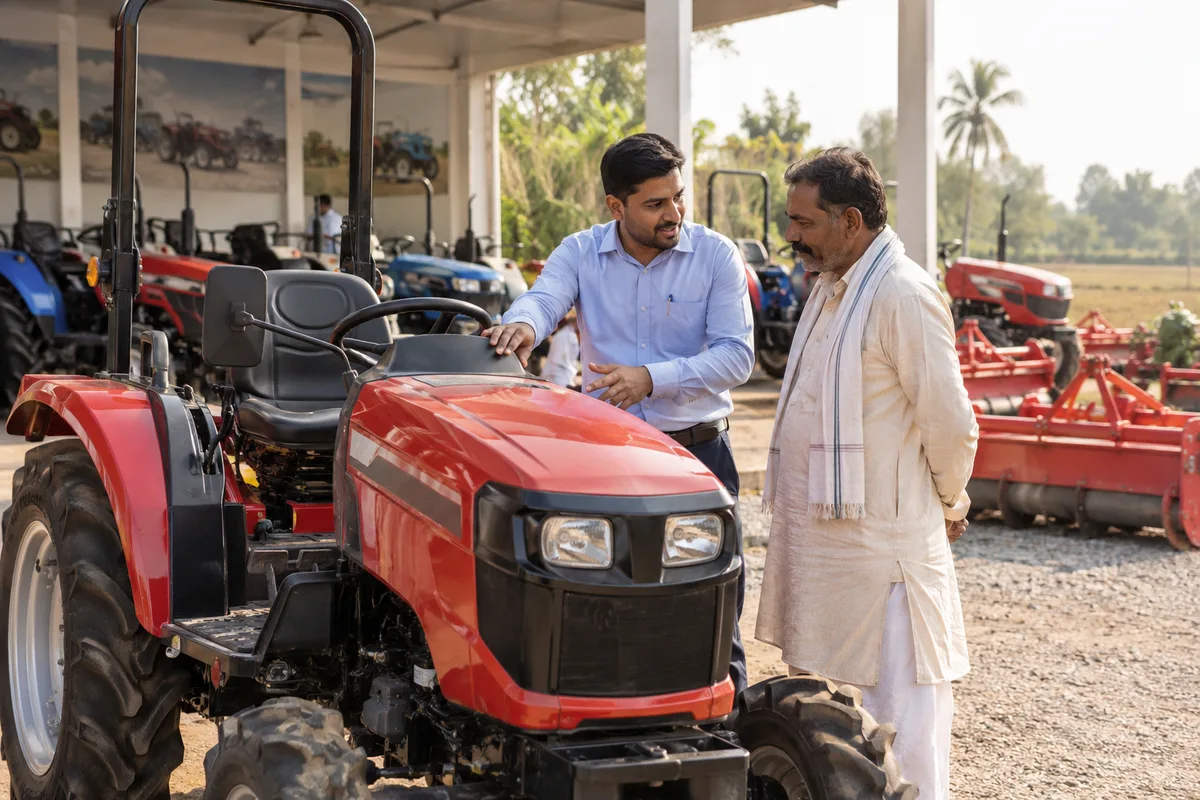
- Show the model in your own yard with a person beside it for scale, not a studio render. Give the horsepower, the hitch type and the work it does best in two plain lines.
- Whether it is in stock and when it can be delivered
- State that it is in the yard, booked or arriving, and update it when it changes. A farmer planning for the sowing window wants a delivery date more than a discount.
- How the loan works and what to bring
- List the documents the lenders you work with ask for and the name of the person who handles the file. The farmer who knows the steps rings with fewer fears.
- Where the workshop is and who answers
- Give the workshop address, hours, the models it services and a phone that is picked up. Mark the days it is closed. Owners search this page at the worst moment, so keep it correct.
- A call button and WhatsApp on every page
- Put both at the top and bottom of every page so a farmer on a phone can act at once. Set the WhatsApp link to open a chat with the model name already typed in.
- Photographs of delivered tractors with consent
- Show real deliveries, with the owner's written or spoken permission. A farmer trusts a tractor handed over in a village they know more than a showroom stock shot.
Who it is for
This is written for these farm equipment and tractor dealers.
- Authorised dealers of a tractor brand
- Implement and attachment dealers
- Combine harvester and paddy transplanter dealers
- Used and pre-owned tractor dealers
- Power tiller and mini tractor dealers
- Drip and sprinkler irrigation equipment sellers
- Spare parts and workshop-led dealers
- Custom hiring centre operators
Not for
It is not the right fit if.
- You have no photographs of the machines on your own yard, and a site of manufacturer pictures would look like every other dealer's.
- Nobody owns the domain and the login, and the first task is to get those into the dealership's hands.
- You cannot answer an enquiry sent from the site, so a new form would only collect farmers who then go to another dealer.
How it works
How the website work runs
The work itself, in order. How an engagement starts, from your brief to a written scope, is set out on our method page.
- 1
Confirm structure and content
We agree the page list, what each page must answer, and who supplies the text and photographs, before any design starts.
- 2
Design the templates
The home page, a service page, a location page and the enquiry page are designed first, on phone and desktop, and shown to you.
- 3
Build and test
The site is built and checked on real phones and the common browsers. Every form, call button and WhatsApp link is tested end to end.
- 4
Load real content
Actual copy, images and information replace placeholders. Pages are read through once by you, since you spot wrong details we cannot.
- 5
Check before launch
Tracking, page titles, the sitemap and the privacy page are checked on the staging site. If an old site exists, its addresses are mapped so old links still land somewhere.
- 6
Launch and hand over access
The site goes live and we record the domain, hosting, content login and analytics in your name. The first live enquiry is traced to confirm tracking works.
Where this fits
Three pieces of sales work, in this order.
This work sits inside sales process design, at stage 1, prospecting and lead generation. The audit comes before it, and sales management keeps it running.
Step 1
Sales audit
Find where deals are being lost and what to fix first.
Start here if you cannot say where orders are lost.
Step 2 · you are here
Sales process design
One written way to sell, from first enquiry to repeat order.
Start here if every salesperson sells differently.
Step 3
Sales management
A target, a review routine and someone who owns the number.
Start here if the team has targets and no routine.
FAQ
Questions owners ask before they call.
Not here? More answers, or ask on WhatsApp.
Is a marketplace listing enough instead of our own site?
Which languages should the site carry?
How fast does it need to be?
Who owns the domain and the site?
How much does it cost?
How long is the contract?
How soon will we see results?
Who will actually do the work?
What do you need from us?
What if we are not happy with the work?
From the blog
Further reading for farm equipment and tractor dealers.
 6 min read · 20 Jul 2026Seasonal and event-linked demand: planning for peaks and quiet monthsHow a specialist trade with busy and slow months can read its own year from past bookings, then time outreach and capacity ahead of each peak instead of after it.
 6 min read · 16 Jun 2026Annual maintenance contracts: how a specialist trade turns a job into recurring workAn annual maintenance contract works when it offers scheduled visits with a clear scope after the job and a recorded due date. This post covers what to offer, when to offer it and how to track renewals.
 6 min read · 17 Mar 2026Handling price haggling in a trade where every job differsWhen no two jobs are alike, a price cut without a scope change teaches buyers to haggle. How to anchor on scope, what to offer instead of a discount, and exact words for the call.
More for farm equipment and tractor dealers
Everything else we would do for you.
Closest to this: search and visibility
Also for farm equipment and tractor dealers
- Lead generation for farm equipment and tractor dealers
- WhatsApp marketing for farm equipment and tractor dealers
- CRM for farm equipment and tractor dealers
- Sales process for farm equipment and tractor dealers
- Referral marketing for farm equipment and tractor dealers
- Reputation management for farm equipment and tractor dealers
Or start from the overview: sales and marketing for farm equipment and tractor dealers.
Your next practical step
Tell us what you are trying to grow, and we will read it before we call.
Eight short steps, mostly taps. Skip anything you would rather answer on the call.