Fabric shops and retailers · Buyer journey
Two buyers walk in, and only one of them started with a search.
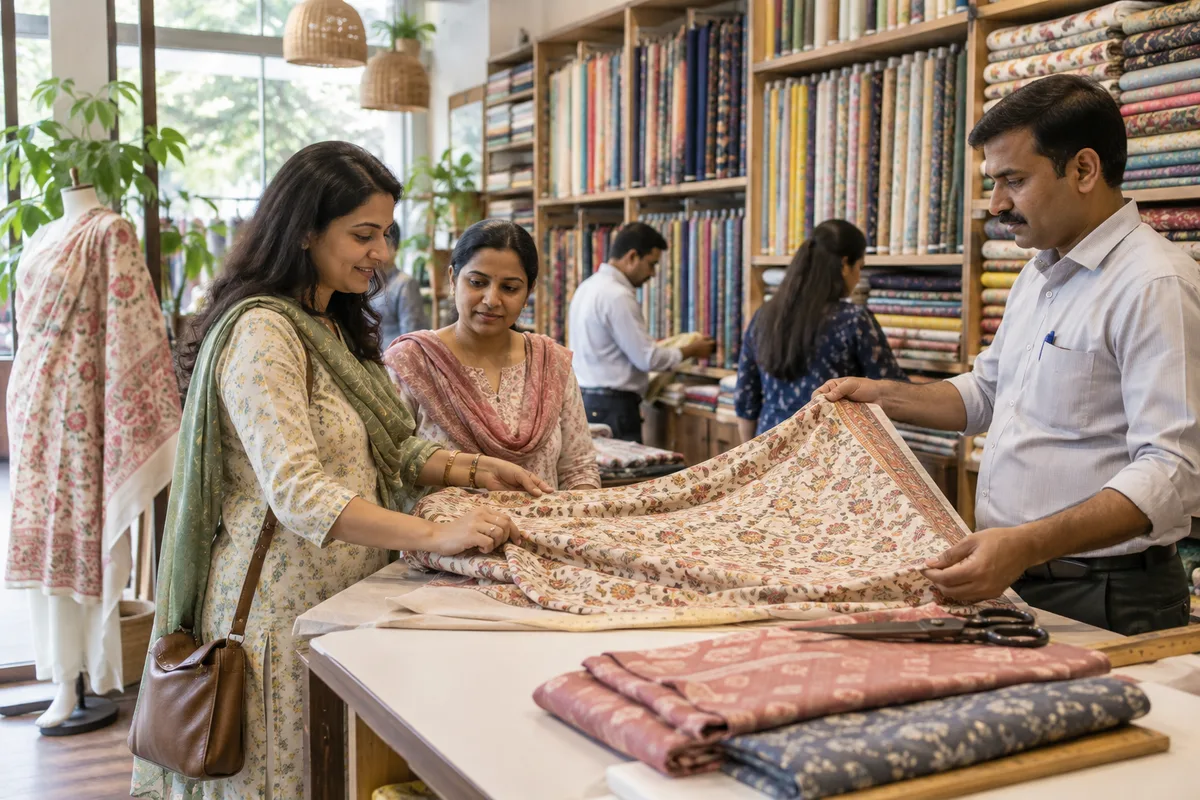
The buyer journey in a cloth shop runs two ways at once. A household buyer is sent by her tailor, checks Maps, forwards a photograph to her sister, then comes to feel the cloth. A tailor or boutique tries one thaan and returns only if the shade is still there. GullySales writes both journeys down and finds where each one breaks.
Scope, fee, reporting and term are agreed in writing after we have read your brief and spoken to you.
What buyer journey means
The buyer journey is the sequence of steps a customer actually takes, from first hearing about you to deciding to buy, which is rarely a single visit or call. GullySales maps this sequence for your business and checks that something useful happens at each step instead of only at the final call.
Also for fabric shops and retailers
- Digital marketing for fabric shops and retailers
- Marketing strategy for fabric shops and retailers
- SEO for fabric shops and retailers
- PPC ads for fabric shops and retailers
- Lead generation for fabric shops and retailers
- Reputation management for fabric shops and retailers
- Local SEO for fabric shops and retailers
- Branding and identity for fabric shops and retailers
Sales and marketing for fabric shops and retailers, the overview.
Last updated 5 Oct 2026.
For fabric shops and retailers
Where it usually goes wrong, and what we would do.
“The journey starts at the stitching table, not at your shutter”
The tailor says lining, fall and a matching blouse piece, and names a shop. Every rupee you put on a hoarding is competing with that one sentence, and walking across to meet her costs an afternoon.
“Shade is the step that cannot happen on a phone”
She will scroll forty photographs, but she will not buy the green until she has held it to the window. Everything you do online exists to bring her to the counter with the design already chosen.
“A trade buyer's journey is a test order”
A boutique takes one thaan to see whether you hold the lot. The second order is the real decision, and it turns entirely on whether that shade was still on your shelf three weeks later.
What we do
What we deliver for fabric shops and retailers.
Every deliverable, what it covers for you, and the result it is there to produce. Nothing here is an extra.
Both journeys written out separately
The household buyer from her tailor's recommendation to the cut bill, and the trade buyer from first sample to repeat lot, each with the steps as they happen in your shop.
Result: Staff stop treating a thaan enquiry like a two-metre enquiry.
The drop points found in one week of enquiries
A week of calls, WhatsApp messages and walk-ins traced through: who was answered, who came, and who stopped after the photograph.
Result: You see exactly where buyers fall off.
What a shopper needs before she travels
Rate band, width, weave and how the shade reads in daylight, fixed as the standard set of facts that goes with every picture.
Result: She arrives ready to buy rather than ready to look.
A first-order routine for a trade buyer
What a tailor or boutique is shown on a first visit, what sample goes back with them, and what is promised about holding the lot.
Result: The test order is set up to become a second one.
Occasion timing set against the journey
When each buyer starts looking, from the muhurat dates to school reopening to a block of flats being handed over.
Result: You reach her while she is still deciding.
A baseline for both journeys
Enquiries by source, walk-ins who came asking for something they saw, and trade accounts that ordered, recorded before any work starts.
Result: You know which of the two buyers is growing.
How the result is measured
- Drop-off rate by step
- Time from first contact to sale
- Steps with no content
Recorded as a baseline before work starts, so every later report has an honest comparison.
Stages of the cloth buyer's journey
A cloth buyer is sent by a tailor, checks the shop on a phone and finishes by feeling the cloth, and each step can be helped.
- The tailor names the cloth
- At the stitching table she is told what to buy for a blouse or a suit. Make sure the tailors near you know what you stock and the metre rate for each fabric.
- Checks Maps and shop photographs
- She looks at the shop front and the shelves. Post photographs of each fabric with its name, width and rate per metre.
- Forwards a photo to family
- Her sister or mother gives an opinion. Take photographs in daylight, since a shade under a shop tube light reads differently on another phone.
- Visits to feel the cloth
- Shade and drape are decided by touch. Keep a swatch card for every shade and let her take a cut piece home to match.
- Buys and measures
- The metre count follows the tailor's advice. Write the metres on the bill and note shrinkage advice for cotton or linen so the tailor is not short.
- Comes back to match
- A later order must match the first. Write the thaan or batch number on the bill so a repeat order can be matched.
Who it is for
This is written for these fabric shops and retailers.
- Retail cloth shops selling suiting and shirting
- Saree and blouse-piece shops
- Dress material and unstitched wear shops
- Curtain, sofa and upholstery fabric houses
- Wholesale cloth merchants supplying tailors and boutiques
- Uniform cloth suppliers for schools, hotels and factories
- Handloom, khadi and silk outlets
- Online fabric sellers cutting to the metre and couriering
- Brand franchise counters for suiting and shirting
How it works
From your first message to the first report.
No open-ended retainer. Every step gives you something in writing.
First
Your brief
You tell us what you need in a few short steps: your business, what you want, where enquiries come from and how they are handled.
After the brief
A conversation and a written scope
We read it, then talk with whoever handles your enquiries. If you want our help, the scope, the fee and the reporting come in writing, and nothing starts before you have read them.
Before work starts
Baseline recorded
The numbers this work is meant to move, such as enquiries, quotations, orders, visits or renewals, written down so every later report has an honest comparison.
After the baseline
The first fix goes live
The fix we agreed to start with is put in place and measured against the baseline, whether that is a reply, a follow-up, a page, a listing or the handover between marketing and sales.
As agreed
Report against the baseline
What moved, what did not, and what changes next, in plain words. How often you get it is set in writing before work starts.
At renewal
Renew on the numbers
The term ends and you decide whether to continue from the results. The length is agreed in writing before anything starts.
How the buyer journey work runs
- 1
Understand the sales process
We walk through how a sale actually happens today, from the person who first answers an enquiry to the one who closes it.
- 2
Audit the data
Website analytics, call logs and CRM records are pulled together to see where people actually drop out, not where they are assumed to.
- 3
Interview buyers and staff
A handful of recent customers and the team who speak to them fill in the reasons behind the numbers.
- 4
Build the map
Stages, touchpoints and drop-off points are set out in one document everyone can read the same way.
- 5
Fix and measure
Each fix is implemented against the stage it addresses, and the drop-off rate at that stage is checked afterwards.
Why us
Why owners pick GullySales over an agency.
Marketing and sales, as one job
Most agencies stop at the enquiry. We also fix what happens after it: the reply, the follow-up, the quote and the CRM.
The person on the first call does the work
No account managers in between. You are never handed to someone you have not met.
A baseline before anything starts
Your numbers are written down on day one, so every later report compares against something honest.
The fee in writing, split three ways
Our time, your media spend and production on separate lines. You always see what goes to us.
No guarantees we cannot keep
The term is agreed in writing and never a default twelve months. We never promise a ranking or a lead count, because nobody controls those.
One office, and we say so
Nagarbhavi, Bengaluru. We work across India by call and WhatsApp and travel when a session needs to be in person.
#257, 3rd floor, Sri Nanjundeshwara Complex, Nagarbhavi 8th Block, Outer Ring Road. How we work.
Your brief
Tell us what you need, and we will read it before we call.
Eight short steps about your business, what you want and who decides. Most questions are a tap, and you can skip any you would rather answer on the call.
FAQ
Questions owners ask before they call.
Not here? More answers, or ask on WhatsApp.
Which buyer should we chase first, retail or trade?
She saw the design online and still walked to three other shops. Why?
A customer asked for the rate on WhatsApp and nothing followed. Should we chase?
Should we keep track of which tailors send customers?
How much does it cost?
How long is the contract?
How soon will we see results?
Who will actually do the work?
What do you need from us?
What if we are not happy with the work?
More for fabric shops and retailers
Everything else we would do for you.
Closest to this: strategy and research
Also for fabric shops and retailers
Or start from the overview: sales and marketing for fabric shops and retailers.
Your next practical step
Tell us what you are trying to grow, and we will read it before we call.
Eight short steps, mostly taps. Skip anything you would rather answer on the call.