Jewellery retailers · Loyalty programmes
Reward the family that returns for every occasion, not only the first bridal set.
For a jewellery retailer, a loyalty programme is a written reward arrangement that recognises a family's repeat purchases across weddings, festivals, anniversaries and gifts. GullySales designs the reward around your margin on gold, diamonds and silver, writes the earning and redemption rules, and sets up the records your staff use to honour it.
Scope, fee, reporting and term are agreed in writing after we have read your brief and spoken to you.
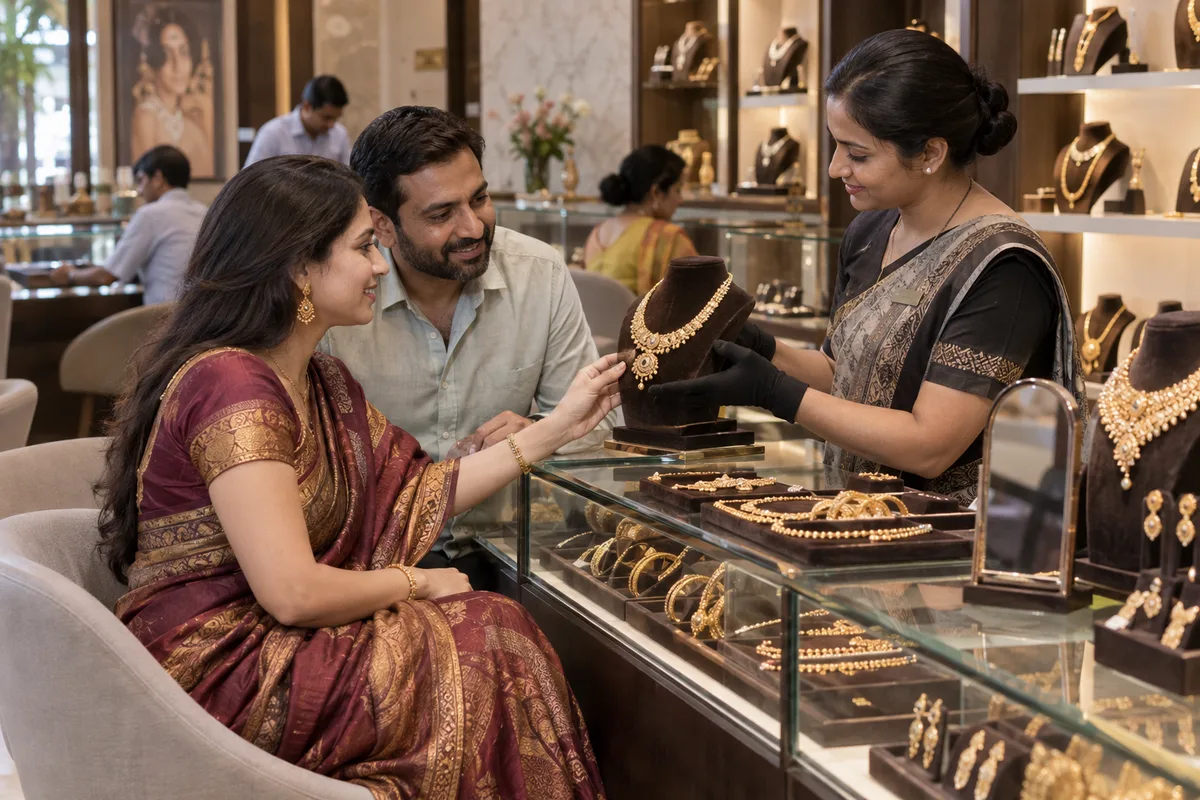
What loyalty programmes means
A loyalty programme is a structured reward, such as points or a discount tier, given to a customer for buying repeatedly. It differs from general retention because it is a specific scheme rather than an ad hoc check-in. GullySales designs the reward structure and the message that reminds customers it exists.
Also for jewellery retailers
- Customer retention for jewellery retailers
- Referral marketing for jewellery retailers
- Customer engagement campaigns for jewellery stores
- Customer lifecycle marketing for jewellery stores
- Referral and loyalty campaign creative design for jewellery retailers
- Cinema advertising for jewellery retailers
- Google Ads for jewellery retailers
- Newspaper advertising for jewellery retailers
Sales and marketing for jewellery retailers, the overview.
Last updated 14 Nov 2026.
For jewellery retailers
Where it usually goes wrong, and what we would do.
“Margins differ across what you sell”
Margin on a gold chain is not margin on a diamond set or a silver gift, and a flat reward on every bill spends money where there is little to spare. The reward must be costed per type of purchase, with a clear line on discounted stock and festival offers. A showroom that copies another's rate without checking its own margin finds the cost only after the season ends.
“Purchases come in bursts around occasions”
A family buys at a wedding, then at festivals, then for a christening or an anniversary, with long quiet gaps between. A scheme built on steady spending does not suit this pattern. The programme should recognise the occasion and the relationship, for example a returning family, a recorded exchange or a purchase made for the next generation, and make the benefit clear before the next purchase decision.
“Gold exchange and returns complicate balances”
Customers bring old gold to exchange, return pieces or ask for alterations, and each affects what has been earned. Rules that do not say what happens to a reward when an invoice is cancelled or an exchange is made lead to arguments at the counter. Staff need worked examples, and the owner needs one approved treatment that every counter follows.
“Trust matters more than points”
A jewellery customer is trusting the showroom with a large and emotional purchase. A scheme that feels like a gimmick, or with terms that change quietly, damages that trust. The programme must be written plainly, kept consistent and explained honestly, including what is not rewarded. Overpromising a reward the showroom cannot afford is worse than offering a smaller one it can always honour.
What we do
What we deliver for jewellery retailers.
The work available for this need. We agree the deliverables and responsibilities for your engagement in writing.
Reward economics sheet
A costing of the reward against your actual margin on gold, diamond, silver and artificial pieces, using sample bills including discounted ones and festival offers. It shows what the programme costs at different redemption levels, so the owner decides what the showroom can afford.
Result: Each reward rule shows its cost against a real sample bill.
Programme rulebook
Written rules for who qualifies, what earns a reward, what is excluded, when balances expire and how returns, cancellations and gold exchange are treated. Worked examples sit beside each rule, so counter staff can answer a customer without calling the owner.
Result: A salesperson can resolve a refund case from the rulebook alone.
Enrolment and record design
How a customer joins at the billing counter, which details are recorded, how consent is asked and where the record is kept. The design avoids slowing the bill during a festival rush, and keeps one record per family so a balance is not split between relatives.
Result: Enrolment fits into the billing step without a second form.
Family and occasion recognition
A rule for linking family members and recording occasions, such as a wedding set, an anniversary or a first-gold gift, with the customer's agreement. It lets staff greet a returning family knowing their history, and helps you decide who deserves a note before a festival.
Result: A returning family's earlier purchases are visible at the counter.
Counter script and staff briefing
Short wording for staff to explain the programme, answer common questions and avoid promises beyond the rulebook. It includes what to say when a customer asks for an exception and who may approve one.
Result: Two salespeople give the same answer to the same question.
Cost and repeat-purchase review
A reading of the redemption cost against repeat purchases recorded after launch, compared with the records taken before it. It shows who joined, who returned and what the rewards cost, and states where the records are too thin to conclude anything.
Result: The review names the records it used and the gaps in them.
How the result is measured
- Members enrolled
- Redemption rate
- Repeat spend by members versus non-members
Recorded as a baseline before work starts, so every later report has an honest comparison.
Who it is for
This is written for these jewellery retailers.
- Bridal and wedding jewellery showrooms
- Gold and diamond jewellery retail chains
- Silver and artificial jewellery stores
- Certified diamond and solitaire retailers
- Traditional and antique jewellery stores
- Single-showroom family jewellers
Before you decide
Agree the work. Know how to judge it.
Customer loyalty programmes for jewellery retailers: use these checks to prepare, choose the scope, and review what changes.
Bring the right evidence
Review repeat orders, inactive customers, and reasons for leaving. Separate a normal buying interval from a customer who stopped because of an unresolved problem.
Make the scope clear
Choose the customer group and the reason to contact them. Agree how complaints, renewal decisions, and additional offers are handled, including when a sales message is inappropriate.
Check the work in use
Track the response through to a retained or repeat order, with discounts and service costs visible. Record why the customer returned rather than crediting every repeat purchase to the campaign.
Know when to change course
If customers leave because delivery is unreliable, fix that before offering a loyalty reward. Repeated promotions can hide the cause without improving the experience.
These are discussion points, not a fixed package. GullySales confirms the deliverables, responsibilities, fee, and term in writing after reading your brief and speaking with you.
Before we start
What to have ready before the work starts.
The records, access and decisions this work needs from jewellery retailers. Anything missing is noted in the written scope, with who will supply it.
- Margin by type of purchase
- Your margin on gold, diamond, silver and artificial pieces, as the owner or accountant understands it. The reward is paid from this margin. Without it, the programme is costed on guesses and the cost appears only when customers redeem.
- A sample of past invoices
- A selection of invoices from different seasons, including discounted bills, exchanges and returns, with customer names removed. They let us test each rule against real cases. When missing, the rules are written for tidy bills that rarely occur in a showroom.
- Your exchange and return policy
- The written policy staff follow when a customer exchanges old gold or returns a piece. The reward rules must sit consistently beside it. If staff apply the policy differently, we need to settle one version first, or the rulebook will contradict the counter.
- A decision on consent and data
- Who will hold customer records, how consent to contact is asked and where it is stored. Check with your own adviser what the rules on personal data require where you trade. When this decision is missing, enrolment either collects too little to be useful or too much to defend.
- One owner for the programme
- A named person who approves exceptions, watches the cost and answers customer complaints. A scheme without an owner drifts, and each salesperson makes their own promises. The owner also decides when the rules change and how customers are told.
How it works
How the loyalty programmes work runs
The work itself, in order. How an engagement starts, from your brief to a written scope, is set out on our method page.
- 1
Read the billing and exchange records
We begin with your invoices, gold exchange entries and repeat customers, looking at whether families return and how they buy. This shows whether your showroom has enough repeat purchases to support a reward. If nearly every customer buys once, we say so and suggest a referral approach instead.
- 2
Cost the reward against margin
With your accountant or owner we test reward ideas against sample bills across gold, diamond and silver. We include discounted stock and festival schemes. The owner chooses the ceiling the showroom can honour, and any option above that ceiling is dropped, not softened.
- 3
Write the rules with worked examples
We draft who qualifies, what earns, what is excluded, how balances expire and how cancellations and gold exchange are treated, with an example for each. You read the examples as though you were the customer and tell us where the wording confuses. Unclear rules are rewritten before launch.
- 4
Design enrolment at the counter
We look at your billing process and decide the moment and the minimum details for joining, including consent to contact. We test it on a few sample bills with your counter staff. If enrolment slows the line during a busy afternoon, we simplify it until it does not.
- 5
Brief staff and set the record
Counter staff are walked through the rulebook and the script, and we set up the record so a balance can be seen at billing. We agree who can approve an exception and where it is noted. The owner signs the final rules, and nothing is announced to customers before that.
- 6
Read the first results against the baseline
Before launch we record repeat-customer counts and the share of bills linked to a known family. Afterwards we read the same figures, with the cost of rewards redeemed. Where the records are too thin to show a change, the review says so and does not claim a result.
Where this fits
Three pieces of sales work, in this order.
This work sits inside sales process design, at stage 7, after the sale. The audit comes before it, and sales management keeps it running.
Step 1
Sales audit
Find where deals are being lost and what to fix first.
Start here if you cannot say where orders are lost.
Step 2 · you are here
Sales process design
One written way to sell, from first enquiry to repeat order.
Start here if every salesperson sells differently.
Step 3
Sales management
A target, a review routine and someone who owns the number.
Start here if the team has targets and no routine.
FAQ
Questions owners ask before they call.
Not here? More answers, or ask on WhatsApp.
Is a loyalty programme worth it for a single-showroom jeweller?
Should the reward be points, cashback or a discount on making charges?
What happens to the reward if a customer returns a piece?
Do we need an app or a card?
Can we announce the programme in an advertisement?
Will this bring in new customers?
How long is the contract?
How soon will we see results?
Who will actually do the work?
What do you need from us?
From the blog
Further reading for jewellery retailers.
 8 min read · 21 Sept 2026Tamil advertising creative: what actually changesTamil is written one way and spoken another, and its script cannot tell b from p. What that means for your line, voice artist and brand spelling.
 8 min read · 21 Sept 2026Radio advertising in BengaluruWho listens to radio in Bangalore, and where: the evening traffic crawl, the auto driver's station, shop counters with FM on, and reach past the city.
 8 min read · 21 Sept 2026Premium audience advertising strategyNo platform in India sells verified income. Affluence targeting is inference, and the cheapest filter you own is putting the price in the first frame.
More for jewellery retailers
Related work to consider.
Closest to this: customers after the sale
Also for jewellery retailers
Or start from the overview: sales and marketing for jewellery retailers.
Your next practical step
Tell us what you are trying to grow, and we will read it before we call.
Eight short steps, mostly taps. Skip anything you would rather answer on the call.