Jewellery retailers · Customer retention
The family that bought the bridal set should buy the baby's bangles from you too.
Retention for a jewellery retailer is measured in years and occasions, not in repeat visits this quarter. A family returns for a wedding, a naming ceremony, a festival purchase and an exchange. GullySales keeps the occasion calendar, the exchange relationship and the savings scheme working so the store is the one they return to.
Scope, fee, reporting and term are agreed in writing after we have read your brief and spoken to you.
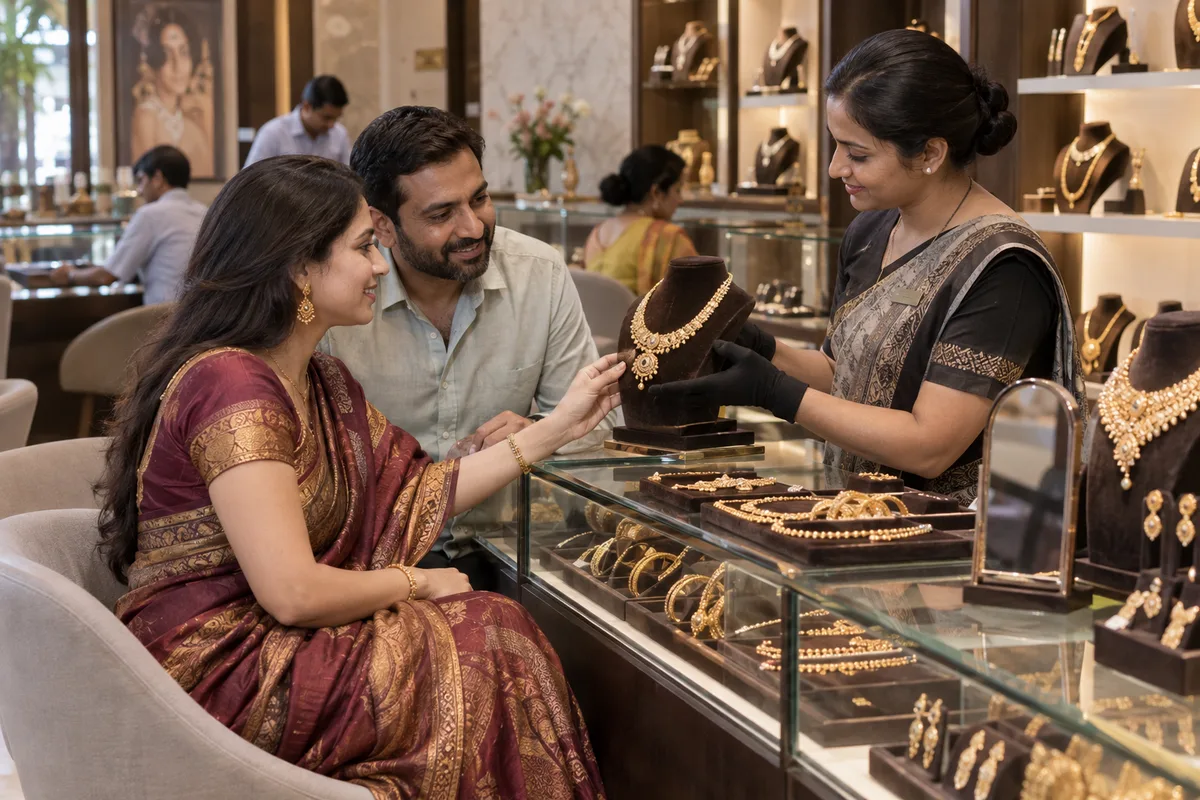
What customer retention means
Customer retention is keeping an existing customer buying again rather than losing them to a competitor after the first purchase, usually cheaper than winning a new customer. GullySales sets a routine of check-ins and renewal reminders aimed at customers before they show signs of leaving.
Also for jewellery retailers
- Referral marketing for jewellery retailers
- Cinema advertising for jewellery retailers
- Google Ads for jewellery retailers
- Newspaper advertising for jewellery retailers
- Outdoor advertising for jewellery retailers
- Radio advertising for jewellery retailers
- Sales and marketing strategy for jewellery retailers
- SEO for jewellery retailers
Sales and marketing for jewellery retailers, the overview.
Last updated 5 Oct 2026.
For jewellery retailers
Where it usually goes wrong, and what we would do.
“Your exchange policy is the real loyalty scheme”
A customer who knows they will get a fair value for old gold at your counter has a reason to buy here rather than anywhere else. Publish the working and hold to it, and the policy does more than any points card.
“A points card fails where the visit is once in two years”
Loyalty schemes work on frequency, and jewellery has almost none. The savings scheme, where the customer pays in instalments towards a purchase, is the one that fits this trade because it commits them to coming back.
“They return to a person, not to a showroom”
The salesperson who remembers the daughter's wedding is the reason the family walks past two newer stores. Record who served whom, and route the returning customer to the same person.
What we do
What we deliver for jewellery retailers.
Every deliverable, what it covers for you, and the result it is there to produce. Nothing here is an extra.
An occasion calendar built from past purchases
Anniversaries, birthdays and the occasions behind earlier orders held as dates, with a contact planned ahead of each.
Result: The store calls with a reason rather than with an offer.
Old gold exchange reminders to past customers
A list of customers who have exchanged before, contacted ahead of the festival calendar when exchange interest rises.
Result: A likely buyer hears from you before they hear from a competitor.
Savings scheme enrolment and follow-through
A routine for inviting customers into the instalment scheme, and for contacting a member who has missed a payment before they drop out.
Result: Members complete the scheme and buy at the end of it.
Returning customers routed to the same salesperson
The record showing who served the family last time, so the same person greets them when they come back.
Result: The relationship survives even as staff change shifts.
Repeat and referral visits reported against the baseline
Visits and orders from existing customers reported separately from new enquiries, against the baseline recorded before work started.
Result: You can see whether the customer base is being kept or spent.
How the result is measured
- Retention rate
- Repeat purchase rate
- Customers won back
Recorded as a baseline before work starts, so every later report has an honest comparison.
Work it out from your records
Your sales and scheme registers show which families have not been back since the last occasion.
- Occasions in the invoice history
- Mark each invoice with its occasion: bridal set, naming ceremony, Akshaya Tritiya, Dhanteras, anniversary. The next likely occasion for the family follows from that, and so does the date for a call.
- Old gold exchange entries
- List customers who exchanged old gold, with the date and what they bought in return. Many exchange again, so the entry tells you when to invite them back.
- Savings scheme members and what happened
- For each savings scheme list members, instalments paid and whether each completed, redeemed or dropped. Members who completed and bought nothing are the group to ask about.
- Customer and salesperson
- Note which salesperson served each customer. A family often returns to a person, so a customer whose salesperson left needs an introduction to the new one.
- Last purchase by category
- Group customers by what they last bought: gold coin, bridal, silver gift, diamond. A customer who buys only coins at festivals is a different call from one who bought a bridal set.
- Repair and cleaning visits that ended without a sale
- Count counter visits for repair, polish or resizing. Those customers are in the shop already, so a staff member can mention a new piece or the scheme without pressure.
Who it is for
This is written for these jewellery retailers.
- Bridal and wedding jewellery showrooms
- Gold and diamond jewellery retail chains
- Silver and artificial jewellery stores
- Certified diamond and solitaire retailers
- Traditional and antique jewellery stores
- Single-showroom family jewellers
Not for
It is not the right fit if.
- You do not record when a customer last bought, so there is no way to tell who has not returned.
- The showroom is new and has too few buyers on record to build a repeat programme around.
How it works
How the customer retention work runs
The work itself, in order. How an engagement starts, from your brief to a written scope, is set out on our method page.
- 1
Read the records
Your sales and billing records are read for repeat purchase, the normal gap between orders and the customers who have gone quiet. The record-keeping gaps found here are listed.
- 2
Ask why they stopped
A small set of lapsed and current customers is called with your team's consent, and asked plainly what changed. The reasons are sorted into price, service, competitor and circumstance.
- 3
Build the strategy
The written plan sets priority groups, touchpoints, offers, owners, consent rules and a target.
- 4
Align existing tactics
Each retention activity you already run is mapped against the plan, then kept, changed or dropped.
- 5
Start with one group
The plan goes live for the most valuable at-risk group first, with a held-back comparison group, before it widens.
- 6
Review against the baseline
Retention is compared with the baseline recorded before work began. How often you are reported to is agreed in writing.
Where this fits
Three pieces of sales work, in this order.
This work sits inside sales process design, at stage 7, after the sale. The audit comes before it, and sales management keeps it running.
Step 1
Sales audit
Find where deals are being lost and what to fix first.
Start here if you cannot say where orders are lost.
Step 2 · you are here
Sales process design
One written way to sell, from first enquiry to repeat order.
Start here if every salesperson sells differently.
Step 3
Sales management
A target, a review routine and someone who owns the number.
Start here if the team has targets and no routine.
FAQ
Questions owners ask before they call.
Not here? More answers, or ask on WhatsApp.
Is a loyalty points card worth running for a jewellery store?
How do we keep in touch without becoming a nuisance?
A customer bought from us before but bought their next piece from another jeweller. Should we ask why?
A salesman who handles our bridal customers is joining another jeweller. What can we do?
How much does it cost?
How long is the contract?
How soon will we see results?
Who will actually do the work?
What do you need from us?
What if we are not happy with the work?
From the blog
Further reading for jewellery retailers.
 8 min read · 21 Sept 2026Tamil advertising creative: what actually changesTamil is written one way and spoken another, and its script cannot tell b from p. What that means for your line, voice artist and brand spelling.
 8 min read · 21 Sept 2026Radio advertising in BengaluruWho is actually listening in this city, and where. The evening crawl, the auto driver's choice, the shop counter with FM on all day, and a signal that reaches past the city limits.
 8 min read · 21 Sept 2026Premium audience advertising strategyNo platform in India sells you verified income. Everything offered as affluence targeting is inference, and the cheapest filter you own is putting the price in the first frame.
More for jewellery retailers
Everything else we would do for you.
Closest to this: customers after the sale
Also for jewellery retailers
Or start from the overview: sales and marketing for jewellery retailers.
Your next practical step
Tell us what you are trying to grow, and we will read it before we call.
Eight short steps, mostly taps. Skip anything you would rather answer on the call.