Website design and development companies · Branding
Decide which sites you are best at before a price war decides it.
Branding for a web company is the decision about what you build best and who for, said the same way on your site, your proposal and your invoice. GullySales writes that position and the sentence a client repeats when a friend asks who built their site.
Scope, fee, reporting and term are agreed in writing after we have read your brief and spoken to you.
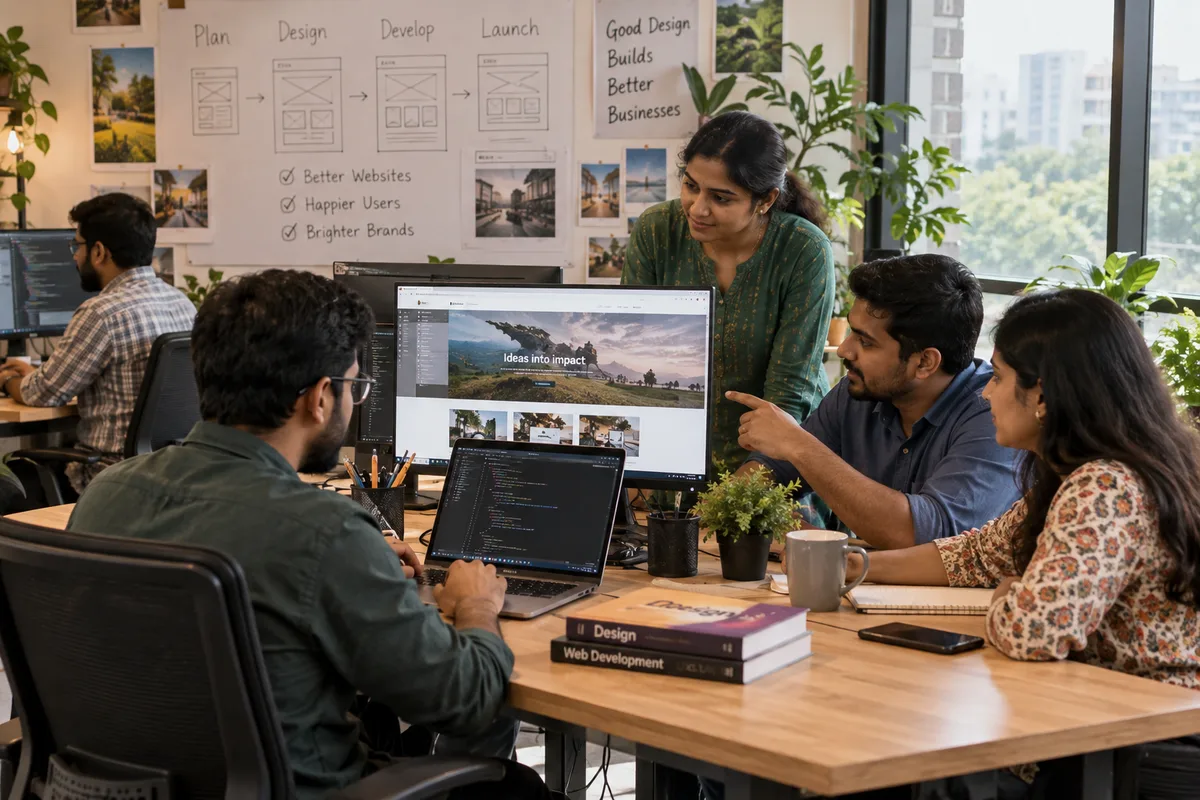
What branding means
Branding is what a customer remembers about your business beyond the product, including your name, colours, tone of voice and what you are known for locally. GullySales sets or corrects this once and applies it consistently across your website, signage and adverts so the business looks like one company everywhere.
Also for website design and development companies
- PPC ads for website design and development companies
- Lead generation for website design and development companies
- Digital marketing for website design and development companies
- Reputation management for website design and development companies
- Social media marketing for website design and development companies
- Content marketing for website design and development companies
- Email marketing for website design and development companies
- Buyer persona for web design companies
Sales and marketing for website design and development companies, the overview.
Last updated 5 Oct 2026.
For website design and development companies
Where it usually goes wrong, and what we would do.
“Full stack for any business is a price war”
When nothing on your site says who you are for, the only thing an owner can compare is the quote.
“A studio name nobody can spell on a call”
Three initials get spelled out on every phone call, and typed wrongly into every search that follows.
“Your own site is the identity, not the logo”
Owners judge a studio by the site it built for itself, and a template with your logo argues against you.
What we do
What we deliver for website design and development companies.
Every deliverable, what it covers for you, and the result it is there to produce. Nothing here is an extra.
A written choice of what you build and for whom
The platforms, the site types and the trades you want more of, and the work you will stop accepting, decided in one session and written down.
Result: Your studio stops competing on price with everybody.
The sentence a client uses to recommend you
One line in plain words that an owner can repeat to a friend who asks who built their site.
Result: Referrals arrive already pointed at the right work.
Site, profile and proposal saying one thing
The same position on your home page, your Google profile, your LinkedIn page and page one of every proposal that leaves the studio.
Result: A prospect hears one studio wherever they look.
The studio site treated as a paid project
A scope, a deadline and a named person for your own website, instead of a job that moves every month a client job lands.
Result: The sample of your work is finally finished.
A starting price you are willing to publish
The lowest figure you will take a project for and what it includes, written so it can sit on the site and be said on the first call.
Result: The ten thousand rupee enquiry ends before it costs you an hour.
One answer to what do you do
What everybody in the studio says when an owner asks, so the developer at a meetup and the founder in a meeting describe the same business.
Result: Nobody hears two versions of your studio.
How the result is measured
- Recognition in customer feedback
- Consistency across channels
- Repeat enquiries by name
Recorded as a baseline before work starts, so every later report has an honest comparison.
Positioning in one sentence
We build this kind of website for this kind of business, and here is the live site they can open.
- Who it is for: the business you build for
- Name the kind of owner, such as clinics, restaurants or manufacturers, and the size. A studio that builds for everyone competes on price with every freelancer. A studio known for clinic sites gets forwarded to the next clinic.
- What you do: build, maintain and what is on top
- Say whether you design, develop, host and maintain, and which platform you use, such as WordPress or Shopify. A client wants to know who answers when the site is down.
- What the client gets that a freelancer or a template does not
- Name the real difference: a named designer and developer, a written scope with what is included, content help, handover of every login to the client. Handing over the logins is a promise worth keeping.
- The proof you can show
- Live sites with the client's permission, plus a page describing the problem, what you built and what the owner now does with it. Show a site that has run for years, not only launches.
- Words every web studio uses
- 'Pixel-perfect', 'responsive' and 'creative solutions' are on every studio site. Replace them with the platform, the pages built, the integrations such as Razorpay or WhatsApp, and who the site is for.
Who it is for
This is written for these website design and development companies.
- Small web design studios for local businesses
- WordPress and WooCommerce developers
- Shopify and e-commerce website builders
- Custom web application developers
- UI and UX design firms
- Web companies focused on one industry, such as healthcare or real estate
- Hosting and website maintenance providers
- Freelance web developers building a team
Not for
It is not the right fit if.
- You take any build from any client and are not ready to say no to a kind of project, so a positioning statement would not match what you do.
- Your studio is two people and the name is not yet fixed, and brand work done before the name settles would be redone.
- You want a new logo to solve a lack of enquiries, but the weak point is that your own site shows no finished work.
How it works
How the branding work runs
The work itself, in order. How an engagement starts, from your brief to a written scope, is set out on our method page.
- 1
Interview customers and team
We talk to real buyers, won and lost, and to people inside the business who deal with customers daily.
- 2
Review the competitive field
We look at how the nearest competitors present themselves so the position is not accidentally identical.
- 3
Draft the position
A first version of the positioning statement and messaging pillars is written and checked against what customers actually said.
- 4
Test it against real conversations
The draft is tried out in a real sales call or two before it is finalised, since a position that does not survive a real conversation needs rework.
- 5
Hand over the rollout brief
The final position, pillars and not-for list are documented for your team and any agency to apply consistently.
Where this fits
Three pieces of sales work, in this order.
This work sits inside sales process design, at stage 1, prospecting and lead generation. The audit comes before it, and sales management keeps it running.
Step 1
Sales audit
Find where deals are being lost and what to fix first.
Start here if you cannot say where orders are lost.
Step 2 · you are here
Sales process design
One written way to sell, from first enquiry to repeat order.
Start here if every salesperson sells differently.
Step 3
Sales management
A target, a review routine and someone who owns the number.
Start here if the team has targets and no routine.
FAQ
Questions owners ask before they call.
Not here? More answers, or ask on WhatsApp.
Should a small studio specialise in one platform?
Do we need a new logo?
Should the studio brand be one word that is easy to spell?
Should we show prices on the website?
How long is the contract?
How soon will we see results?
Who will actually do the work?
What do you need from us?
What if we are not happy with the work?
More for website design and development companies
Everything else we would do for you.
- PPC ads for website design and development companies
- Lead generation for website design and development companies
- Digital marketing for website design and development companies
- Reputation management for website design and development companies
- Social media marketing for website design and development companies
- Content marketing for website design and development companies
Or start from the overview: sales and marketing for website design and development companies.
Your next practical step
Tell us what you are trying to grow, and we will read it before we call.
Eight short steps, mostly taps. Skip anything you would rather answer on the call.