Digital advertising · Marketing
Know which online medium you are buying before the first rupee goes into it.
There is no single thing called digital advertising. There is a search auction, a social feed auction, a video platform, a network of publisher sites bought through an exchange, and the ad breaks inside streaming apps. This is the page for choosing between them, before anybody argues about cost per click.
Scope, fee, reporting and term are agreed in writing after we have read your brief and spoken to you.
In one paragraph
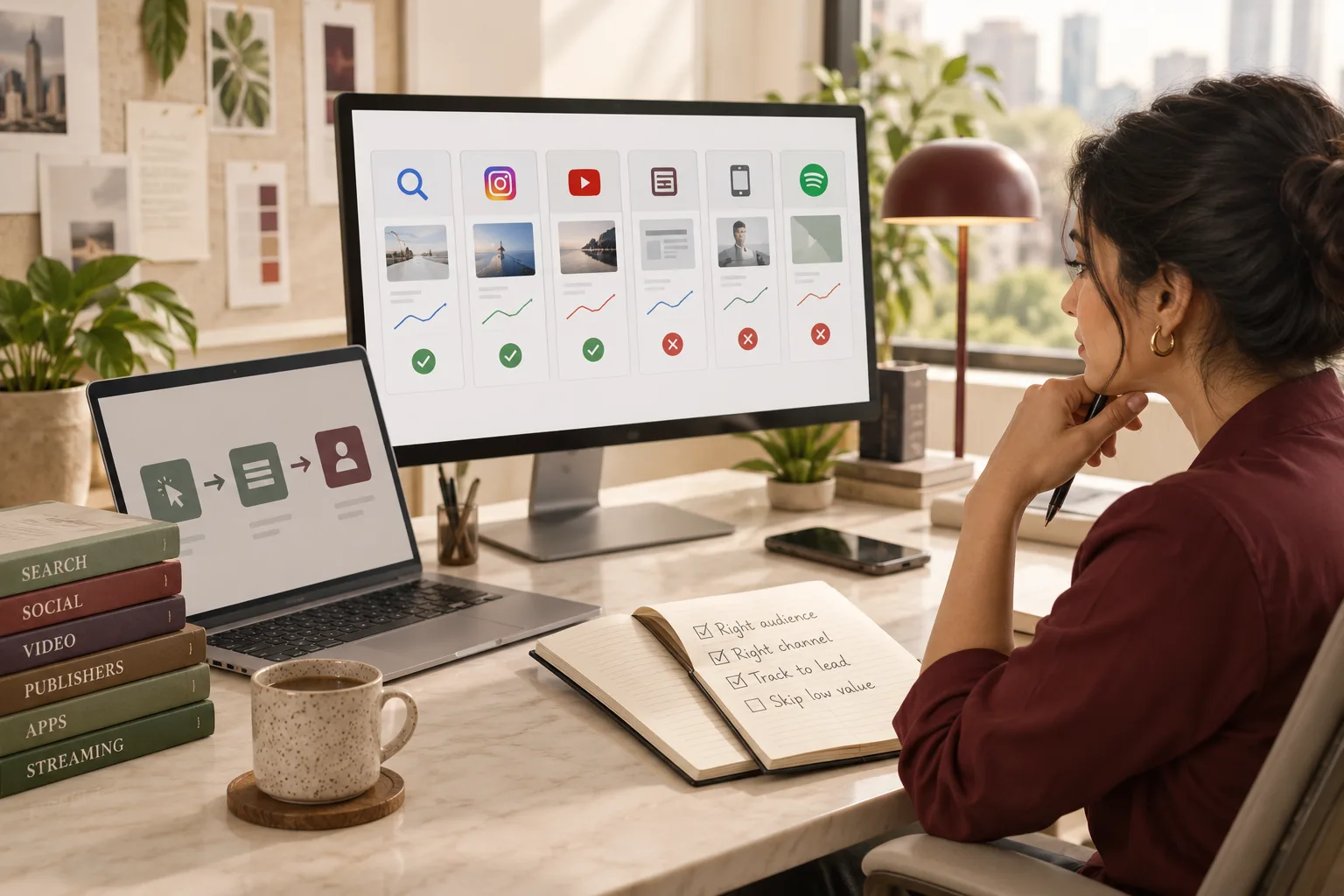
Digital advertising is the paid space available online: search results, social feeds, video, publisher sites, apps and streaming, each sold in a different auction on a different unit. GullySales works out which of them fits your goal and your buyer, sets up the route from the click to your lead record, and names the ones not worth opening.
Once two or three channels are live and reporting, the question changes. It becomes which of them earns the next rupee, and that work is performance marketing and PPC. Here the question is narrower: which medium is worth opening an account on at all.
We choose by what the buyer is doing at the moment the advertisement appears. Somebody typing "orthodontist near me" is halfway to booking. Somebody scrolling at eleven at night is not, and an advertisement that speaks to them as though they were gets skipped.
Who it is for
This is written for you if these sound familiar.
- Owners told to "do digital" who do not know whether that means search, social or video
- Businesses running one platform out of habit because somebody set it up years ago
- A new branch or a new product nobody is searching for by name yet
- Companies with a budget too small to run four platforms badly
- Firms whose agency reports clicks and impressions but cannot show a single enquiry record
Not for
It is not the right fit if.
- Businesses already running several channels well and needing budget moved between them, which is performance marketing and PPC
- Anyone who wants an account opened this week without deciding what the advertisement should get somebody to do
- A business with no landing page and no record of who called, where the spend disappears into an untracked inbox
- Election and political advertisers, a category we do not work in
The problem
Does this sound like your business?
What owners tell us on the first call, in their words.
“We are on every platform and I cannot tell you what any of them did”
Each platform claims the conversions it believes it influenced, so four dashboards add up to more enquiries than the business actually received.
“The advertisements were rejected and nobody explained why”
Clinics, lenders and property sellers run into policy rules on before-and-after images, claimed results and promised returns. The account keeps running. The advertisement simply stops serving.
“Most of the display budget went somewhere I would never advertise”
Open exchange inventory includes muted autoplay video below the fold and banners inside mobile games, bought per thousand impressions because it is cheap. It is cheap for a reason.
“The advertisement is good and the page behind it is not”
The click lands on a home page with a form nobody completes. No change of medium fixes that.
What we do
Everything that is included.
Each deliverable, and what it gets you. Nothing here is an extra.
Medium shortlist with reasons
Search, social, video, display, native and streaming judged against your goal and your buyer's moment, with the ones we would not buy named and why.
Pricing unit note
What each shortlisted medium charges for: a click, a thousand impressions, a completed view or a submitted lead form. A rupee buys a different thing in each.
Landing page and form check
Where the click lands, what it asks for, and whether the enquiry reaches a person the same day. Settled before any account is opened.
Tracking that ends in the CRM
Conversion tracking set so an enquiry is recorded once, in your lead record, with its source attached, instead of four times across four dashboards.
Creative brief per medium
A search advertisement, a vertical video and a display banner are three pieces of work. Each is briefed with the specification it gets rejected for missing.
Test budget and stop rules
A defined amount per medium, and the point at which it is scaled or switched off, agreed before it starts.
Report against enquiries
What each medium produced in enquiries and orders, read from the lead record rather than the platform's own claim.
How the result is measured
- Enquiries recorded in the CRM with a source attached
- Cost per enquiry by medium, counted once
- Advertisement and landing page rejections, and what caused them
- Share of spend on inventory we chose against inventory the network filled
- Test budgets closed with a decision
Recorded as a baseline before work starts, so every later report has an honest comparison.
How it works
How the digital advertising work runs
The work itself, in order. How an engagement starts, from your brief to a written scope, is set out on our method page.
- 1
Fix the goal
We agree whether this is an enquiry, a call, a booking or a walk-in, and what one of them is worth to you.
- 2
Match the medium to the moment
We choose by what your buyer is doing when the advertisement appears, not by which platform is being talked about this year.
- 3
Build the route after the click
Landing page, form, phone number and CRM entry are in place before the first campaign is switched on.
- 4
Launch small and read the lead record
Each medium starts on a test budget and is judged on the enquiries that reach your CRM.
- 5
Keep what works and stop the rest
Mediums producing enquiries take the budget. The others are switched off and the reason is written down.
Where this fits
Three pieces of sales work, in this order.
This work sits inside sales process design, at stage 1, prospecting and lead generation. The audit comes before it, and sales management keeps it running.
Step 1
Sales audit
Find where deals are being lost and what to fix first.
Start here if you cannot say where orders are lost.
Step 2 · you are here
Sales process design
One written way to sell, from first enquiry to repeat order.
Start here if every salesperson sells differently.
Step 3
Sales management
A target, a review routine and someone who owns the number.
Start here if the team has targets and no routine.
FAQ
Questions owners ask before they call.
Not here? More answers, or ask on WhatsApp.
How is this different from performance marketing and PPC?
Why do the platform reports show more leads than we actually received?
Can a clinic or a finance business advertise online?
How much do I need to spend to know whether it works?
Why did the same click cost more this month?
How is this priced?
How long is the contract?
How soon will we see results?
Who will actually do the work?
What do you need from us?
By industry
Digital advertising, written for your industry.
Related services
Often bought with this, or instead of it.
Read before you buy
- Outdoor advertising vs digital advertising: which should you buy?Outdoor buys a place for a month and cannot be switched off. Digital buys one person at a time and can be stopped by lunchtime. Different money, different job.
- Retargeting for a business with a long buying cycle: how long to follow peopleHow to choose a retargeting window of 7, 30 or 90 days from your own enquiry-to-order records, how to cap frequency and how to stop before the ads start to feel like stalking.
- A YouTube ad for a service business: a script that holds attention in five secondsA shot-by-shot script for a skippable YouTube ad from a local service business: what the first line must do, how to show proof quickly and where to send the viewer afterwards.
Your next practical step
Tell us what you are trying to grow, and we will read it before we call.
Eight short steps, mostly taps. Skip anything you would rather answer on the call.