Hyperlocal advertising · Marketing
How far a customer will travel to you decides this plan, not the channel.
Ask how far somebody will actually come. A salon in Nagarbhavi loses a customer to the one two streets away. A cardiac unit draws patients from three districts, and a school fills from whichever roads its bus covers.
Scope, fee, reporting and term are agreed in writing after we have read your brief and spoken to you.
In one paragraph
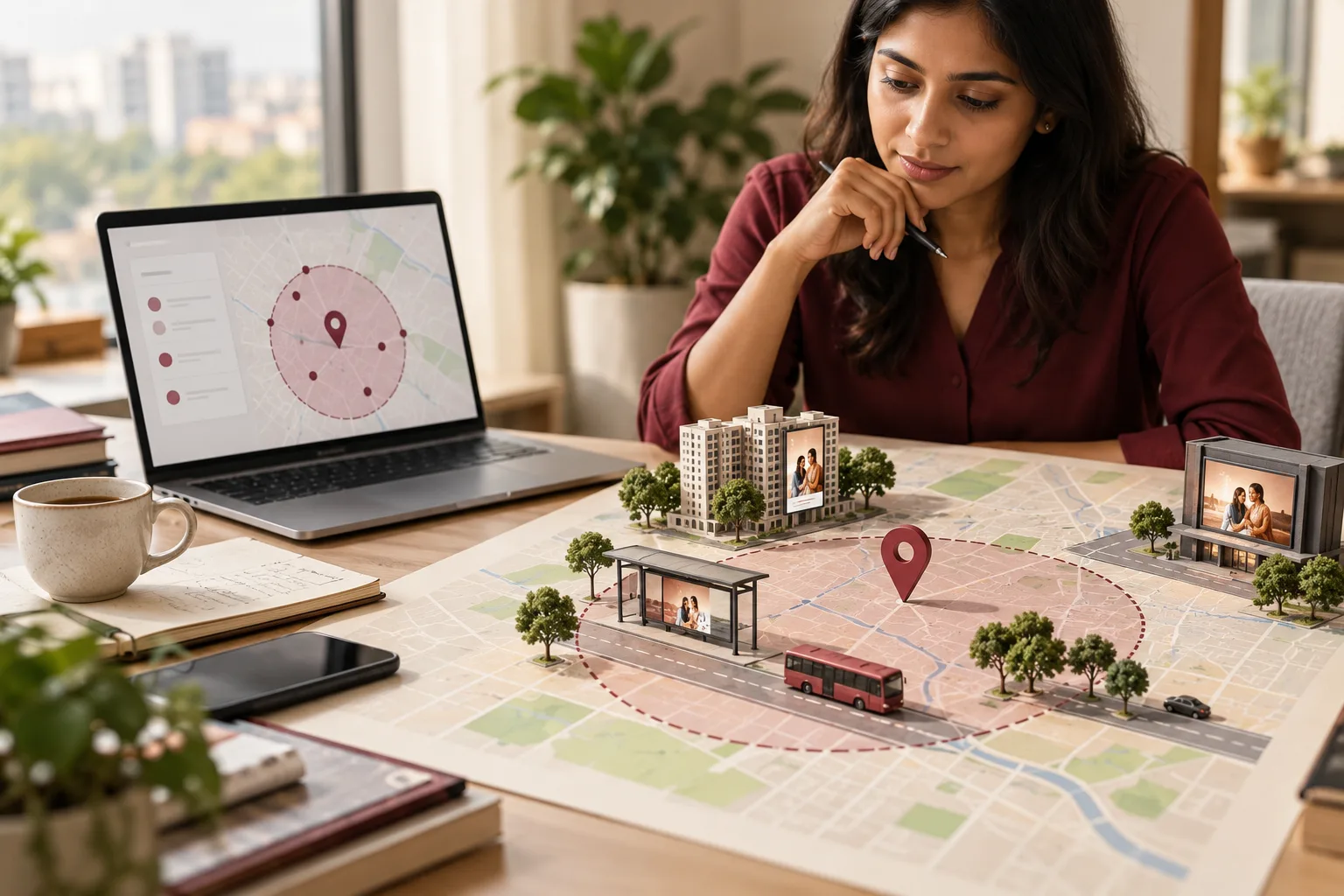
Hyperlocal advertising buys media for one catchment instead of a whole city: radius and pin-code targeting, apartment panels, the bus shelter on the approach road and the nearest cinema screen. GullySales draws the catchment first, then buys only the media sitting inside it.
That distance is the plan. Inside a three kilometre ring, a lift panel, a bus shelter and a radius-targeted search campaign reach the same household twice a week for very little. Outside it, the same money buys sightings from people who will never make the drive.
Most local campaigns are bought the other way round. A pamphlet printer calls, a hoarding agent offers a site, an apartment agency quotes a lift panel, and the money follows whoever sold hardest. We put the catchment on a map in pin codes and roads before anybody is paid.
Who it is for
This is written for you if these sound familiar.
- A clinic, salon or gym whose customers all live or work within a few kilometres
- Restaurants that fill from the offices and apartments within a fifteen-minute drive
- A property project selling mostly to buyers who already live in that part of the city
- New branches and stores in an area where nobody knows the name yet
- Chains that need one plan per branch catchment instead of a single city buy
Not for
It is not the right fit if.
- Businesses selling across India, where a buyer's pin code changes nothing
- B2B sellers chasing a few named accounts, since a list and a caller beat any radius
- Anyone who needs volume quickly from a wide area, where a city campaign is the honest answer
The problem
Does this sound like your business?
What owners tell us on the first call, in their words.
“We advertised across the city and our customers all live two kilometres away”
The hoardings, the radio spot and the city-wide campaign were paid for in full, while everybody who could realistically reach the shop lives inside a small ring around it.
“The apartment standee was taken down in two days”
Apartment media runs on the association's permission. The secretary decides what is allowed, whether that is the notice board, a lift panel or a stall on Sunday morning, and anything put up without written approval comes down.
“Twenty thousand pamphlets went out and the phone did not ring”
Nobody checked which streets the distributor covered, and the pamphlet carried no offer, no number of its own and no reason for a family to keep it.
“Every branch runs the same advertisement”
One branch sits beside an IT park and another beside a wholesale market, so the same creative and the same targeting cannot work for both.
What we do
Everything that is included.
Each deliverable, and what it gets you. Nothing here is an extra.
Catchment map
Pin codes, the roads people actually use, drive times at the hours your customers travel, and the flyover or railway line that stops them coming at all.
Radius and pin-code targeting
Search, social and Maps campaigns set to the catchment rather than the city, with the Google Business Profile corrected so the map result agrees with the advertisement.
Apartment and gated community media, with permission
The association is approached for written permission first, then the notice board, lift panels, a stall or sampling on the day it allows.
Physical media inside the ring
The bus shelter on the approach road, the nearest cinema screen and auto branding on routes into the area. The local edition covers the locality in the language spoken there.
Local voices
Creators who post about that part of the city, resident WhatsApp and Facebook groups, and the shops and clinics next door who already send people on.
One number per catchment
A dedicated phone number and QR code for each branch, so a call or a walk-in is traced to the campaign that produced it.
Reporting by area
Enquiries counted by pin code, so the spend moves towards the streets that answer.
How the result is measured
- Enquiries by pin code
- Walk-ins traced to the campaign's own number or QR code
- Cost per enquiry inside the catchment
- Apartment permissions secured against those approached
- Share of enquiries arriving from outside the catchment
Recorded as a baseline before work starts, so every later report has an honest comparison.
How it works
How the hyperlocal advertising work runs
The work itself, in order. How an engagement starts, from your brief to a written scope, is set out on our method page.
- 1
Plot where your customers came from
We take the last few hundred bills or CRM records and plot the pin codes, which settles the catchment argument faster than any survey.
- 2
Rank the media inside the ring
Every option that reaches those pin codes is compared on cost and on how many times the same household sees it.
- 3
Collect the permissions
Association approvals, site and artwork approvals, and the dates each one allows, in hand before anything is booked.
- 4
Launch with a number of its own
The phone number, QR code and landing page for this catchment go live before the first panel or pamphlet does.
- 5
Measure by area and move the money
Spend then shifts towards the pin codes that reply and away from the ones that stay silent.
Where this fits
Three pieces of sales work, in this order.
This work sits inside sales process design, at stage 1, prospecting and lead generation. The audit comes before it, and sales management keeps it running.
Step 1
Sales audit
Find where deals are being lost and what to fix first.
Start here if you cannot say where orders are lost.
Step 2 · you are here
Sales process design
One written way to sell, from first enquiry to repeat order.
Start here if every salesperson sells differently.
Step 3
Sales management
A target, a review routine and someone who owns the number.
Start here if the team has targets and no routine.
FAQ
Questions owners ask before they call.
Not here? More answers, or ask on WhatsApp.
How big should the catchment be?
Can we advertise inside an apartment complex?
What does this look like for a hospital?
And for a restaurant, a property project or a store?
Is buying one catchment cheaper than buying the city?
How is this priced?
How long is the contract?
How soon will we see results?
Who will actually do the work?
What do you need from us?
By industry
Hyperlocal advertising, written for your industry.
Related services
Often bought with this, or instead of it.
Read before you buy
- Outdoor advertising in Bengaluru: what is actually out thereRoadside hoardings are the smallest part of this city's outdoor now. Metro pillars, barricades, mall facades, IT park foyers and apartment gates are separate media with separate owners, and each reaches a different Bengaluru.
- Newspaper advertising in Bengaluru: which paper reaches which cityTwo cities read two sets of papers here. The English dailies reach the corridor that arrived in the last decade, the Kannada dailies reach the settled one, and the insert by pincode reaches your own street.
- How to track cinema advertisingA dark hall is the most attentive audience you can buy and the hardest to trace. Response arrives after the film, so read the catchment, not the screen.
Your next practical step
Tell us what you are trying to grow, and we will read it before we call.
Eight short steps, mostly taps. Skip anything you would rather answer on the call.