Regional TV advertising · Marketing
Kannada subtitles on a Hindi film are read as somebody else's advertisement.
Television advertising answers whether a broadcast buy is worth making at all. This page starts after that, at the moment you choose between a national Hindi feed and a Kannada, Tamil or Telugu channel. Each of those languages has a page of its own, and this is the decision that comes first.
Scope, fee, reporting and term are agreed in writing after we have read your brief and spoken to you.
In one paragraph
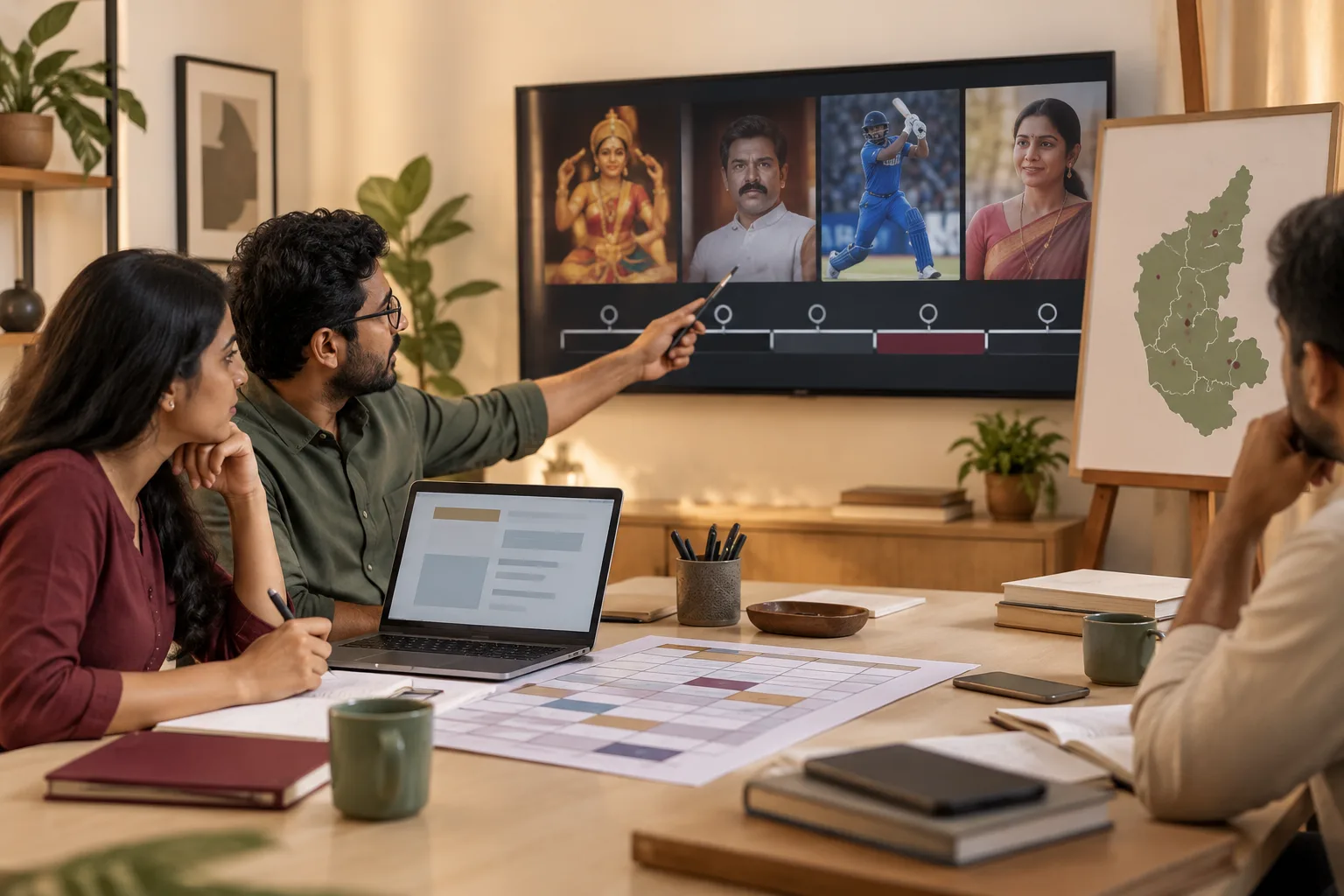
Regional television advertising buys spots on a language feed watched in one state, sold in ten-second units against a named channel and a time band. The purchase is that state's market, not the language on the soundtrack. GullySales plans the channels and bands, coordinates the booking with the broadcaster or their agency, and reads the telecast log afterwards.
The choice is a market, not a language. A Kannada entertainment channel in its prime band sells against the serial running there, and that serial's viewer is the housewife in Davanagere as much as in Bengaluru. Your ten seconds is bought against her evening.
A dubbed film gives itself away. The lip movement, the names, the shop in the background and the accent of the voice-over all say this was made for somebody else. Shoot the regional version or buy a different medium.
The problem
Does this sound like your business?
What owners tell us on the first call, in their words.
“The Hindi film was dubbed and it showed”
The mouth does not match the words and the voice is plainly not from the state. Viewers take it as an outsider's advertisement and look away.
“We bought the channel and not the band”
A spot at three in the afternoon and a spot inside the prime serial are the same ten seconds at very different value. Our plan carried only the channel name.
“Nobody checked what actually telecast”
Spots are dropped, shifted or run in another break. Without the telecast log set against the release order, there is nothing to claim back.
“The feed does not reach where we sell”
Carriage is decided operator by operator and area by area. Your distribution stops at three districts and the buy covered thirty.
What we do
Everything that is included.
Each deliverable, and what it gets you. Nothing here is an extra.
Feed and market check
Which channels are carried in the districts you actually sell in, and whether the feed on offer is the state one or a wider regional beam.
Band and programme mapping
The time bands and what sits inside them: the prime serial, the afternoon repeat, the morning devotional hour, the news spike on a results day.
Spot length and frequency plan
Whether the budget goes on ten-second spots repeated through the week or on thirty seconds fewer times. Both are defensible and they buy different things.
What commercial time is free
The advertising time inside a band is limited and committed spenders hold first call on it. We ask what is genuinely available before anything is promised to you.
Regional creative rather than a dub
A script written in the language, a voice from the state, and on-screen text read by somebody who reads it every day. Shot fresh where budget allows.
Booking through the proper route
Coordinated with the broadcaster's sales team or their appointed agency, with band, dates and spot count written on the release order.
Telecast log reconciliation
The post-telecast log read line by line against the order, with a claim raised for every spot that did not run as booked.
A response route you can read
A campaign number or a code on screen, and enquiries counted district by district before, during and after the burst.
How the result is measured
- Spots telecast against spots booked, by band
- Rate per ten seconds against the first quote
- Credits claimed for spots that did not run
- Calls to the campaign number during the burst
- Enquiries by district before, during and after
Recorded as a baseline before work starts, so every later report has an honest comparison.
Who it is for
This is written for you if these sound familiar.
- State and multi-state brands whose buyers watch in their own language
- Hospitals, jewellers and builders advertising across a state rather than one city
- Food and consumer brands with distribution in the towns a state feed reaches
- A national brand running its Hindi film in the south and wondering why nothing moved
- Education groups buying around results season and the admission news cycle
- Businesses willing to shoot a second version of the film in the state's language
Not for
It is not the right fit if.
- Businesses selling in one locality, where most of a state feed is paid for outside your delivery area
- Anyone needing to prove which spot produced which enquiry, because television reports telecast and nothing else
- A brand with no dealer network in the towns the feed covers, since demand arrives where you cannot supply
How it works
From your first message to the first report.
No open-ended retainer. Every step gives you something in writing.
First
Your brief
You tell us what you need in a few short steps: your business, what you want, where enquiries come from and how they are handled.
After the brief
A conversation and a written scope
We read it, then talk with whoever handles your enquiries. If you want our help, the scope, the fee and the reporting come in writing, and nothing starts before you have read them.
Before work starts
Baseline recorded
The numbers this work is meant to move, such as enquiries, quotations, orders, visits or renewals, written down so every later report has an honest comparison.
After the baseline
The first fix goes live
The fix we agreed to start with is put in place and measured against the baseline, whether that is a reply, a follow-up, a page, a listing or the handover between marketing and sales.
As agreed
Report against the baseline
What moved, what did not, and what changes next, in plain words. How often you get it is set in writing before work starts.
At renewal
Renew on the numbers
The term ends and you decide whether to continue from the results. The length is agreed in writing before anything starts.
How the regional TV advertising work runs
- 1
Fix the market first
The districts where you can supply and service. A jeweller with three showrooms in south Karnataka has no use for a feed that reaches Bidar.
- 2
Shortlist channels by carriage
We work out which channels reach those districts, and what your buyer has on at that hour of the evening.
- 3
Choose bands, not only channels
Every spot in the plan names its programme band. That is what decides the value, and it is the first thing a broadcaster moves.
- 4
Negotiate and get it on paper
Rates are negotiated and the schedule confirmed through the broadcaster or their agency, with spot counts and bands on the release order.
- 5
Produce the regional version
Script, voice and on-screen text made for the state, approved by you, delivered in the broadcaster's format well before the start date.
- 6
Reconcile and report
Telecast log against order, credits claimed where spots were missed, and enquiries by district set beside the weeks before the burst.
Why us
Why owners pick GullySales over an agency.
Marketing and sales, as one job
Most agencies stop at the enquiry. We also fix what happens after it: the reply, the follow-up, the quote and the CRM.
The person on the first call does the work
No account managers in between. You are never handed to someone you have not met.
A baseline before anything starts
Your numbers are written down on day one, so every later report compares against something honest.
The fee in writing, split three ways
Our time, your media spend and production on separate lines. You always see what goes to us.
No guarantees we cannot keep
The term is agreed in writing and never a default twelve months. We never promise a ranking or a lead count, because nobody controls those.
One office, and we say so
Nagarbhavi, Bengaluru. We work across India by call and WhatsApp and travel when a session needs to be in person.
#257, 3rd floor, Sri Nanjundeshwara Complex, Nagarbhavi 8th Block, Outer Ring Road. How we work.
Engagement options
Ways to work with us.
Pick the size of commitment that fits. Every option starts with your brief and a conversation.
Option 1
The conversation on its own
A call after you send your brief. It says honestly whether you need outside help, and many fixes are ones your own team can make.
Option 2
One fix, scoped
Start with the fix that matters most, such as reply time or follow-up. The fee is in writing before anything starts.
Option 3
An ongoing programme
We run the work, report against the baseline, and you renew on the numbers. The term and the reporting are agreed in writing first.
Option 4
Guidance for your own team or agency
We plan, brief and check the work of your in-house team or current agency, instead of replacing them.
Your brief
Tell us what you need, and we will read it before we call.
Eight short steps about your business, what you want and who decides. Most questions are a tap, and you can skip any you would rather answer on the call.
FAQ
Questions owners ask before they call.
Not here? More answers, or ask on WhatsApp.
Should we dub the Hindi film or shoot a new one?
What is a band and why does it cost more?
Can you guarantee our spot runs in the serial break?
How do we know it worked?
Is regional television affordable for a mid-sized business?
How long is the contract?
How soon will we see results?
Who will actually do the work?
What do you need from us?
What if we are not happy with the work?
By industry
Regional TV advertising, written for your industry.
Related services
Often bought with this, or instead of it.
Your next practical step
Tell us what you are trying to grow, and we will read it before we call.
Eight short steps, mostly taps. Skip anything you would rather answer on the call.