Tamil TV advertising · Marketing
Buying Tamil television means buying Tamil Nadu, not translating your film.
The market is the point here, not the language. A Tamil buy reaches households across Tamil Nadu, along with the Tamil-speaking pockets of Bengaluru and Hosur. The viewer at the other end has watched the same serial at the same hour for four years.
Scope, fee, reporting and term are agreed in writing after we have read your brief and spoken to you.
In one paragraph
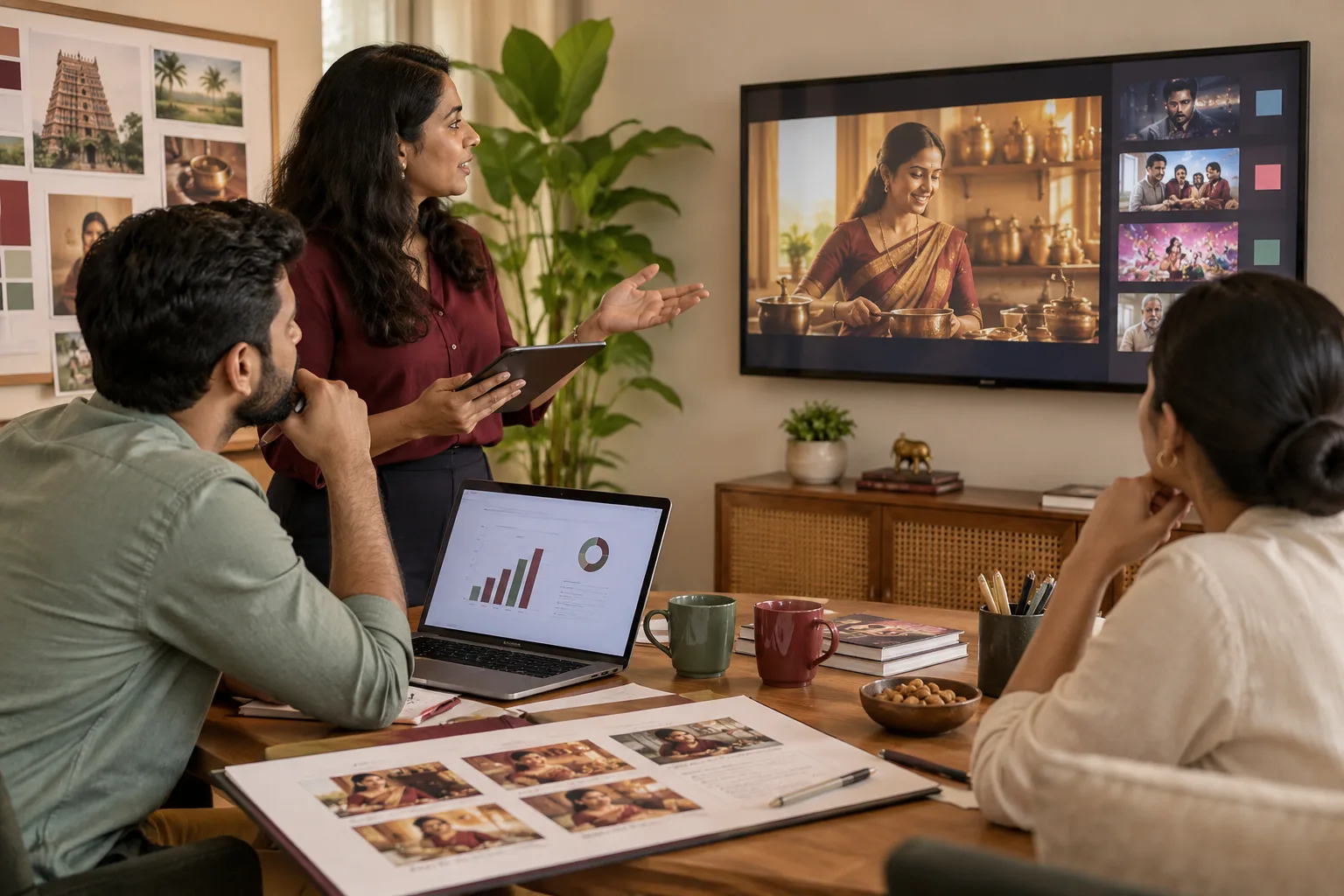
Tamil television advertising buys commercial time on Tamil channels, sold in ten-second units and priced by the band a spot runs in. GullySales works out which bands your buyer watches, has the film made in Tamil instead of dubbed, and coordinates the booking with the channel's sales house or its appointed agency.
Time is sold in ten-second units inside bands, and the band sets the rate. Prime evening carries the serials and costs the most. Daytime is cheaper and reaches the person who is at home in the afternoon, while a film premiere or a match is sold on its own terms.
A dubbed Hindi film is recognised as a dubbed Hindi film. The voice, the face and the phrasing have to be Tamil. Pongal is the year's biggest selling window and the weeks around it go months in advance.
Who it is for
This is written for you if these sound familiar.
- Brands selling across Tamil Nadu through dealers, who need the state to know the name before a salesman walks in
- Jewellers, textile retailers and furniture showrooms whose season is Pongal, Aadi and the wedding months
- Hospitals and education groups drawing patients or students from several districts at once
- Consumer product companies whose national Hindi campaign lands flat in Chennai and Coimbatore
- Businesses opening branches in Madurai, Salem or Trichy where nobody has heard the name
Not for
It is not the right fit if.
- A single clinic or showroom serving one locality, where a state-wide buy wastes almost everything you pay for
- Businesses with no dealer, branch or delivery in Tamil Nadu, since the calls arrive from places you cannot serve
- A budget covering a handful of spots, which nobody remembers because nothing repeats
The problem
Does this sound like your business?
What owners tell us on the first call, in their words.
“The film was dubbed and it showed”
A Hindi film with a Tamil track laid over it reads as an outsider's advertisement within five seconds. The lip movement and the setting give it away before the claim is heard.
“The spots ran and nobody can say what ran when”
Without the telecast certificate held against the plan, a spot shifted into a cheaper band looks the same on the invoice as the one you booked.
“Pongal was sold before we decided”
The weeks around Pongal are booked well ahead and priced for it. A brand that makes up its mind in December buys whatever is left, in the bands nobody wanted.
“The number was on screen for two seconds”
Television leaves nothing behind. A phone number said once at the end of a spot is the only route a viewer has, and that one was unreadable.
What we do
Everything that is included.
Each deliverable, and what it gets you. Nothing here is an extra.
Band and channel plan
Which bands your buyer watches, and what a spot in each costs for the same money, worked out before a channel is chosen.
Spot plan with weights
How many ten-second units, in which bands, across how many weeks, built so one household meets the film several times rather than once.
Creative made in Tamil
Script, voice and casting done in the language, with the claim written for a viewer in Madurai instead of translated from a national film.
Season and event calendar
Pongal, Aadi, the wedding months and the admission weeks, with premium weeks booked early and quiet ones used for volume.
Release order and material delivery
The booking coordinated with the channel's sales house or its appointed agency, and the film delivered to their technical specification before the deadline.
Telecast certificate reconciliation
The certificate read against the plan spot by spot, with shortfalls and wrong bands claimed back as replacement airtime.
A response route worth putting on screen
One number held on screen long enough to be written down, or a short word a viewer can search, used on no other medium.
Reading the effect without a click
Brand searches, calls to the campaign number and dealer walk-ins across the state, before, during and after the burst.
How the result is measured
- Ten-second units delivered by band against the plan
- Calls to the campaign number during the burst
- Brand searches from Tamil Nadu before, during and after
- Dealer and showroom walk-ins across the burst weeks
- Rate booked against the first quote
Recorded as a baseline before work starts, so every later report has an honest comparison.
How it works
How the tamil TV advertising work runs
The work itself, in order. How an engagement starts, from your brief to a written scope, is set out on our method page.
- 1
Fix the market before the channel
Which districts you can actually serve, and whether the dealer there can handle the calls a burst produces on a Monday.
- 2
Plan the bands
Prime, daytime and weekend bands are compared on cost per ten seconds, and each gets a weight in the plan.
- 3
Make the film in Tamil
Script, voice and casting in the language, read by somebody who speaks it daily, before production is signed off.
- 4
Book and deliver the material
The order goes to the channel's sales house and the film reaches their technical desk ahead of the material deadline.
- 5
Track the burst while it runs
Telecast certificates, the campaign number's call log and brand searches are collected during the weeks on air.
- 6
Reconcile and report
Delivered against booked, the claims raised, and enquiries from across the state go into the report.
Where this fits
Three pieces of sales work, in this order.
This work sits inside sales process design, at stage 1, prospecting and lead generation. The audit comes before it, and sales management keeps it running.
Step 1
Sales audit
Find where deals are being lost and what to fix first.
Start here if you cannot say where orders are lost.
Step 2 · you are here
Sales process design
One written way to sell, from first enquiry to repeat order.
Start here if every salesperson sells differently.
Step 3
Sales management
A target, a review routine and someone who owns the number.
Start here if the team has targets and no routine.
FAQ
Questions owners ask before they call.
Not here? More answers, or ask on WhatsApp.
Can we run our Hindi film with a Tamil voice-over?
How many spots do we need?
Can you tell us how many enquiries the television campaign brought?
Do you buy directly from the channels?
How is this priced?
How long is the contract?
How soon will we see results?
Who will actually do the work?
What do you need from us?
What if we are not happy with the work?
By industry
Tamil TV advertising, written for your industry.
Related services
Often bought with this, or instead of it.
Your next practical step
Tell us what you are trying to grow, and we will read it before we call.
Eight short steps, mostly taps. Skip anything you would rather answer on the call.