Telugu TV advertising · Marketing
Telugu is two states, and your dealers may only be in one of them.
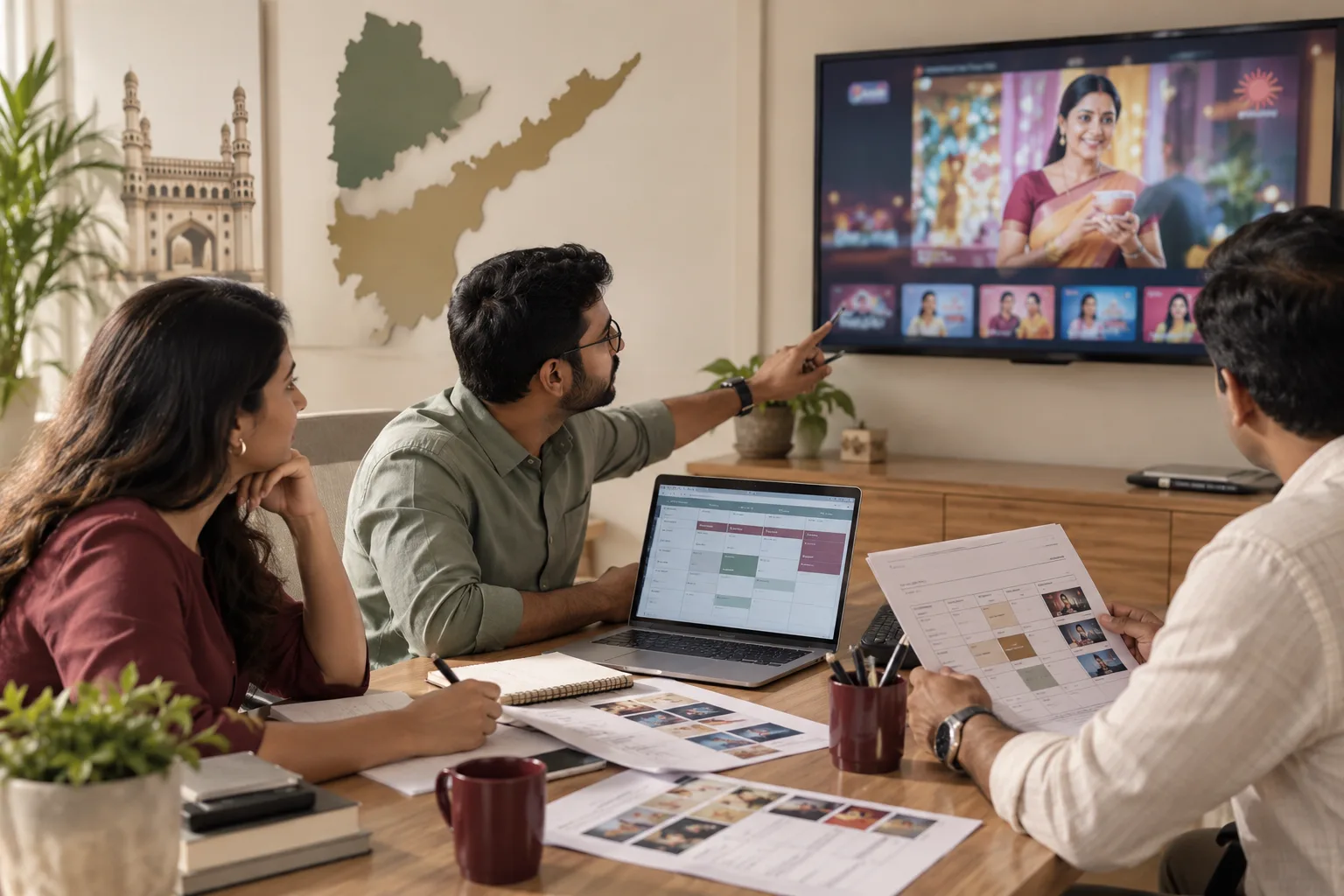
Our television advertising page explains how spots, bands and telecast logs work on any channel. This one is about a market, because a Telugu buy is a decision about Andhra Pradesh and Telangana before it is a decision about language.
Scope, fee, reporting and term are agreed in writing after we have read your brief and spoken to you.
In one paragraph
Telugu television advertising buys spots on channels whose feed covers Andhra Pradesh and Telangana, sold in ten-second units against a time band rather than an audience you choose. GullySales plans the channels and bands your buyer watches, coordinates the booking with the broadcaster or their agency, and reads the telecast log against the order.
The two states do not shop alike. Hyderabad is a metro with its own rates, while a manufacturer selling through the Godavari districts reaches people on channels a Hyderabad plan would skip. If your network stops at the state border, a feed that crosses it is money spent on households that cannot buy from you.
Sankranti is the date the whole market plans around. Families travel home, the big films release, everybody is in front of a television, and the good bands are committed months before it. A Sankranti plan made in December is a plan made too late.
Who it is for
This is written for you if these sound familiar.
- Brands with dealers or branches across both states, or across a set of districts inside one
- Makers of consumer durables, building materials and agricultural inputs who sell through a district network
- Hospitals and education groups in Hyderabad or Vijayawada drawing patients and students from the districts
- Businesses whose Hindi or English commercial means nothing inside a Telugu household
- Advertisers who tried a national buy, paid for twenty states and sell in two
Not for
It is not the right fit if.
- Businesses with no stock or service in the districts the feed covers, where the demand created walks to a competitor
- Anyone without a film in Telugu, since airtime with nothing worth playing in it is the most expensive mistake on this page
- A handful of scattered spots, which spends real money and is noticed by nobody
The problem
Does this sound like your business?
What owners tell us on the first call, in their words.
“We dubbed the Hindi film and it fell flat”
A voice that does not sound local places the brand somewhere else within three seconds. The words sit badly on the mouth and the joke stops working.
“Half the spend went to districts we do not serve”
One feed covers two states. Without a district view of your own sales, a state-wide buy pays for a market where nobody stocks you.
“Sankranti was gone by the time we rang”
The festive bands sell out early and at their own rate. A plan built in December on off-season numbers does not survive the answer that comes back.
“Nobody could confirm our spots went out”
Spots are bought against a schedule and the telecast log is the only record of what was actually aired. Unread, a dropped spot is never claimed back.
What we do
Everything that is included.
Each deliverable, and what it gets you. Nothing here is an extra.
Market drawn before channel
Which districts your dealers can genuinely serve, set against what each channel's feed covers, so the buy stops where your distribution does.
Channel and band plan
News for daytime weight, entertainment for prime against the serials, movie channels for the weekend film block, with the reason each one is in or out.
Spot count in ten-second units
How many spots, in which bands, across how many weeks, written as a pattern so a burst stays a burst and does not thin into a scatter.
Festive position taken early
Sankranti, Ugadi and Dasara bands asked for months ahead, priced at what the season actually costs rather than what the plan hoped.
A film made in Telugu
Script, voice and casting in the language, checked by a Telugu speaker for idiom and for how your brand name sounds when said aloud.
Supers and a campaign number
The dealer address, the branch and a number held on screen long enough to be read and written down, changed by region where the schedule allows.
Telecast log read against the plan
Every spot checked against what was booked, with make-good spots claimed from the broadcaster for anything that did not go out.
How the result is measured
- Spots telecast against spots booked, from the log
- Rate negotiated against the opening quote
- Calls to the campaign number during the burst
- Dealer walk-ins and enquiries by district, before and during
- Branded searches across the two states through the flight
Recorded as a baseline before work starts, so every later report has an honest comparison.
How it works
How the telugu TV advertising work runs
The work itself, in order. How an engagement starts, from your brief to a written scope, is set out on our method page.
- 1
Draw the market from your invoices
We start from where your orders come from now and where you could serve next quarter. That map picks the channels, not the other way round.
- 2
Choose the hour, then the channel
A farmer, a housewife in Hyderabad and a shop owner in Guntur watch different things at different times. The plan follows the hour.
- 3
Book the season ahead of it
Festive and film-release weeks are asked for well in advance through the broadcaster's sales team or their agency, and the rate is negotiated before the band fills.
- 4
Make the film properly
The commercial is written and voiced in Telugu and cut to the slot lengths bought, with the name and number on screen long enough to register.
- 5
Run it, log it, report it
The telecast log is checked and missed spots are claimed. Calls to the campaign number and dealer walk-ins are reported against the weeks the spots ran.
Where this fits
Three pieces of sales work, in this order.
This work sits inside sales process design, at stage 1, prospecting and lead generation. The audit comes before it, and sales management keeps it running.
Step 1
Sales audit
Find where deals are being lost and what to fix first.
Start here if you cannot say where orders are lost.
Step 2 · you are here
Sales process design
One written way to sell, from first enquiry to repeat order.
Start here if every salesperson sells differently.
Step 3
Sales management
A target, a review routine and someone who owns the number.
Start here if the team has targets and no routine.
FAQ
Questions owners ask before they call.
Not here? More answers, or ask on WhatsApp.
Is one Telugu channel enough to cover both states?
Can we simply dub our Hindi commercial?
How early should we book for Sankranti?
Can television tell us how many enquiries it produced?
What proof do we get that our spots ran?
How is this priced?
How long is the contract?
How soon will we see results?
Who will actually do the work?
What do you need from us?
By industry
Telugu TV advertising, written for your industry.
Related services
Often bought with this, or instead of it.
Read before you buy
- Planning the Sankranti buying season backwards from BhogiSankranti sales in coastal Andhra can be lost in November. Work back from Bhogi to the dates your stock, offer and WhatsApp list must be ready, and know when to sit it out.
- Planning Dasara and Bathukamma sales from the stock date, not the last weekStart the festival plan from the day stock and offers must be in the shop, which falls before Bathukamma begins, and message past buyers before the crowd arrives.
- Advertising in Telugu: translate the call and the offer, keep the spec terms in EnglishTranslate what carries the conversation, the first call, the WhatsApp reply and the offer, into Telugu. Keep in English the specification words your buyer already says in English at your counter.
Your next practical step
Tell us what you are trying to grow, and we will read it before we call.
Eight short steps, mostly taps. Skip anything you would rather answer on the call.