Website accessibility · Marketing
Make the site work for the customer who cannot use a mouse or see the screen clearly.
An elderly patient zooms the page to read your fees and the text runs off the screen. A buyer who is blind tries to book a visit and the form announces nothing. Neither of them calls to complain. They leave, and your enquiry numbers never show why.
Scope, fee, reporting and term are agreed in writing after we have read your brief and spoken to you.
In one paragraph
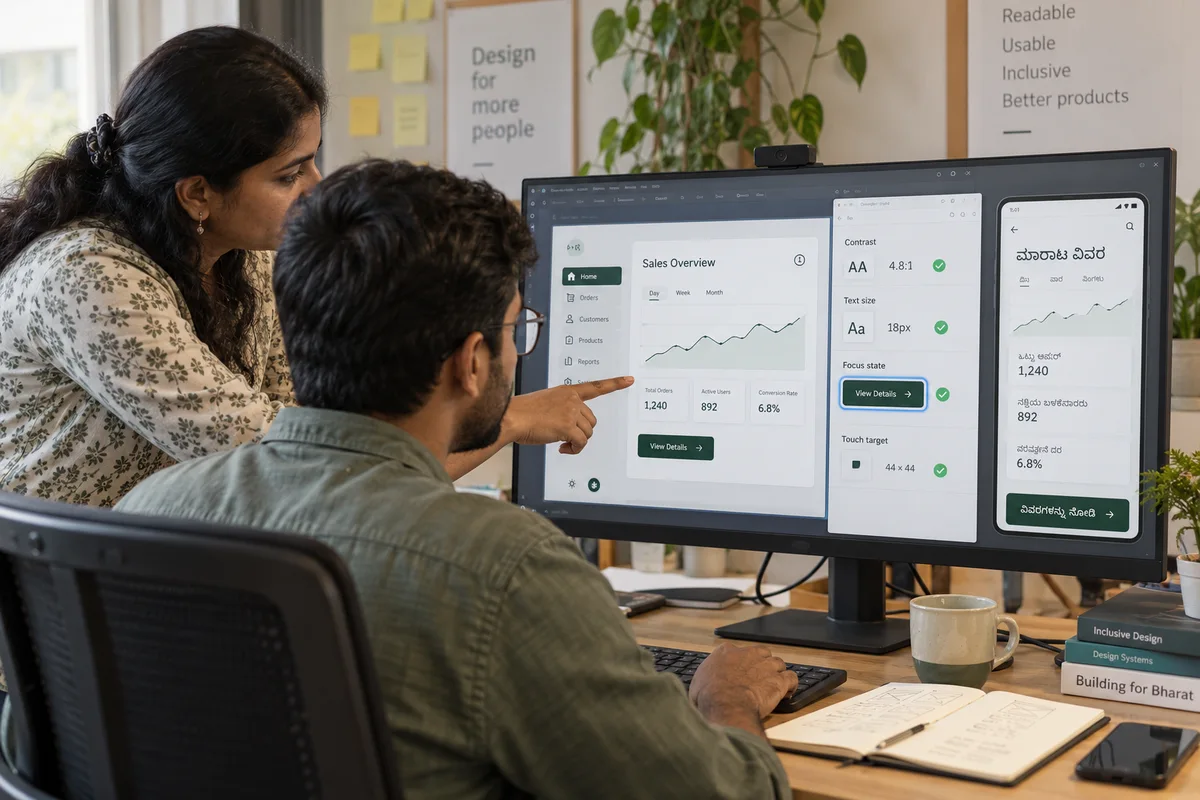
Website accessibility is the work of making a site usable by people who rely on screen readers, keyboards, captions or large text, following the WCAG standard. GullySales tests your pages the way those visitors use them, then fixes forms, colour contrast, headings and navigation page by page.
Accessibility is also a matter of plain business sense in India. The Rights of Persons with Disabilities Act 2016 covers access to information, and banks, hospitals, schools and government suppliers are asked about it in tenders more often each year. Your own lawyer will tell you what applies to your business.
We test against the WCAG guidelines with a screen reader, a keyboard alone and a phone at 200 per cent zoom. You get a list of what fails, in plain words, ranked by how many visitors it stops.
The problem
Does this sound like your business?
What owners tell us on the first call, in their words.
“A customer said they could not fill in our form”
Fields without labels, error messages that appear only in red and buttons a keyboard cannot reach all stop a form from working for some visitors.
“Our text is grey on white and hard to read”
Pale colours look neat in a design file and fail on a phone in sunlight. Low contrast is the most common failure we find, and the quickest to fix.
“A tender asks if the site meets WCAG and nobody knows”
Procurement teams now ask the question in writing. Without a test result on file, you are guessing at the answer.
“The new site looks good but the old problems came back”
Accessibility fixed once and never checked again slips every time a developer adds a banner or a pop-up.
What we do
Everything that is included.
Each deliverable, and what it gets you. Nothing here is an extra.
Accessibility audit
Your key pages tested against WCAG with a screen reader, keyboard-only use and mobile zoom, with every failure written down.
Colour contrast review
Text, buttons and links checked against the contrast limits, with replacement colours that stay inside your brand.
Form and checkout fixes
Labels, error messages, focus order and required-field cues corrected on enquiry, booking and payment forms.
Heading and landmark structure
Each page given a logical order of headings and page regions so a screen reader can jump to the part the visitor wants.
Image and media descriptions
Alternative text for images that carry meaning, captions for video and a text version of anything spoken.
Keyboard and focus repair
Menus, pop-ups, sliders and the WhatsApp button made reachable and visible without a mouse.
Accessibility statement
A plain page telling visitors what works, what does not yet, and how to reach you, written from the audit and not from a template.
Brief for your developer
A checklist your developer can build to, so new pages do not undo the fixes.
How the result is measured
- Failures found and fixed, by page
- Form completion on tested pages before and after
- Contrast failures remaining
- Pages passing a keyboard-only walkthrough
- Enquiries from visitors using zoom or assistive settings, where analytics records them
Recorded as a baseline before work starts, so every later report has an honest comparison.
Who it is for
This is written for you if these sound familiar.
- Hospitals, clinics and diagnostic labs whose patients include older people and people with low vision
- Banks, insurers and fintech companies whose forms must work for every applicant
- Schools, colleges and edtech companies serving students with learning or sight needs
- Manufacturers and suppliers who sell to government or large corporates that ask for accessibility in tenders
- Online stores where a broken checkout for keyboard users costs real orders
Not for
It is not the right fit if.
- You need a legal opinion on what the law requires of your business. That is for your lawyer, and we will work from their list.
- Your site is about to be rebuilt from scratch. Fix accessibility in the new design brief instead of patching the old pages.
How it works
From your first message to the first report.
No open-ended retainer. Every step gives you something in writing.
First
Your brief
You tell us what you need in a few short steps: your business, what you want, where enquiries come from and how they are handled.
After the brief
A conversation and a written scope
We read it, then talk with whoever handles your enquiries. If you want our help, the scope, the fee and the reporting come in writing, and nothing starts before you have read them.
Before work starts
Baseline recorded
The numbers this work is meant to move, such as enquiries, quotations, orders, visits or renewals, written down so every later report has an honest comparison.
After the baseline
The first fix goes live
The fix we agreed to start with is put in place and measured against the baseline, whether that is a reply, a follow-up, a page, a listing or the handover between marketing and sales.
As agreed
Report against the baseline
What moved, what did not, and what changes next, in plain words. How often you get it is set in writing before work starts.
At renewal
Renew on the numbers
The term ends and you decide whether to continue from the results. The length is agreed in writing before anything starts.
How the website accessibility work runs
- 1
Choose the pages that matter
We list the pages visitors use to reach you: home, service pages, contact, booking and checkout.
- 2
Test them as visitors use them
We go through each page with a screen reader, with the keyboard only and with the text enlarged.
- 3
Rank the failures
Problems that block an enquiry or a payment come first. Cosmetic ones wait.
- 4
Fix and retest
Fixes go into the site or into a written brief for your developer, and each fix is tested again on the same device.
- 5
Hand over the checks
You receive a short list your team runs before publishing any new page.
Why us
Why owners pick GullySales over an agency.
Marketing and sales, as one job
Most agencies stop at the enquiry. We also fix what happens after it: the reply, the follow-up, the quote and the CRM.
The person on the first call does the work
No account managers in between. You are never handed to someone you have not met.
A baseline before anything starts
Your numbers are written down on day one, so every later report compares against something honest.
The fee in writing, split three ways
Our time, your media spend and production on separate lines. You always see what goes to us.
No guarantees we cannot keep
The term is agreed in writing and never a default twelve months. We never promise a ranking or a lead count, because nobody controls those.
One office, and we say so
Nagarbhavi, Bengaluru. We work across India by call and WhatsApp and travel when a session needs to be in person.
#257, 3rd floor, Sri Nanjundeshwara Complex, Nagarbhavi 8th Block, Outer Ring Road. How we work.
Engagement options
Ways to work with us.
Pick the size of commitment that fits. Every option starts with your brief and a conversation.
Option 1
The conversation on its own
A call after you send your brief. It says honestly whether you need outside help, and many fixes are ones your own team can make.
Option 2
One fix, scoped
Start with the fix that matters most, such as reply time or follow-up. The fee is in writing before anything starts.
Option 3
An ongoing programme
We run the work, report against the baseline, and you renew on the numbers. The term and the reporting are agreed in writing first.
Option 4
Guidance for your own team or agency
We plan, brief and check the work of your in-house team or current agency, instead of replacing them.
Your brief
Tell us what you need, and we will read it before we call.
Eight short steps about your business, what you want and who decides. Most questions are a tap, and you can skip any you would rather answer on the call.
FAQ
Questions owners ask before they call.
Not here? More answers, or ask on WhatsApp.
Is website accessibility compulsory in India?
What is WCAG?
Can an overlay widget make my site accessible?
Will fixing accessibility change how my site looks?
Do you test on real devices?
How much does it cost?
How long is the contract?
How soon will we see results?
Who will actually do the work?
What if we are not happy with the work?
By industry
Website accessibility, written for your industry.
Related services
Often bought with this, or instead of it.
Your next practical step
Tell us what you are trying to grow, and we will read it before we call.
Eight short steps, mostly taps. Skip anything you would rather answer on the call.