Notes for owners · Industry playbooks
Automotive tier-2 forging suppliers: what a tier-1 purchase team looks for in a new source
What a tier-1 commodity buyer and supplier quality engineer check before adding a forging source, and how a tier-2 forger should prepare the visit, the process description and the parts on the table.
The GullySales team · Updated 17 Oct 2026 · 6 min read
On this page
A tier-1 steering or transmission parts maker adds a forging source when it has to. A new vehicle programme, an incumbent at full capacity or a price review are the usual triggers. Its commodity buyer and supplier quality engineer then ask for three things. They want to visit your floor, read a description of your process from bar to dispatch, and handle forgings you have already made that look like theirs. A tier-2 forger who has these ready before the first call stands a far better chance of the RFQ.
Who comes on the visit, and what each one is judging
The commodity buyer looks at capacity first. Can your presses carry the volumes, is your price structure believable, and can your finances carry the payment terms?
The supplier quality engineer, the SQA in most plants, looks at control. They want to see a part traced from bar to bin and a reject kept apart from good parts, and they check whether the records on the floor match the ones in the file.
A development engineer sometimes joins them. The question here is the die. Does your tool room design and sink it, or do you depend on an outside die maker? And how fast can a die be corrected after the first samples?
Behind all three sits the vehicle maker. For some parts a tier-1 cannot add a sub-tier source without its own customer's approval. Ask early whether your part is one of them, because it changes how long the whole process runs.
How a buyer decides who gets a drawing at all is in which unit gets the RFQ. This post starts after that: the tier-1 has noticed you.
The process description, on one sheet
Draw your process on a single A3 sheet, from bar receipt to dispatch. For each step, write what is checked, who checks it, where it is recorded, and what happens to a part that fails. Bring printed copies and hang one on the shop wall.
The SQA may then ask for a control plan and a process FMEA in the company's format. If you have never made one, say so, and ask for their template rather than filling in a generic one from the internet. An honest "we have not made one; send us your format" goes down better than a document that does not match your floor.
Parts on the table
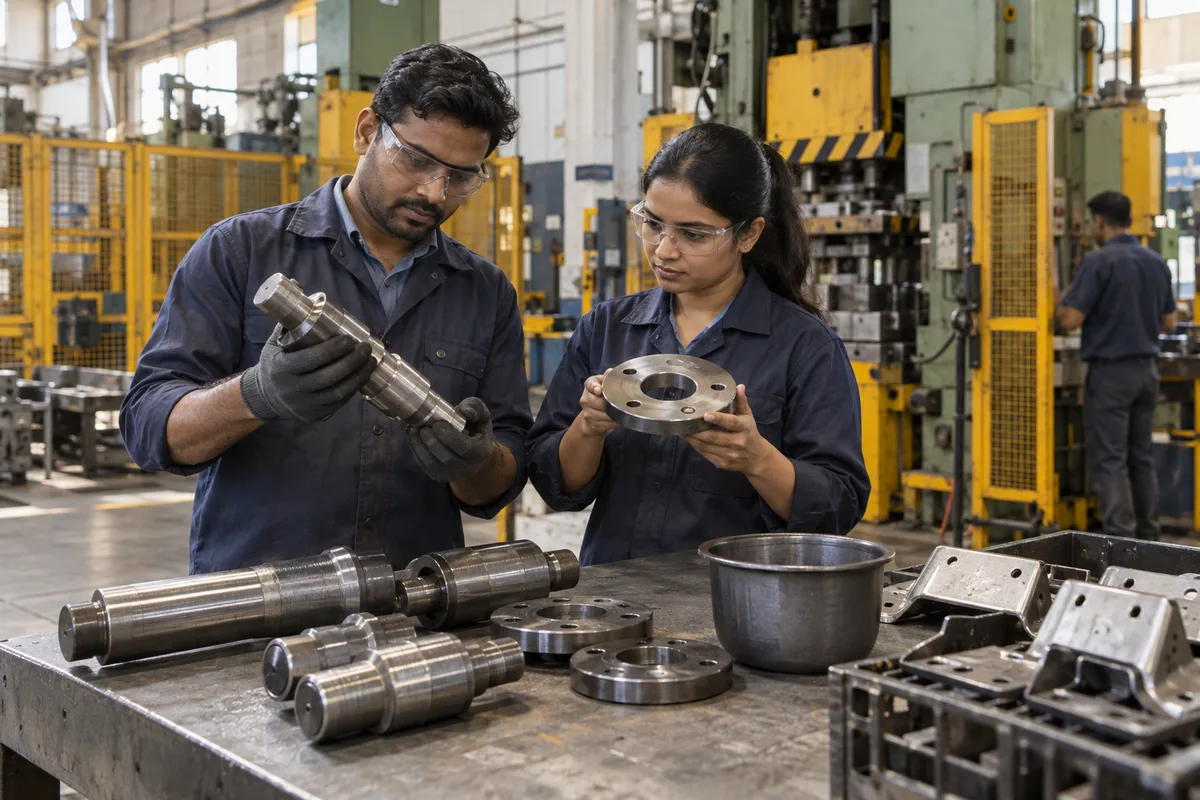
Before the visit, lay out the forgings closest in shape and weight to their part family: yokes, flanges, gear blanks, knuckles, whatever you actually make. Label each with the steel grade, forged weight, the press it ran on and its heat treatment.
Add one forging cut through and etched to show the grain flow. The engineer will ask about die fill and flow lines, and a section answers better than a sentence. Keep one finished part with its whole trail in a folder beside it: mill certificate, heat number, heat treatment chart and inspection report.
Visit-day checklist, in the order you walk
- Gate and bar store: bar stacked by grade with colour marks or tags, mill certificates filed by heat number.
- At the saw or shear: cut weight checked on the first pieces of each lot and written down.
- Heating: billet temperature checked with a pyrometer, and a written rule for what happens to a billet that has been overheated, because the engineer will ask.
- Forging line: a first-off approval record at each set-up, and a history card with each die.
- Trimming: flash in the scrap bin.
- Heat treatment: the furnace chart kept with each batch, and hardness checks recorded per lot.
- Crack detection: results written down, and rejects held in a marked red bin.
- Gauges: calibration status visible.
- Dispatch: a tag on each bin that traces back to the heat number.
- Office: a rejection and complaint register, and a capacity sheet with free hours per press.
The day before, walk it yourself with someone from outside the shop, and pick a part at random from dispatch. Trace it to its mill certificate while they time you. If it takes more than a few minutes, that is the first thing to fix.
For example: a warm forging unit in Pithampur
Imagine an invented warm forging unit in Pithampur, near Indore, invited to show itself to a tier-1 that makes steering parts. Every detail is made up.
The owner kept the visitors in the conference room for an hour. The deck covered the company's history, its association awards and a slide of every customer logo. When the SQA engineer finally reached the floor, they lifted a finished part from a dispatch bin and asked for its heat number. Nobody could trace it past the heat treatment batch. The visit ended politely, and no RFQ followed.
Some months later the unit asked for a second visit, and prepared differently. The parts board stood in reception and the process flow hung on the shop wall. The deck shrank to five slides. The engineer walked the line in process order, picked a part from a bin and watched the quality head trace it to the mill certificate at the stores desk. Two heats from the previous quarter still had no certificate on file, and the engineer noted it. An RFQ arrived, but only for a small bracket, and the unit treated it as the start of the approval, not a consolation. The first visit had cost about a year.
When chasing a tier-1 is the wrong move
If your largest press cannot forge their part family, a visit wastes both sides' time. Say so and ask to stay on their list for smaller parts.
Work out the payment terms before the visit, not after the first order. Long terms can strain a small forger's working capital, and your bank decides how much of that you can carry.
Watch the concentration too. If one tier-1 would soon fill most of your presses, you have traded many customers for one. Decide your limit first.
And if you sense you are being added mainly to pressure the incumbent's price, ask plainly what share of the part a new source can expect. The answer tells you whether the approval is worth the effort.
Capability presentations is the related work for the short deck, and once a sample order arrives, first-article approval takes over.
Trace one part before you ask for a visit
Pick a forging from your dispatch area today and follow its trail back to the bar. Wherever the trail breaks, fix it first. The wider picture for makers like you sits under forging and metal forming. When the floor is ready and you want the deck and parts board prepared, tell us what you need.