Manufacturing · Machining, metal and components
We shape metal that other people's products depend on, and almost none of them know we exist.
A forging or stamping shop makes a part inside somebody else's product. The tractor, the bicycle, the pump, the switchgear all carry parts the end customer never sees. The buyer who does see them is a purchase engineer with a drawing, a die-cost question and a long list of suppliers already working for them.
Scope, fee, reporting and term are agreed in writing after we have read your brief and spoken to you.
In one paragraph
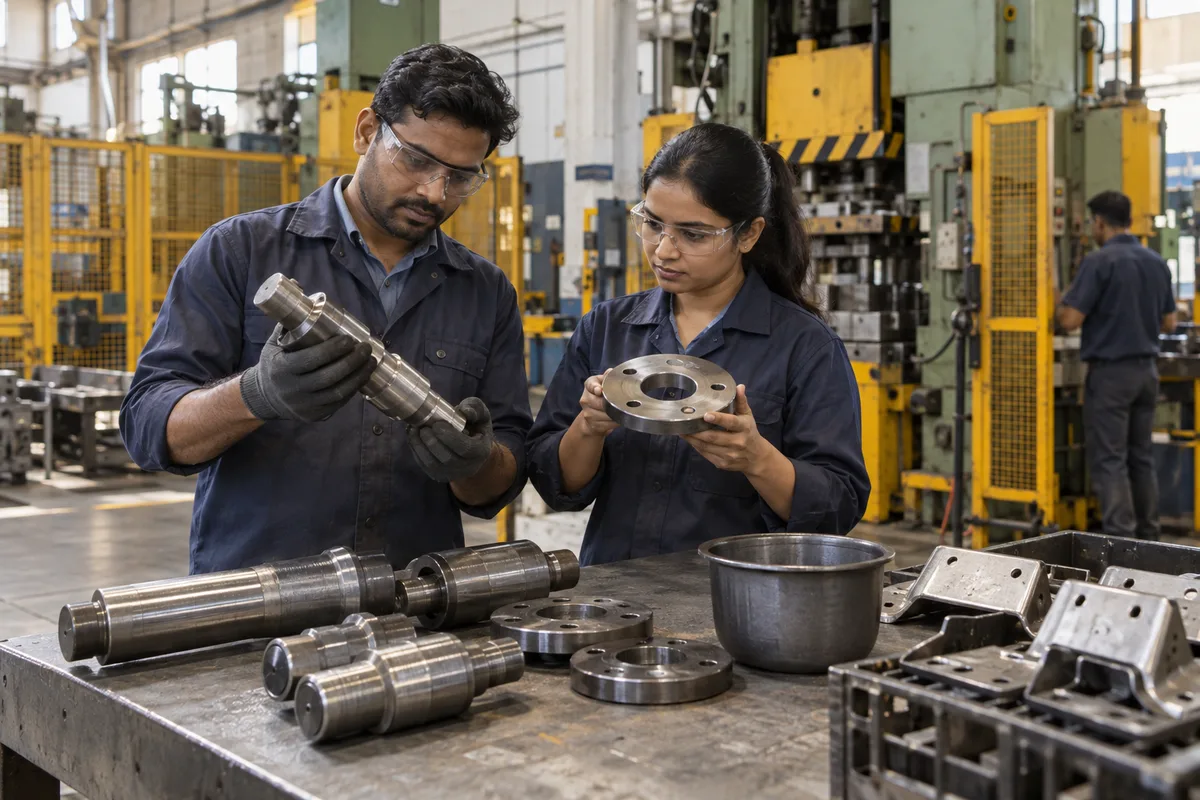
Forging and metal forming means shaping metal by force, by hammering, pressing, drawing or rolling it, instead of cutting or casting it. GullySales helps forgers and forming shops get found by the OEMs and purchase teams who specify the part, answer each request for quotation properly, and follow it up through the die and sample stage.
The enquiry is rarely urgent. It is a long conversation about tooling, tolerances, material, annual volume and approval. Shops that win it are the ones that reply with the right questions, keep the thread alive and still exist in the buyer's mind when the next part comes up.
This page covers the segment. The pages below take one process each, because a hot forger, a cold forger and a stamper are asked different questions by different buyers.
Last updated 16 Oct 2026.
7 types of work
Each kind of forging & metal forming is bought differently, so each has its own page.
Open the one that matches what you make. It covers who buys it, where the order is lost and what we would do.
- Hot ForgingOur hammer and press run full, and the three customers behind them decide our year.
- Cold ForgingWe turn out millions of small parts and buyers still think a bolt is a bolt.
- Precision ForgingOur forgings come off the press near net shape, and the buyer still wants a machined price comparison.
 Metal StampingThe progressive die made us efficient, and it also made us dependent on one part number.
- Deep DrawingWe draw cups and shells that nobody else will touch, and buyers think we only make steel utensils.
- Roll FormingOur line makes a profile in a single pass, but buyers keep asking us for a price per metre as if that were the whole job.
- Forged Automotive PartsVehicle makers buy from vendors they have audited, and we cannot get an audit without an introduction.
Who it is for
This is written for you if forging & metal forming is what you make or sell.
- Hot and warm forging shops supplying automotive, agricultural and engineering buyers
- Cold forging and precision forging units making fasteners and small, tight-tolerance parts
- Press shops doing stamping, deep drawing and progressive-die work
- Roll forming units making sections, profiles and panels
- Shops that also machine and heat-treat their forgings and sell finished components
Not for
It is not the right fit if.
- A shop that runs only on one large customer's schedule and has no capacity to take another
- A unit without a tool room or a die partner, which will lose tooling enquiries it cannot quote
- A trader who buys forgings or stampings elsewhere and cannot speak to the process
How buyers choose
What decides who wins in forging & metal forming.
A drawing, a volume and a die decision
The buyer sends the drawing and an annual quantity, and asks for die cost and piece price separately. The decision to invest in tooling often takes longer than the quotation.
Material and its certificate
The grade of steel or alloy, the supplier's mill certificate and sometimes the heat number are traced. Shops that keep this record are easier to approve.
First-article approval and the quality plan
A sample part is measured, sometimes destructively tested, and a control plan is agreed. Buyers also ask for the inspection equipment you hold.
Vendor registration and plant visit
OEMs register new vendors through a form and a visit. The visit checks the shop floor against what the form said.
Where orders are lost
What usually goes wrong when you sell forging & metal forming.
In the words owners use on the first call.
“Our customers have been with us for years and we have not met a new one in as many”
The shop's list has not changed since the last owner. When one customer moves a part to a new vendor, there is nothing waiting to replace it.
“We quote the die and never hear back”
A die quotation is a large number, so the buyer goes away to think. If nobody phones, the die is made at another shop.
“We are a forging shop, but buyers search for something else”
Buyers search for a part name or a material, not a process. A website that lists only machines does not appear for them.
“Every buyer sends a drawing and expects a price in a day”
Without a standard set of questions, the shop quotes on guesswork or loses days asking for information one message at a time.
The scope
The work we would propose for forging & metal forming.
Measured on qualified enquiries, quotation requests, follow-up on each quotation, trial orders won and repeat orders. Anything here that needs a platform, directory or tool we have not used with you is confirmed with you before it goes in the scope.
- A page for each process, material and part familyPages that say what you forge or form, in which steel or alloy, at what weight or size range and with what finishing.
- A request-for-quotation reply routineA first reply that asks for the drawing, material, annual volume and delivery date, so the next message is a quotation.
- Die-quotation follow-upA call plan for every die and piece-price quotation, with the decision date and who else is involved.
- A prospect list of OEMs and tier-one buyersTractor, pump, two-wheeler and electrical makers who buy forgings and stampings, with the part they probably need.
- Marketplace listings written by partListings by part and material, with a way to filter rate checks from real requests.
A vendor-registration pack
Profile, equipment list, quality records and approval history, ready to attach to each vendor form.
What we do
What you get for forging & metal forming.
Each deliverable and what it is there to change.
A capability sheet by process and part family
One document per process with materials, size range, tooling facility and testing, which a buyer can forward.
A request-for-quotation form that asks the right questions
Drawing, material, volume, delivery date and tooling arrangement, so incomplete enquiries show themselves.
A die-quotation template
Die cost, expected life, ownership and piece price in a form a purchase committee can approve.
A follow-up routine for quotations that went quiet
Each quotation has an owner and a next call date.
A vendor-registration folder
Documents buyers ask for, collected once and kept up to date.
How the result is measured
- Qualified quotation requests
- Die quotations followed up
- Drawings received against enquiries
- Vendor registrations started and completed
- Sample approvals and trial orders
- Repeat orders from new customers
Recorded as a baseline before work starts, so every later report has an honest comparison.
How it works
From your first message to the first report.
No open-ended retainer. Every step gives you something in writing.
First
Your brief
You tell us what you need in a few short steps: your business, what you want, where enquiries come from and how they are handled.
After the brief
A conversation and a written scope
We read it, then talk with whoever handles your enquiries. If you want our help, the scope, the fee and the reporting come in writing, and nothing starts before you have read them.
Before work starts
Baseline recorded
The numbers this work is meant to move, such as enquiries, quotations, orders, visits or renewals, written down so every later report has an honest comparison.
After the baseline
The first fix goes live
The fix we agreed to start with is put in place and measured against the baseline, whether that is a reply, a follow-up, a page, a listing or the handover between marketing and sales.
As agreed
Report against the baseline
What moved, what did not, and what changes next, in plain words. How often you get it is set in writing before work starts.
At renewal
Renew on the numbers
The term ends and you decide whether to continue from the results. The length is agreed in writing before anything starts.
What the work involves for forging & metal forming
- 1
Read the requirements brief
You tell us what you make, for whom and where orders have been lost, and we read it before we speak.
- 2
Go through the quotations
We look at the last quotations and replies to see where each stalled.
- 3
Write the process pages and listings
Capability pages, listings and a capability sheet are written from what your presses and dies do.
- 4
Set up the quotation routine
Every request gets a first reply and every quotation a next call, in one record.
- 5
Report against the baseline
Enquiries, quotations and orders are reported against the figures recorded before work started, on a schedule agreed in writing.
What we need from you
What to have ready before we talk.
None of it has to be tidy. We read what you have.
- Your website link and marketplace listings
- The last ten quotations sent, including die quotations
- Customer list with the parts they buy
- Press and hammer list with capacities
- Test equipment, certificates and quality records you hold
Export and new regions
Selling forging & metal forming beyond your home market.
Where you sell decides standards, documents, payment terms and freight. We work from Bengaluru and have no overseas office, so for a new region we start from your own enquiries, your existing buyers and the directories you already use.
OEMs and import buyers abroad
Overseas OEMs source forgings and stampings through sourcing agents and direct vendor lists. The first step is to look at your own export enquiries and existing buyers abroad.
Documents and tests overseas buyers ask for
Mill certificates, dimensional reports and sample approval are routine requests. We will ask what you already issue and not decide what a market requires.
Tooling payment and freight
Tooling ownership and payment terms need agreeing before the die is made. Quote them in the first reply.
FAQ
Questions about selling forging & metal forming.
Not here? More answers, or ask on WhatsApp.
How do OEMs find a new forging or stamping supplier?
Should we publish our press capacity?
Can marketing help when the process is mostly job work for a few buyers?
What if we make both forgings and stampings?
How much does it cost?
How long is the contract?
How soon will we see results?
Who will actually do the work?
What do you need from us?
What if we are not happy with the work?
Makers of forging & metal forming also need
Looking for the wider industry page? See steel rolling mills and tmt bar makers.
This page is part of the manufacturing section. The hub also lists every manufacturing industry we write for.
Why us
Why owners pick GullySales over an agency.
Marketing and sales, as one job
Most agencies stop at the enquiry. We also fix what happens after it: the reply, the follow-up, the quote and the CRM.
The person on the first call does the work
No account managers in between. You are never handed to someone you have not met.
A baseline before anything starts
Your numbers are written down on day one, so every later report compares against something honest.
The fee in writing, split three ways
Our time, your media spend and production on separate lines. You always see what goes to us.
No guarantees we cannot keep
The term is agreed in writing and never a default twelve months. We never promise a ranking or a lead count, because nobody controls those.
One office, and we say so
Nagarbhavi, Bengaluru. We work across India by call and WhatsApp and travel when a session needs to be in person.
#257, 3rd floor, Sri Nanjundeshwara Complex, Nagarbhavi 8th Block, Outer Ring Road. How we work.
Engagement options
Ways to work with us.
Pick the size of commitment that fits. Every option starts with your brief and a conversation.
Option 1
The conversation on its own
A call after you send your brief. It says honestly whether you need outside help, and many fixes are ones your own team can make.
Option 2
One fix, scoped
Start with the fix that matters most, such as reply time or follow-up. The fee is in writing before anything starts.
Option 3
An ongoing programme
We run the work, report against the baseline, and you renew on the numbers. The term and the reporting are agreed in writing first.
Option 4
Guidance for your own team or agency
We plan, brief and check the work of your in-house team or current agency, instead of replacing them.
Your brief
Tell us what you need, and we will read it before we call.
Eight short steps about your business, what you want and who decides. Most questions are a tap, and you can skip any you would rather answer on the call.
Your next practical step
Tell us what you are trying to grow, and we will read it before we call.
Eight short steps, mostly taps. Skip anything you would rather answer on the call.