Notes for owners · Industry playbooks
How ENT clinics handle night-time enquiries
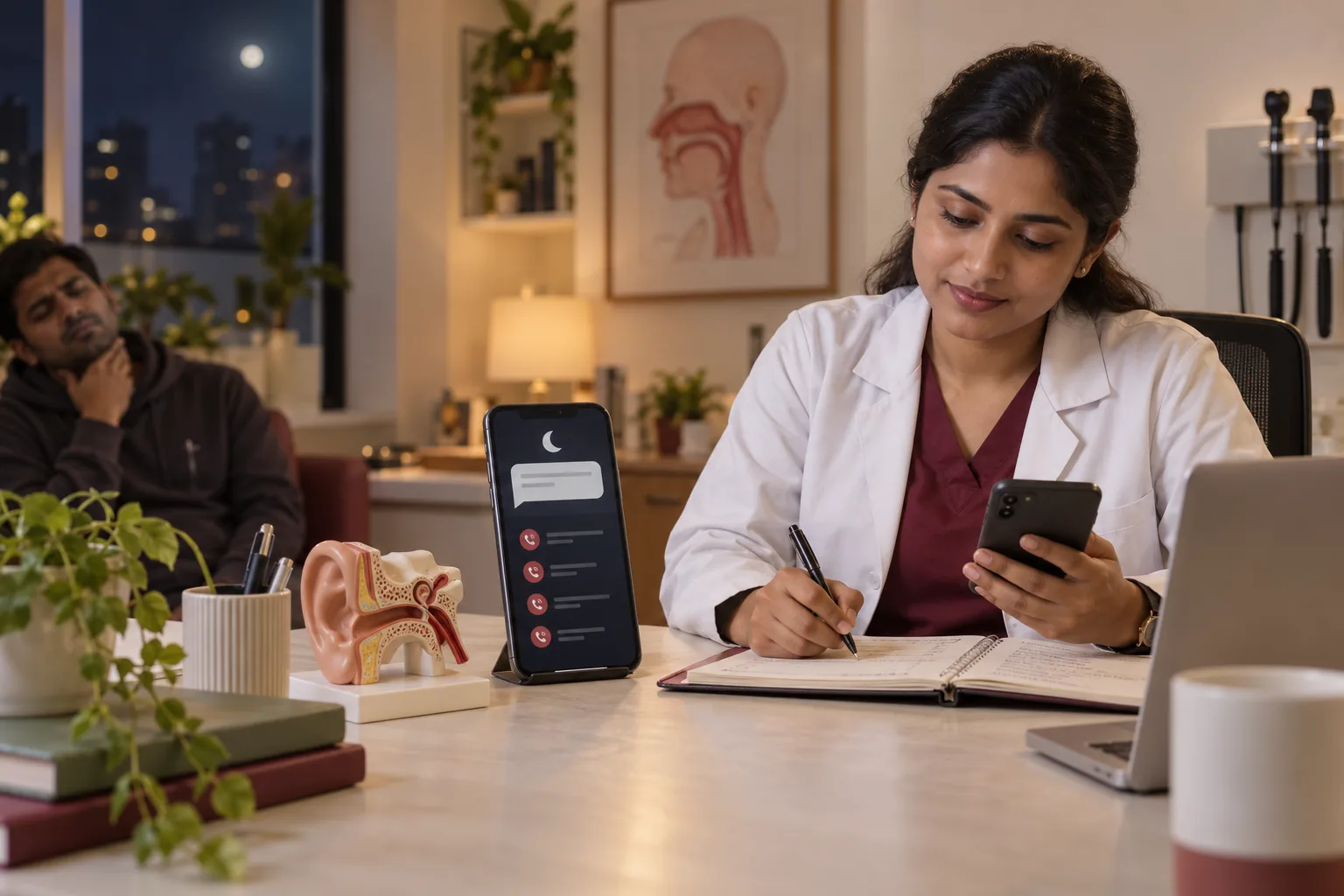
Patients with throat and ear pain search Maps after midnight. An honest automatic reply, correct hours and a missed-call list worked first win the booking.
The GullySales team · Updated 13 Nov 2026 · 7 min read
Rules for this trade differ by state and professional body, and they change. Check the current position with your own council or adviser before you act on anything here.
On this page
- What the midnight searcher actually wants
- Write the automatic reply so it does not practise medicine
- Your hours on Maps are a booking system
- The missed-call list is the morning's first job
- The 2am message and the 9pm message are not the same
- Who reads the number at eight
- What an urgent message looks like
- Language and the family
- What not to promise
- An invented case: the parent at one in the morning
- Reviews that mention the night
- A short routine for the clinic manager
- What to do next
Decide the hour at which somebody opens the phone, put that hour in the automatic reply, and keep to it. Most ENT searches at two in the morning come from a person working out whether to wait until daylight or go to a casualty. They are not asking for treatment over a message. They want to know when you open, where you are, and whether anybody will answer. Give them those three and the booking is yours by breakfast.
What the midnight searcher actually wants
A patient with a throat too sore to swallow is not comparing clinics. They are looking for the first signal that a real practice exists at the other end.
They check three things in about forty seconds. Whether Maps says you are open or closed, and when you open next. Whether the number connects to anything. And whether the last few reviews mention the doctor by name. Then they either book, or keep scrolling, and by seven in the morning the decision is made.
Write the automatic reply so it does not practise medicine
The temptation is to be helpful about the symptom. Resist it. An automatic message that suggests a gargle or a tablet is advice given without an examination, and it is the one thing in this whole routine that can get a practice into trouble.
A reply that works reads something like this:
Thank you for messaging [clinic name]. This number is read from 8am, Monday to Saturday. The clinic is at [address], and consultations run from 9am. For an appointment, reply with the patient's name and age and we will confirm a slot. If you have severe difficulty breathing or swallowing, heavy bleeding, or a swelling that is growing quickly, go to the nearest casualty now.
Short, factual, with one safety line. Rules on what a clinic may publish differ and change, so ask your own council or adviser to read it once before you switch it on.
Your hours on Maps are a booking system
Most of this traffic reaches you through the open now filter, which means the hours field is doing more work than your website.
| What to set on the profile | Why it decides a booking |
|---|---|
| The real opening time, not the time staff arrive | A patient who turns up to a shutter writes the review |
| The lunch closure, as a break rather than a guess | Callers at 2pm are told to try at 4pm instead of giving up |
| Special hours for festivals and the doctor's leave | A clinic shown open on a day it is shut loses the next search too |
| Separate hours for the hearing test room, if it has them | Stops a patient travelling for a test nobody can run that day |
| A WhatsApp number in the profile, not only a landline | The night-time message has somewhere to land |
For example, an ENT practice in Thrissur with a surgeon who operates on two mornings. The details are illustrative. Its profile shows the same hours all week, so patients arrive on operating mornings, wait, and leave annoyed. Splitting the hours by day fixes a complaint that looked like a staffing problem.
The missed-call list is the morning's first job
Every phone keeps a log of calls that were not answered. Almost no clinic reads it.
Print it or open it at 8am, before the first patient. Ring back anything from after closing time, in the order the calls came. Say who you are and offer a slot. A caller who rang four clinics at midnight has not necessarily booked with any of them, because the others are not ringing back either.
Give the job to one named person and write the outcome of each call somewhere another person can read. A missed call with no note is a patient who was lost twice.
The 2am message and the 9pm message are not the same
Sort them as they arrive. The 9pm message is a planned enquiry: a parent asking about a child's repeated ear infections, somebody asking whether the doctor does septum surgery, a patient wanting a Saturday slot. Those need a proper answer in the morning from somebody who can book and quote.
The 2am message is a frightened person. The reply that works names the opening hour and the address, and nothing more.
What does not work at either hour is a chatbot that guesses, a promise to reply in a set number of minutes that nobody has staffed, or an answering machine that takes a message no one plays back. A clinic is better off saying plainly that the number is read from eight.
Who reads the number at eight
A reply that says "read from 8am" binds the clinic to keep that promise. Name the person who opens the inbox, make it the first task of the day, and name a second person who covers when the first is on leave. A promise kept every morning builds a reputation faster than any advertisement.
Give that person a list of what to do in order: read the night's messages, ring back the missed calls, confirm the slots offered, and note anything that looks urgent for the doctor. Tell them what counts as urgent, in words the doctor has approved, and what to do when it appears.
What an urgent message looks like
Some night messages cannot wait for a clinic to open. Difficulty breathing, a swelling in the throat, heavy bleeding from the nose after an injury or a foreign body in a child's airway or ear are matters for a casualty, not a booking. The doctor decides the wording, and the automatic reply states it in a line.
The staff should never decide on their own whether a message is serious. They pass it to the doctor when the clinic opens, and in the meantime the reply has already told the patient what to do. The point of the reply is to protect the patient and the clinic together.
Language and the family
Night messages are sometimes written by a relative on behalf of the patient: an adult child writing for a parent, or a parent writing for a child. Reply in the language the message used, and address the sender. Ask for the patient's name and age in the reply, and book the slot in the patient's name.
If the message is in Kannada, Hindi or Malayalam, answer in that language, even if the clinic's website is in English. A reply the family can read with ease is a reply they trust.
What not to promise
Do not promise that a doctor will call back at a particular time unless the doctor has agreed. Do not say that a condition is minor, or that a treatment will work, or that surgery will be avoided. Do not name a price for a procedure in a message. Rules on what a clinic may say and how patient information is handled differ by council and state and change, so ask your own council or adviser what applies.
Keep images that patients send out of group chats and personal phones, and do not forward them. Say in the reply that the doctor will look at them at the visit.
An invented case: the parent at one in the morning
Take an invented ENT clinic in Mysuru that received a message at one in the morning from a parent whose child had been pulling at an ear since evening. The message asked whether the clinic was open and whether the doctor could see the child.
The automatic reply gave the opening time, the address, the line about breathing and bleeding, and a question: what is the child's age? The parent replied at seven, the receptionist read it at eight, and offered two slots that morning. The parent took the first. The clinic's reply had said nothing about the ear. It had said when somebody would be there. That was the thing the parent needed.
Reviews that mention the night
A patient who messages at night and is answered kindly in the morning may write a review about it. Read your reviews for those words. If patients write that the reply was clear and the clinic open as promised, you have found what to protect. If they write that nobody answered, you have found what to fix.
Reply to each review in your own words, thank the patient, and do not discuss the patient's condition. A reply that mentions anything medical identifies the patient to every reader.
A short routine for the clinic manager
Once the reply and the opening hour are set, the manager has a small job each week: look at the number of night messages, the number answered by nine, the number that became bookings and the number that did not. Write the four numbers on a sheet and compare them over the season. If the first is rising and the third is not, the problem is the reply or the slot. If the second is low, the problem is the morning routine. Four figures are enough, and nobody is promised a result by them.
What to do next
Open your phone's call log tomorrow morning and count the calls after closing time from the past week. That count, multiplied by whatever a first consultation is worth to you, is the price of nobody ringing back. If you want that counted properly, along with how fast your messages are answered and what happens to a family told to consider surgery, tell us what you need and we will read it before we call.
Put the reading to work
Try this with your own records.
List the records your team uses and show how an enquiry becomes an order today. Bring examples of duplicate entries, missing owners, and reports that require manual correction.
How to review the result
Ask the people who will use the CRM to complete a real handover and find the next action without help. Check that the management report can be traced back to individual records.