Payment service providers · Financial services
Get the merchant from signed form to first live payment.
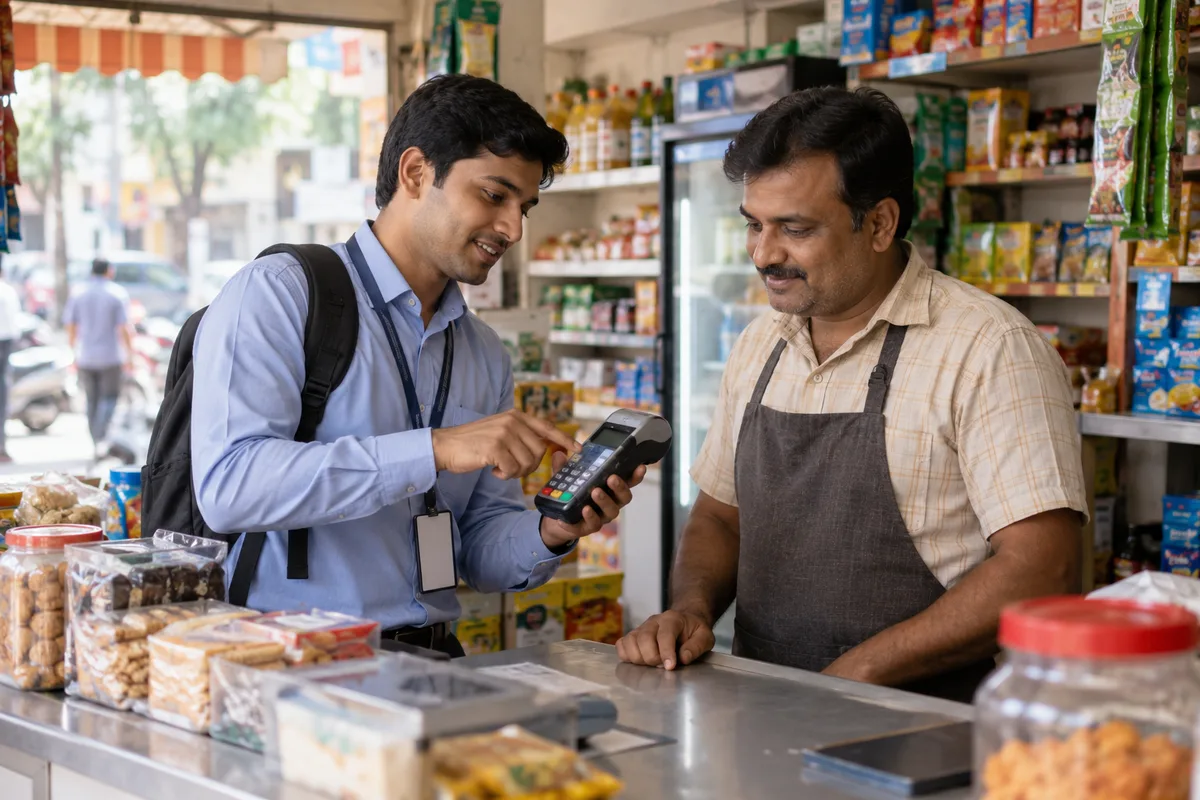
A field executive in Hubballi signs up a garment shop for a QR and soundbox. The owner pays the deposit, the executive photographs the cheque and the shop board, and the forms go to a back office in Mumbai.
Scope, fee, reporting and term are agreed in writing after we have read your brief and spoken to you.
In one paragraph
A payment service provider lets merchants take money by card, UPI, net banking or QR and settles it to their bank account. Marketing finds merchants and developers who need to start taking payments. Sales is the onboarding: documents, integration and the first live transaction. GullySales builds the route and counts merchants who go live.
Nine days later the shop still has a dead soundbox because one document was unclear, and nobody phoned the owner. The neighbouring shops hear about it. The executive loses that sale and the next two.
A payment company sells the same thing to a kirana and to a D2C brand's engineering team, and the two buyers share almost nothing. The shop owner wants money in the account and a person to call. The developer wants documentation, a sandbox and a clear error code. Both leave when the first week goes badly.
Last updated 18 Oct 2026. Rules for this trade differ by state and professional body, and they change. We describe restrictions in general terms, so check the current position with your own council or adviser before you publish anything.
How buyers decide
How payment service providers are chosen.
A small merchant chooses on the person who walks in, the shop next door that already uses the service, and whatever the executive says about settlement at the counter. The deposit and the charge on each transaction get compared, and whoever fixed a failed payment on a busy Saturday is remembered. Brand matters less than a phone number that is answered.
An online business chooses with its developers and finance head. The developer checks the documentation, the sandbox, the plugins for the platform the store runs on, and how failed payments are reported. The finance head asks about settlement timing, reconciliation reports that match the accounting software, and what happens in a dispute.
Both audiences ask whether the provider is authorised by the regulator and who holds the money. A page that answers in plain words earns more trust than any claim about being the fastest.
The problem
What usually goes wrong for payment service providers.
What owners tell us on the first call, in their words.
“Merchants sign up and never go live”
The form is signed and the account is stuck at documents, activation or integration. We pay the field executive for the signup and receive nothing for the stall.
“Our website talks to developers and our buyers are shopkeepers”
The homepage has an API diagram, and the kirana owner who found us on a QR sticker cannot tell what is being sold.
“The field team is stronger than our back office”
Executives sell hard on the shop floor and the activation team takes days to clear a file, so merchants lose faith in the promise.
“We cannot say we are cheaper without losing the margin”
Larger merchants ask for lower charges. Our service is what we offer in return, and it is hard to show on a page.
“Online merchants reach us from a search and abandon the signup form”
The form asks for business documents on the first screen, and a seller who only wanted to try a payment link leaves.
“Support complaints tell us more than our reports do”
Failed settlements and unreconciled payments are repeated on social media long before we see them on a dashboard.
What we do
What we do for payment service providers.
Everything included for payment service providers.
Two sets of pages, one for the shop and one for the developer
A plain-language path for shop and restaurant owners with a phone number, and a documentation-first path for developers with plugin guides, a sandbox and a list of error codes.
An onboarding tracker from signup to first live payment
Each merchant recorded with the stage reached (documents, verification, activation, device delivered, first payment) and the person who owns the next step.
A merchant message routine
A WhatsApp or SMS template for each onboarding stage, a script for the call that clears an unclear document, and a helpline number on every message.
Field team kit
A one-page pitch, a document checklist in the merchant's language, a territory list and a record of calls and signups per executive.
A trust and settlement page
A page that says in plain words who is authorised to hold money, how settlement works, how disputes are handled and who to call, approved by your compliance head.
Sector pages for the merchants you want
Pages for schools collecting fees, clinics taking appointments, restaurants and logistics firms, each in the language of that trade.
Reporting on live merchants
Signups, merchants live and merchants with a transaction in the last stage you define, by source and executive.
How the result is measured
- Signups against merchants live
- Days spent at each onboarding stage, by stage
- Cost per live merchant, by source
- Share of merchants transacting after the first payment
- Developer sandbox signups against integrations completed
- Support calls per hundred live merchants
Recorded as a baseline before work starts, so every later report has an honest comparison.
Every service, written for payment service providers
Each has its own page: what it involves for payment service providers, what you get, and what it is measured on.
- Lead generationFind the merchants who will actually switch on payments and transact.
- SEOBe the answer when a seller searches for a way to take payments online.
- Social media marketingShow shop owners and sellers how payments work before they ever sign up.
- Content marketingPublish what a merchant needs to read before choosing a payment provider.
- Buyer personasKnow who is buying, who is signing and who is blocking the merchant's go-live.
- CRMKeep every merchant's path from enquiry to first payment in one record.
- Follow-up systemsChase the stalled merchant with a reason, not a reminder.
- WhatsApp marketingUse WhatsApp to guide the merchant through documents to the first payment.
- Digital marketingSpend where merchants who go live come from, and stop where they do not.
- WebsiteGive each visitor a page that explains what they can do with your payments.
Worth a page and a campaign of their own
Online payment gateway for websites and apps · UPI QR, soundbox and card machines for shops · Payment links for sellers who take orders on WhatsApp · Recurring collections and mandates · Payouts to vendors and sellers · Reconciliation and settlement reports · Embedded payments for platforms · Cross-border collections · Merchant onboarding and activation
Priority campaigns
Campaigns for what payment service providers most want to sell.
Each one planned around when your buyers decide, and measured against the baseline.
Shop QR and soundbox campaign
Local search, Meta ads and a field push in a few chosen markets, with a clear offer and a number a shopkeeper can call.
Online seller payment link campaign
Content and search ads for Instagram and WhatsApp sellers who take orders by message, with a short signup and a test payment link in the first session, and live payments once the provider's merchant checks are done.
Developer-led campaign
Documentation, sample code, a plugin page for the main store platforms and posts on developer forums.
Sector campaign for fee collection
Outreach to school and college accountants and clinic managers on collecting fees and booking payments, with a demo built on their forms.
Dormant merchant reactivation
A call and WhatsApp message to merchants who signed up and never went live, or who stopped transacting, finding the stuck step and fixing it, whether that is a document, a visit or a settlement account.
Beyond search
Where we reach buyers of payment service providers, beyond Google.
Search matters, but it is rarely the only way this industry's buyers find a supplier.
Field sales and reseller partners
The main channel for shops and restaurants. It works when the executive's promise matches what the back office does.
Google Search
Merchants search for payment gateway, QR code payment and payment link. Developers search for documentation and error codes.
Instagram and WhatsApp seller communities
Small sellers who take orders by message and have no website at all.
Accountants, ERP and billing software vendors
They decide which gateway a business uses and which reconciliation report it expects.
Developer communities
Where an engineer asks a question and gets an answer from a peer who has integrated you.
Who it is for
This is written for these payment service providers.
- Payment aggregators and gateways for online sellers and platforms
- UPI QR, soundbox and card machine providers for shops and restaurants
- Payment link and invoice collection providers for small sellers
- Merchant acquiring resellers and sales partners
- Payout and vendor payment platforms for marketplaces and businesses
- Bill payment and recurring collection providers for fees and subscriptions
- Cross-border payment providers for exporters and freelancers
- Providers that serve a single sector, such as schools, clinics or logistics
Not for
It is not the right fit if.
- You want a guaranteed Google ranking or a guaranteed number of leads. Nobody honest can promise either.
- You need enquiries by next week and have nobody to answer them.
- You want posts and reach reported, not enquiries and orders.
How it works
How the work runs for payment service providers
The work itself, in order. How an engagement starts, from your brief to a written scope, is set out on our method page.
- 1
Trace a merchant from signup to first payment
A sample of merchants is followed through the whole path, with a note of where each waited and why.
- 2
Split the audiences
Shop owner, online seller, developer and finance head each get their own page and their own message.
- 3
Fix the stalls
The tracker, the messages and the helpline are set up so no merchant is left waiting without a reason.
- 4
Run acquisition and field support
Search, social, developer content and field kits, all tied to the same tracker.
- 5
Count merchants who transact
Cost per live merchant is worked out by source and by executive, so spend follows merchants who transact.
Where this fits
Three pieces of sales work, in this order.
GullySales builds every engagement from three pieces of sales work. This page is not one of them, but the same three steps apply to the business behind it.
Step 1
Sales audit
Find where deals are being lost and what to fix first.
Start here if you cannot say where orders are lost.
Step 2
Sales process design
One written way to sell, from first enquiry to repeat order.
Start here if every salesperson sells differently.
Step 3
Sales management
A target, a review routine and someone who owns the number.
Start here if the team has targets and no routine.
FAQ
Questions payment service providers ask before they call.
Not here? More answers, or ask on WhatsApp.
What are we allowed to say about charges, settlement time and approvals?
Can you help our field executives close more merchants?
Is this the same as your page for payment and fintech companies?
We have a good product and poor onboarding. Is that a marketing issue?
Do you create developer documentation?
How long is the contract?
How soon will we see results?
Who will actually do the work?
What do you need from us?
What if we are not happy with the work?
Part of Financial services. See the other industries in the sector.
Your next practical step
Tell us what you are trying to grow, and we will read it before we call.
Eight short steps, mostly taps. Skip anything you would rather answer on the call.