Home cleaning companies · Branding
Look like the company you would trust with your own house keys.
Branding for a home cleaning company means a consistent name and verified staff shown across the listing, website and vehicles, since trust is what a buyer judges first. GullySales sets this once and carries it across your Google listing, uniforms and vehicles, so every touchpoint looks like the same company.
Scope, fee, reporting and term are agreed in writing after we have read your brief and spoken to you.
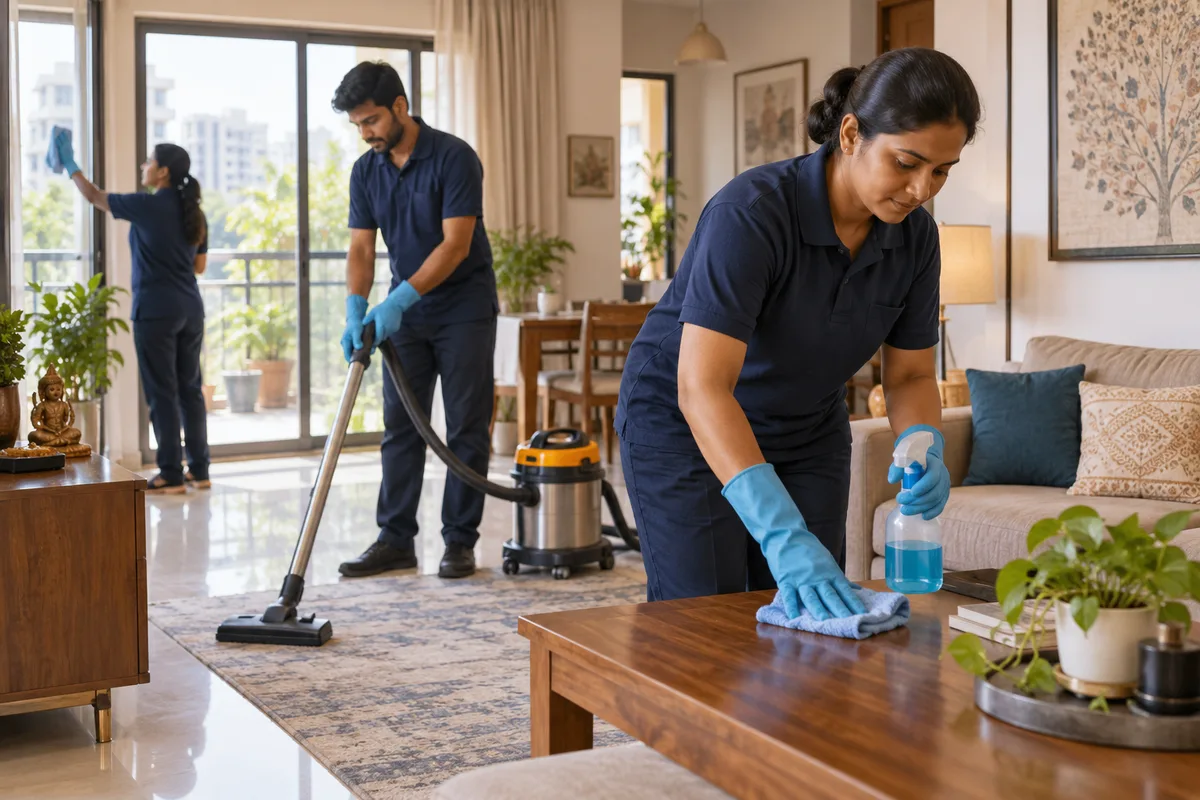
What branding means
Branding is what a customer remembers about your business beyond the product, including your name, colours, tone of voice and what you are known for locally. GullySales sets or corrects this once and applies it consistently across your website, signage and adverts so the business looks like one company everywhere.
Also for home cleaning companies
- Apartment advertising for home cleaning companies
- Buyer journey mapping for home cleaning companies
- Buyer personas for home cleaning companies
- Content marketing for home cleaning companies
- Digital marketing for home cleaning companies
- Lead generation for home cleaning companies
- Paid advertising for home cleaning companies
- Public relations for home cleaning companies
Sales and marketing for home cleaning companies, the overview.
Last updated 8 Nov 2026.
For home cleaning companies
Where it usually goes wrong, and what we would do.
“Uniforms and ID badges do the real work”
A photographed, uniformed team on the listing answers the safety question before a customer has to ask it.
“One service name, not three”
A company known by different names on Google, WhatsApp and invoices reads as less established than it is.
“Vehicles carry the same look”
A branded vehicle parked outside a customer's building reassures a neighbour who might book next.
What we do
What we deliver for home cleaning companies.
Every deliverable, what it covers for you, and the result it is there to produce. Nothing here is an extra.
Verified-staff photo and badge set for the listing
Photographs of uniformed, ID-badged staff prepared for the Google listing, website and quote messages, replacing any stock imagery.
Result: A customer sees exactly who would be entering their home.
One consistent business name across every channel
The same name and spelling checked and corrected across the Google listing, WhatsApp, invoices and vehicles.
Result: The company looks like one established business, not several.
A vehicle and uniform design brief
A simple design brief for vehicle signage and staff uniforms, so both carry the same look as the listing and website.
Result: A neighbour seeing the van recognises the same trusted company.
A brand consistency check across materials
A review of the listing, invoices, uniforms and any printed material, with a written list of where the name or look does not match.
Result: Materials a customer sees reinforce the same company.
Wording for the first quote message
Ready phrasing for the first WhatsApp or call reply, written in a consistent tone that matches the rest of the brand.
Result: A customer hears the same trustworthy company at each step.
How the result is measured
- Recognition in customer feedback
- Consistency across channels
- Repeat enquiries by name
Recorded as a baseline before work starts, so every later report has an honest comparison.
Positioning in one sentence
Fill this sentence in for the company, and the badge, the quote and the van will tell one household who is coming.
- Who it is for, as a home and a moment
- Name the home and the moment: a family moving into a new flat who need a deep clean, a working couple who want regular help, a society that needs common-area cleaning. Each calls at a different time.
- What you clean, in the booking words
- Use the job names people book: deep cleaning, kitchen and bathroom cleaning, sofa and carpet shampooing, move-in cleaning. Add the flat sizes you price by, such as 2 BHK.
- What a household gets that the app and the maid do not
- Choose one: staff with ID and police verification you can show, a checklist signed at the end, the same team returning. Say what you actually do rather than a general promise.
- The proof you can show
- Show uniformed staff photographed with permission, a sample checklist, the products and machines you use, and customers who will take a call. Do not use stock photographs of a team you do not employ.
- Words every cleaning company uses
- Spotless, hygienic and trained professionals appear on every page. Replace one with the checklist, the machine or the product you use for a particular job.
- The name and tagline test
- A name should sound like a firm you let into your home. Check it does not clash with a larger brand, and that the badge, the quote and the Google listing show the same name.
Who it is for
This is written for these home cleaning companies.
- Deep cleaning and one-time service providers
- Recurring home maintenance cleaning companies
- Sofa, carpet and upholstery cleaning specialists
- Move-in and move-out cleaning services
- Office and commercial cleaning contractors
- Society and apartment complex cleaning contracts
- Franchise-model cleaning companies
Not for
It is not the right fit if.
- You have no uniform, identity card or named supervisor yet, so a new logo would sit on a service customers cannot recognise at the door.
- Your problem is that quotes arrive late, and a fresh identity will not make a slow quote faster.
- You plan to change the name while repeat customers still book by the old one, which would make them wonder who is at the gate.
How it works
How the branding work runs
The work itself, in order. How an engagement starts, from your brief to a written scope, is set out on our method page.
- 1
Interview customers and team
We talk to real buyers, won and lost, and to people inside the business who deal with customers daily.
- 2
Review the competitive field
We look at how the nearest competitors present themselves so the position is not accidentally identical.
- 3
Draft the position
A first version of the positioning statement and messaging pillars is written and checked against what customers actually said.
- 4
Test it against real conversations
The draft is tried out in a real sales call or two before it is finalised, since a position that does not survive a real conversation needs rework.
- 5
Hand over the rollout brief
The final position, pillars and not-for list are documented for your team and any agency to apply consistently.
Where this fits
Three pieces of sales work, in this order.
This work sits inside sales process design, at stage 1, prospecting and lead generation. The audit comes before it, and sales management keeps it running.
Step 1
Sales audit
Find where deals are being lost and what to fix first.
Start here if you cannot say where orders are lost.
Step 2 · you are here
Sales process design
One written way to sell, from first enquiry to repeat order.
Start here if every salesperson sells differently.
Step 3
Sales management
A target, a review routine and someone who owns the number.
Start here if the team has targets and no routine.
FAQ
Questions owners ask before they call.
Not here? More answers, or ask on WhatsApp.
Do we need a logo redesign?
How does branding help with trust?
Should staff wear branded uniforms and ID cards?
Should we name the person who will come to the home?
How much does it cost?
How long is the contract?
How soon will we see results?
What do you need from us?
What if we are not happy with the work?
From the blog
Further reading for home cleaning companies.
 7 min read · 21 Sept 2026How to advertise to startup employeesThere is no tech park to buy. A forty person company sits above a bakery, so the audience is the neighbourhood, the delivery app and the coworking floor.
 7 min read · 21 Sept 2026How to advertise to apartment residentsGetting to apartment residents is a permission problem before it is a media problem. Learn who holds the gate, what the association will agree to, and what gets you banned.
 5 min read · 24 Apr 2026Before-and-after photos as proof: how to take and use themHow a home service firm can shoot matching before-and-after photos on every job, caption them, get the customer's permission and turn each one into proof that a stranger will believe.
More for home cleaning companies
Everything else we would do for you.
Or start from the overview: sales and marketing for home cleaning companies.
Your next practical step
Tell us what you are trying to grow, and we will read it before we call.
Eight short steps, mostly taps. Skip anything you would rather answer on the call.