Locksmiths · Sales training
Train technicians to quote clearly and offer the upgrade naturally.
Sales training for a locksmith teaches technicians to confirm arrival time, quote clearly on site, and mention a relevant upgrade once, without turning a visit into a pitch.
Scope, fee, reporting and term are agreed in writing after we have read your brief and spoken to you.
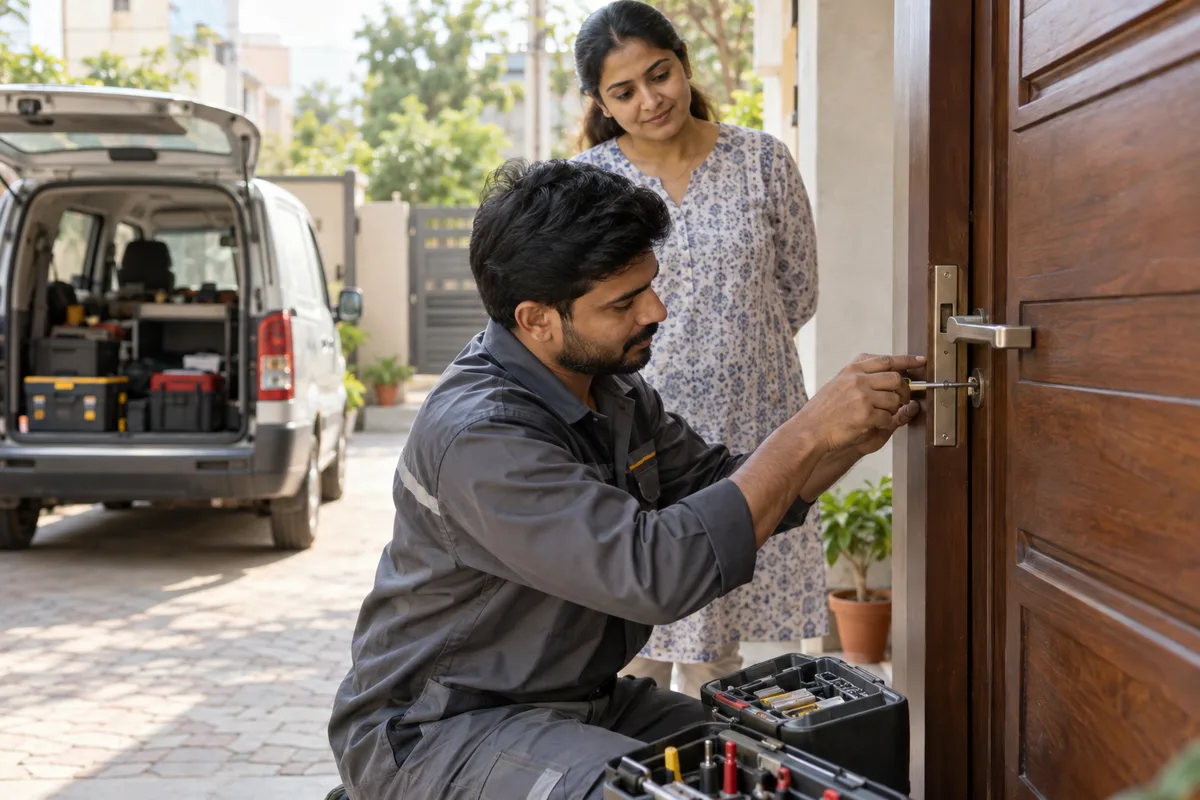
What sales training means
Sales training teaches a sales team a skill it does not yet have, such as handling a specific objection or running a proper site visit, usually through a structured session. GullySales runs these sessions around real objections and calls from your business rather than generic sales theory.
Last updated 14 Nov 2026.
For locksmiths
Where it usually goes wrong, and what we would do.
“Calm communication matters more than a script”
A stressed customer responds better to a confident, simple explanation than a rehearsed sales pitch.
“The upgrade mention is trained to be brief”
One sentence about a digital lock, offered once, reads as helpful rather than pushy.
“On-site quoting is trained as a fixed habit”
Stating cost before starting work, every time, prevents the disputes that damage reviews.
What we do
What we deliver for locksmiths.
The work available for this need. We agree the deliverables and responsibilities for your engagement in writing.
A calm-communication training session
A short session on speaking clearly and confidently with a stressed customer, without relying on a rehearsed sales script.
Result: A panicked customer feels reassured rather than sold to.
A one-sentence upgrade mention, trained as a habit
Practice delivering a single, brief upgrade mention after every emergency job, so it becomes routine rather than forced.
Result: The upgrade gets offered consistently without sounding like a pitch.
On-site quoting practice with real scenarios
Training that walks technicians through stating cost clearly before starting work, using real job scenarios from past disputes.
Result: Technicians quote the same clear way, every visit.
A feedback review a few weeks after training
A short check-in on real jobs a few weeks after training, to see whether the quoting and upgrade habits are actually being used.
Result: Training turns into a habit instead of fading after the session.
How the result is measured
- Skill assessment scores
- Objection handling improvement
- Conversion rate after training
Recorded as a baseline before work starts, so every later report has an honest comparison.
Situations to practise
Six call-out conversations a locksmith should practise, and what good looks like.
- A lockout call at night
- Ask location, door type (wooden, UPVC or metal gate) and who is locked out. Give a price range and what adds to it before leaving. Practise confirming it on WhatsApp.
- The price on arrival is different from the phone price
- Explain what is different before touching the lock, and get a yes on the new price. Practise this so it is never raised for the first time at the door.
- The customer is nervous about a stranger at the door
- Share your name, ID and vehicle before arriving, and ask for proof of residence before opening. Practise saying why, so it sounds like care and not suspicion.
- The upgrade mention
- After the job, say one sentence, such as the cylinder is worn and a higher-grade lock would last longer, then leave a card. Practise it as one line and stop.
- A car key duplication or transponder enquiry
- Ask make, model, year and key type, and what proof of ownership you will need. Practise saying what you can and cannot programme before travelling.
- A society secretary asks about a yearly contract
- Ask number of flats, doors and common areas. Offer a site visit before the quote. Practise a formal, written reply in place of a phone price.
Who it is for
This is written for these locksmiths.
- Emergency and 24-hour locksmiths
- Automotive locksmiths and key programming specialists
- Residential lock and security installers
- Commercial and office locksmith services
- Safe installation and repair specialists
- Smart lock and digital security installers
- Society and RWA-contracted locksmiths
Before you decide
When this may not be the right fit.
- Your technicians have no agreed price list, so training on how to quote would teach them to explain figures that differ.
- You have a single technician who is the owner, and the training would be a note to self.
- You plan to train technicians to sell upgrades before the lockout is solved, which makes a panicked customer feel pressed.
Before you decide
Agree the work. Know how to judge it.
Sales training for locksmiths: use these checks to prepare, choose the scope, and review what changes.
Bring the right evidence
Bring real questions, objections, and call examples that the team finds difficult. Agree which selling behaviour needs to change and how it will be observed at work.
Make the scope clear
Choose the roles and situations to practise. Separate a training session from coaching, manager follow-up, and any scripts or reference material to be produced.
Check the work in use
Use a realistic practice conversation, then review the same skill in live work with appropriate permission. Look for a change in behaviour before attributing a sales result to training.
Know when to change course
If the problem is an unclear offer, missing product knowledge, or no permission to make a decision, fix that first. A communication workshop cannot remove those barriers.
These are discussion points, not a fixed package. GullySales confirms the deliverables, responsibilities, fee, and term in writing after reading your brief and speaking with you.
Before we start
What to have ready before the work starts.
The records, access and decisions this work needs from locksmiths. Anything missing is noted in the written scope, with who will supply it.
- Every technician in the room
- Training aimed at the owner alone changes nothing at the door. Each person who visits customers must attend. If one cannot, we run the session again for them.
- Real scenarios from your own jobs
- The practice rounds use true cases: a price quarrel, a refused quote, a nervous caller. Write down three or four, without names. Without them we invent scenarios that do not fit your town. Two of the scenarios should involve the owner's own mistakes, because staff learn faster when the person who trains them is also practising.
- A quiet place and a phone to role-play
- Practice works best where nobody interrupts. A shop room or a parked van will do. A phone lets us practise the call lines as they sound. If neither is available, the session shrinks.
- Agreement on the price and upgrade policy
- Technicians cannot practise a quote they do not understand. You must tell them what they may charge and offer. If you have not decided, we settle it with you before the session. We write the agreed limits on the card, such as the highest discount a technician may give at the door, so nobody has to ring the owner mid-job.
- Your own willingness to be coached
- The owner is part of the practice. If the owner answers calls differently from the card, the team follows the owner. Be ready to take the same turn as the technicians.
How it works
How the sales training work runs
The work itself, in order. How an engagement starts, from your brief to a written scope, is set out on our method page.
- 1
Watch a technician work a job
We begin by joining one technician on an ordinary job, or listening to their account of it. You tell us who is the best at calm talk at the door. We note how they arrive, speak and quote. Their habits become the model for training. If a technician is wary of being watched, we ask them to describe a recent job aloud instead, and we listen for the words they use to calm a customer.
- 2
Run the calm-communication session
In a short session we practise what to say to a frightened person locked out: slow voice, plain words, a clear next step. You and the technicians take turns as caller and responder. We stop to name what worked, and you pick the lines to keep. We also practise the case where the customer is angry at being locked out and blames the technician for the delay, since the first minute sets the tone for the whole job.
- 3
Practise the quote at a real door
We act out quoting on site with scenarios from your own jobs: a high price for a damaged lock, a customer who says it was cheaper elsewhere. The technicians practise stating the price, the cause and the choice. You judge which wording sounds honest. We also practise saying no politely to a request to open a door that the customer cannot show is theirs, and recording what was asked.
- 4
Train the one-sentence upgrade mention
Each technician learns a single sentence that suggests a stronger lock after a job. They practise saying it once and stopping. You decide the cases where it must be left unsaid. Each technician also learns to read when the customer has no interest, such as a short answer or a glance at the phone, and to leave the mention unmade.
- 5
Give each technician a pocket card
We put the calm lines, the quote order and the upgrade sentence on a card each technician keeps. You and we check the card against what was practised, and cut what nobody used. We check that the card fits in the pocket of the work shirt and that the type can be read in poor light.
- 6
Review jobs after the training
Some time after the session, we read the job notes and call record against the figures from before. We look at disputes, accepted upgrades and conversions. You and each technician talk about what is working and what slipped.
Where this fits
Three pieces of sales work, in this order.
This work sits inside sales management. A target, a review routine and someone who owns the number.
Step 1
Sales audit
Find where deals are being lost and what to fix first.
Start here if you cannot say where orders are lost.
Step 2
Sales process design
One written way to sell, from first enquiry to repeat order.
Start here if every salesperson sells differently.
Step 3 · you are here
Sales management
A target, a review routine and someone who owns the number.
Start here if the team has targets and no routine.
FAQ
Questions owners ask before they call.
Not here? More answers, or ask on WhatsApp.
Who needs this training?
How long does this take to embed?
We are a two-person team. Can we practise without a trainer?
How do technicians give a higher price without sounding like cheats?
How do technicians state a higher price without sounding like cheats?
Can the owner train the team without us afterwards?
How long is the contract?
Who will actually do the work?
What do you need from us?
What if we are not happy with the work?
More for locksmiths
Related work to consider.
Closest to this: sales craft
Also for locksmiths
Or start from the overview: sales and marketing for locksmiths.
Your next practical step
Tell us what you are trying to grow, and we will read it before we call.
Eight short steps, mostly taps. Skip anything you would rather answer on the call.