Manufacturing · Plastics, rubber, packaging and print
Everyone in town has a printing press, so why would a buyer call yours?
A print buyer asks three printers for a rate and picks the lowest. That is the usual story, and it is true for the jobs where the three printers look the same. The way out is to be the printer who is obviously right for one kind of job: the label for a bottling line, the monthly catalogue, the pharmacy carton, the paper bag for a garment chain.
Scope, fee, reporting and term are agreed in writing after we have read your brief and spoken to you.
In one paragraph
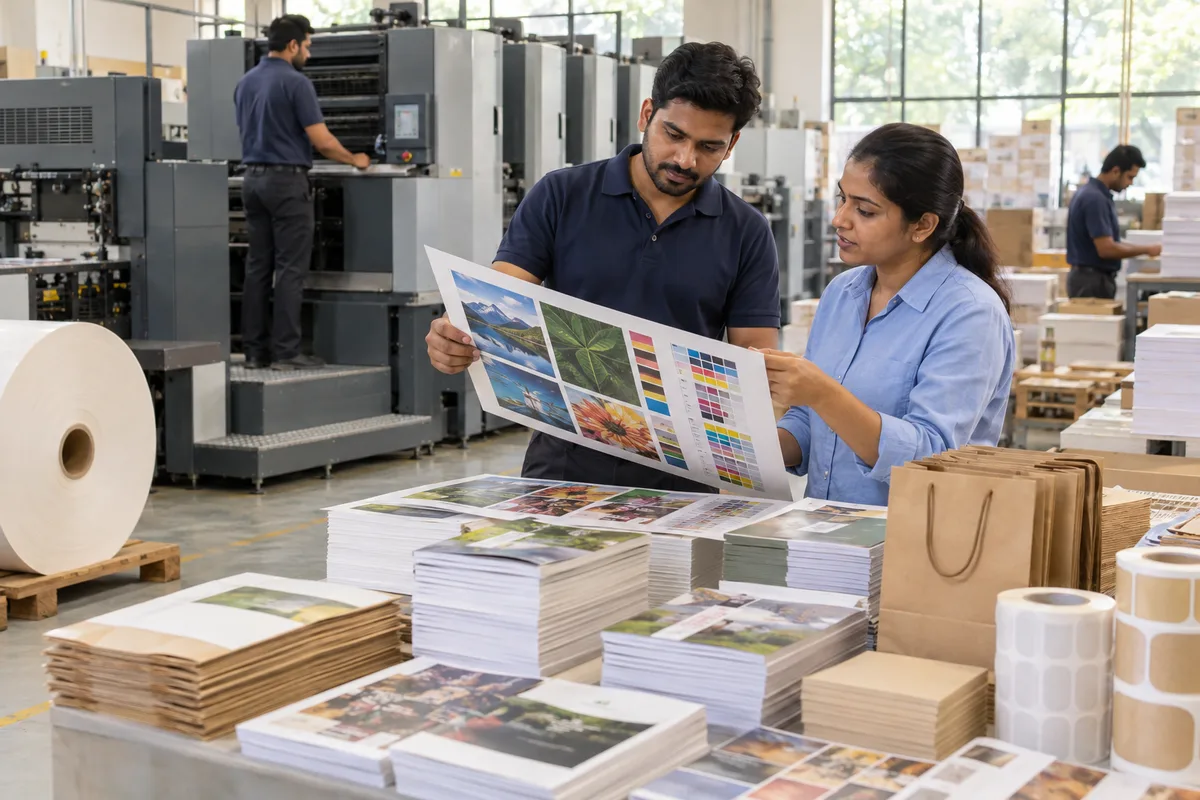
Paper and printing manufacturing covers makers of paper products, labels, bags and stationery stock, and the presses that print for businesses, brands and institutions. GullySales helps the printer or converter be found for the jobs it does best, answer every job enquiry with a proper quotation and win the repeat order.
Most shops are in the opposite position. The website lists offset, digital, flex and screen, visiting cards and wedding cards, and says nothing about who buys and why. Enquiries arrive from every direction, most are small, and the good repeat accounts are kept alive by one person's phone calls.
Print is a repeat business, which makes it a follow-up business. The brand that ordered labels last year needs them again, and the school that ordered notebooks needs them before the new session. Somebody has to remember.
Last updated 16 Oct 2026.
7 types of work
Each kind of paper & printing is bought differently, so each has its own page.
Open the one that matches what you make. It covers who buys it, where the order is lost and what we would do.
 Paper ProductsWe make the paper, but our buyers only ever phone about the price per kilo.
- Commercial PrintingWe print for half the businesses on this road and still wait for the phone to ring.
- Labels & StickersBrand owners reorder labels all year, and we hear about it when they have already switched.
- Offset PrintingOur press runs best on long jobs, but the enquiries are for two hundred copies.
- Digital PrintingCustomers want fifty copies by evening, and we cannot charge for that.
- Industrial PrintingWe print on things that are not paper, and no one knows to look for us.
- Paper BagsShops are moving away from plastic bags, and we are not the name they call.
Who it is for
This is written for you if paper & printing is what you make or sell.
- Commercial and offset presses wanting more repeat business from companies and institutions
- Label and sticker printers serving food, pharma, chemical and consumer brands
- Digital print shops handling short runs, variable data and quick jobs
- Paper bag, notebook and paper-product makers selling to retailers and wholesalers
- Industrial printers who print on plastics, metal, glass or packaging for manufacturers
Not for
It is not the right fit if.
- A press that wants only walk-in street trade for visiting cards and flex. Local presence matters more than marketing.
- A shop that cannot hold a delivery date it promises. Marketing brings the buyer once, and the late job ends the account.
- A printer wanting a pure online ordering shop with automatic pricing. That is a different build.
How buyers choose
What decides who wins in paper & printing.
Rate comparison on three quotations
A company buyer collects quotations from several printers for a job with a defined size, paper and quantity. The reply that is complete and quick usually gets a second look before price is compared.
Samples and proofs
A buyer asks for printed samples and signs off a proof before the run. Print quality is judged by hand, which is why sample packs travel.
Colour and finish matching
Brand owners care about colour consistency across reorders. A printer who can show how they match and hold a colour is trusted with the repeat.
Delivery date and repeat supply
Print is bought against a date: the launch, the exam, the festival. A printer is judged on whether the job arrived when promised.
Where orders are lost
What usually goes wrong when you sell paper & printing.
In the words owners use on the first call.
“We get enquiries only for the cheapest jobs”
A generic page draws generic buyers. A page for one product, with the stock, the sizes and the finishing options, draws buyers who know what they want.
“They ask for a rate and then go quiet”
Most print enquiries are rate requests. If the reply is a one-line price on WhatsApp, the buyer has nothing to compare except the number.
“Our best customers are never called”
The repeat accounts order when they remember. A printer who calls before the reorder is due wins it more often than one who waits.
“Our work looks the same as everyone's”
Photographs of printed work, shot properly, with the paper, the finish and the run size beside each, show what a rate card cannot.
The scope
The work we would propose for paper & printing.
Measured on qualified enquiries, quotation requests, follow-up on each quotation, trial orders won and repeat orders. Anything here that needs a platform, directory or tool we have not used with you is confirmed with you before it goes in the scope.
- A page for each job typeCatalogues, labels, cartons, notebooks, paper bags, each with sizes, stock, finishes and run sizes you handle.
- Photographs of the workPrinted work shot well, with the stock and the finish named, and a short video of the press and the finishing room.
- Local and trade searchGoogle Business Profile and pages for the areas and the industrial estates you serve.
- Quotation follow-upEvery rate request logged, quoted properly and called back.
- Reorder reminders for repeat accountsA list of customers with the last order date and the date they usually reorder, so the call comes before the competitor's.
- Sample packs and cataloguesA sample pack designed for a buyer to hold, with paper swatches and finishes labelled.
What we do
What you get for paper & printing.
Each deliverable and what it is there to change.
A job-type page set
One page for each product, with a way to ask for a quotation with size, stock and quantity.
A sample pack
A physical set of printed examples with stock and finish noted, sent to buyers before a quote is accepted.
A quotation template that explains the rate
Shows size, stock, colours, finish, quantity and delivery date, so the buyer compares like with like.
A reorder calendar for repeat accounts
Shows which customer is due, for what job, so a call goes out before they look elsewhere.
A Google Business Profile with work photographs
Makes the press visible to businesses searching within a few kilometres.
How the result is measured
- Qualified enquiries by job type
- Quotation requests and quotations sent
- Follow-up on each quotation
- Sample packs requested
- Trial orders won
- Repeat orders and reorder calls made
Recorded as a baseline before work starts, so every later report has an honest comparison.
How it works
From your first message to the first report.
No open-ended retainer. Every step gives you something in writing.
First
Your brief
You tell us what you need in a few short steps: your business, what you want, where enquiries come from and how they are handled.
After the brief
A conversation and a written scope
We read it, then talk with whoever handles your enquiries. If you want our help, the scope, the fee and the reporting come in writing, and nothing starts before you have read them.
Before work starts
Baseline recorded
The numbers this work is meant to move, such as enquiries, quotations, orders, visits or renewals, written down so every later report has an honest comparison.
After the baseline
The first fix goes live
The fix we agreed to start with is put in place and measured against the baseline, whether that is a reply, a follow-up, a page, a listing or the handover between marketing and sales.
As agreed
Report against the baseline
What moved, what did not, and what changes next, in plain words. How often you get it is set in writing before work starts.
At renewal
Renew on the numbers
The term ends and you decide whether to continue from the results. The length is agreed in writing before anything starts.
What the work involves for paper & printing
- 1
Read the shop
We look at your machines, finishing, past jobs and the customers who reorder, to see which job you win.
- 2
Pick the jobs to push
One or two kinds of work are chosen to lead with, based on margin, machine fit and repeat potential.
- 3
Show the work
Job pages, photographs, a sample pack and a business profile that match the jobs chosen.
- 4
Answer every rate request properly
A quotation template, a reply routine and a record of every enquiry and what happened.
- 5
Call the repeat accounts
A reorder calendar and a short call plan for customers due or gone quiet.
What we need from you
What to have ready before we talk.
None of it has to be tidy. We read what you have.
- Your website link and Google Business Profile
- Photographs or physical samples of recent jobs
- A list of repeat customers with last order dates
- Recent rate requests, won and lost
- Machine list with sheet sizes and finishing equipment
Export and new regions
Selling paper & printing beyond your home market.
Where you sell decides standards, documents, payment terms and freight. We work from Bengaluru and have no overseas office, so for a new region we start from your own enquiries, your existing buyers and the directories you already use.
Print buyers outside India
Importers, publishers and brands abroad outsource books, labels and packaging print to India. Start with export buyers you already serve.
Proofs, colour and samples across borders
Overseas buyers sign off on colour. Agree whether the proof is digital or physical, and who pays courier.
Payment terms and freight
Printed goods are heavy and paper is sensitive to damp. Quote freight and packing clearly and state payment terms before the job.
FAQ
Questions about selling paper & printing.
Not here? More answers, or ask on WhatsApp.
How can a printing press stand out when price is all buyers ask about?
Is IndiaMART worth it for a printer?
Should we put prices on the site?
How do we win back customers who stopped ordering?
How long is the contract?
How soon will we see results?
Who will actually do the work?
What do you need from us?
Makers of paper & printing also need
Looking for the wider industry page? See printing businesses.
This page is part of the manufacturing section. The hub also lists every manufacturing industry we write for.
Why us
Why owners pick GullySales over an agency.
Marketing and sales, as one job
Most agencies stop at the enquiry. We also fix what happens after it: the reply, the follow-up, the quote and the CRM.
The person on the first call does the work
No account managers in between. You are never handed to someone you have not met.
A baseline before anything starts
Your numbers are written down on day one, so every later report compares against something honest.
The fee in writing, split three ways
Our time, your media spend and production on separate lines. You always see what goes to us.
No guarantees we cannot keep
The term is agreed in writing and never a default twelve months. We never promise a ranking or a lead count, because nobody controls those.
One office, and we say so
Nagarbhavi, Bengaluru. We work across India by call and WhatsApp and travel when a session needs to be in person.
#257, 3rd floor, Sri Nanjundeshwara Complex, Nagarbhavi 8th Block, Outer Ring Road. How we work.
Engagement options
Ways to work with us.
Pick the size of commitment that fits. Every option starts with your brief and a conversation.
Option 1
The conversation on its own
A call after you send your brief. It says honestly whether you need outside help, and many fixes are ones your own team can make.
Option 2
One fix, scoped
Start with the fix that matters most, such as reply time or follow-up. The fee is in writing before anything starts.
Option 3
An ongoing programme
We run the work, report against the baseline, and you renew on the numbers. The term and the reporting are agreed in writing first.
Option 4
Guidance for your own team or agency
We plan, brief and check the work of your in-house team or current agency, instead of replacing them.
Your brief
Tell us what you need, and we will read it before we call.
Eight short steps about your business, what you want and who decides. Most questions are a tap, and you can skip any you would rather answer on the call.
Your next practical step
Tell us what you are trying to grow, and we will read it before we call.
Eight short steps, mostly taps. Skip anything you would rather answer on the call.