Food processing companies · Manufacturing
The bulk buyer asks for samples, certificates and a plant visit before placing a first order.
A buyer at a sauce brand in Pune types “tomato paste supplier” into Google, opens four websites and sends the same message to all of them on WhatsApp: price per kilo, brix level, pack size, can you send a sample.
Scope, fee, reporting and term are agreed in writing after we have read your brief and spoken to you.
In one paragraph
A food processing company turns raw produce such as fruit, vegetables, grain, spices or milk into pulp, powder, paste, flour or cut and packed ingredients, mostly for other businesses to buy. GullySales helps processors get found by brands, exporters and institutional kitchens, answer sample and price enquiries properly, and follow each buyer through trials to a repeat order.
The processor in Chittoor who answers first, with a spec sheet and the FSSAI licence number attached, is the one the buyer writes back to. A reply three days later that says “call me” answers a message the buyer has stopped thinking about.
A food processing unit can end up selling the way it started: the owner knows a few buyers, a broker brings the rest, and prices are settled on the phone. That holds while the raw material is cheap. When a big buyer drops out, or a mango pulp season ends with a godown full of stock, the unit has no other door to knock on, because none has been built.
Last updated 13 Nov 2026.
How buyers decide
How food processing companies are chosen.
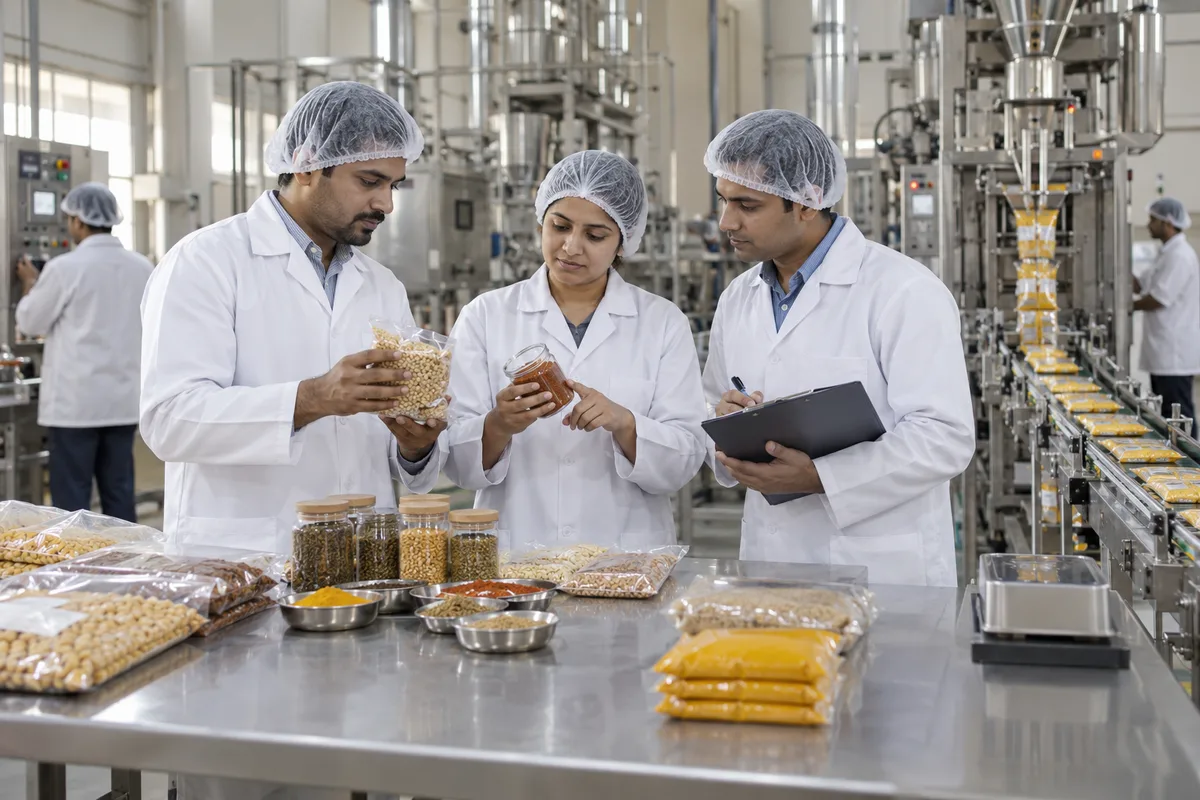
A processing unit is chosen by the buyer's quality team before the purchase manager gets a say. They ask for the FSSAI licence, a sample, a spec sheet, a certificate of analysis and a visit to the plant. Brands that sell onward want to know about cold storage, farm-lot traceability and the handling of a recall, and a plant with all of this in one folder reaches the trial first.
Price matters. Consistency matters more. One batch with a different colour or moisture level is hard for a buyer to forget. So the second order, not the first, is where the sale is actually won, and it depends on whether the buyer got the same product again and was told in advance when raw material was running short.
The calendar rules the business. Mango pulp, tamarind, green chilli, onion and tomato all have a season when the farm gate price is low and the unit must buy and process quickly. Selling the processed stock across the rest of the year is the real task, and it is the one most units leave to chance.
The problem
What usually goes wrong for food processing companies.
Common situations to check against your own enquiry records.
“Sample requests arrive and then go quiet”
We send a one-kilo sample by courier, the buyer says it looks good, and then we never hear back or learn why.
“We depend on two or three big buyers”
If one of them shifts to another supplier or delays payment, the plant runs half empty for months.
“Brokers hold the buyer relationships”
Our brokers know who buys what, we do not, and a buyer we served for years can leave with the broker.
“Season stock sits unsold”
We process well in the season, then carry pulp or powder for months with no list of buyers to offer it to.
“Buyers ask for documents we cannot find quickly”
Spec sheets, test reports and licence copies sit in different phones and folders, and the buyer moves on while we search.
“Export and brand enquiries do not turn into orders”
People write from other states and countries asking for private label or bulk quantities, and we have no clear way to price, qualify or follow them up.
What we do
What we do for food processing companies.
Possible deliverables for food processing companies. Your written scope confirms what is included.
A buyer pack for every product
One document per product with the specification, packing options, shelf life, storage conditions, licence details and a photograph of the unit, written so a purchase manager can forward it inside their company.
Product and buyer-type pages on your website
Separate pages for tomato paste, mango pulp or spice blends, and for what each type of buyer needs from them, such as a caterer, a brand or an exporter.
A sample-to-order register
A record of every sample sent, with the call to be made, the questions to ask about the trial and a note of the reason when a buyer says no.
IndiaMART and marketplace enquiry handling
Listings rewritten with specifications and pack sizes, and a script for the first reply that asks quantity, destination and use before quoting.
A private label and co-packing proposal
A short document that explains what you can make under another brand, minimum batch sizes you decide, packaging options and what the buyer must supply.
Buyer contact lists by segment
Lists of brands, caterers, bakeries, exporters and distributors in your region and beyond, built from public sources and your own records.
How the result is measured
- Enquiries by source and by product
- Samples sent against samples that became trial orders
- Reply time to marketplace and website enquiries
- Repeat orders from buyers who started in the last year
- Share of sales from the biggest three buyers
- Off-season stock sold against stock carried
Recorded as a baseline before work starts, so every later report has an honest comparison.
Every service, written for food processing companies
Each has its own page: what it involves for food processing companies, what you get, and what it is measured on.
- Lead generationFind the brands, caterers and exporters who buy your pulp, paste or powder in bulk.
- SEOBe the supplier a buyer finds when they search for the exact ingredient they need.
- Social media marketingShow buyers the plant behind the product on the platforms where they check you out.
- Content marketingWrite the pages and guides a quality team reads before they ask for a sample.
- Buyer personasKnow who inside the buyer's company asks, tests and signs for your ingredient.
- CRMKeep every buyer, sample and quote in one record that does not live in one phone.
- Follow-up systemsCall back after the sample, the quote and the first order, so buyers do not go quiet.
- WhatsApp marketingAnswer price, sample and specification requests on the app buyers actually use.
- Digital marketingPut search, listings, social pages and outreach to work for a bulk ingredient business.
- WebsiteGive a buyer's quality team the proof they look for in one clear place.
- Industry researchRead the buyer's sector before you quote a processed ingredient into it.
Worth a page and a campaign of their own
Buyer-ready documents: spec sheet, certificate of analysis, licence copies · A sample request routine that ends in a follow-up call · Pages for each product and each type of buyer · IndiaMART and marketplace enquiries answered quickly, with the right questions asked first · Private label and co-packing enquiries qualified before they reach the owner · A plan to sell off-season stock to a named list of buyers · Reaching purchase managers at brands, caterers and exporters directly · Overseas importer introductions that lead with the documents they check
Priority campaigns
Campaigns for what food processing companies most want to sell.
Each one planned around when your buyers decide, and measured against the baseline.
Season-end stock campaign
Before the season closes, a call and WhatsApp push to buyers who used your product in the past, with the current pack sizes and a note on how long the stock can be held.
Private label launch drive
Outreach to new food start-ups and regional brands that outsource manufacture, with the co-packing proposal and an offer to talk through a first trial batch.
Caterer and institutional kitchen outreach
A routine for reaching central kitchens, hostel and canteen contractors and large caterers with cut vegetables, flour or spice packs, supported by a sample day.
Export buyer response
A set of replies in clear English for overseas enquiries, with the documents an importer expects, and a checklist of what to confirm before sending a quote.
Win-back for lapsed buyers
A call list of buyers who ordered once or twice and stopped, with a short message asking what changed and whether anything went wrong with a batch.
Beyond search
Where we reach buyers of food processing companies, beyond Google.
Search matters, but it is rarely the only way this industry's buyers find a supplier.
Brand purchase and quality teams
Food brands and private label owners that use your ingredient are listed with their purchase and quality contacts, and the introduction leads with documents rather than a price.
Caterers, hotels and central kitchens
A kitchen that cooks in bulk buys on consistency, so the pack and the sample day are built around the same batch repeating.
Exporters and merchant traders
A merchant exporter sourcing your product already runs its own supplier checks, and the introduction is written to meet them.
Start-up food brands looking for a manufacturer
A founder needing a plant for first batches searches for contract manufacturing, so a page for that search sits beside direct outreach.
Distributors and wholesalers
Wholesalers who repack for retail want a rate sheet by pack size and the credit terms you set.
A practical starting point · Food processing companies
Start with one buying journey.
Use a real enquiry to find the first useful change. You do not need to buy every service listed on this page.
- The record to review
- Start with a recent RFQ and the quotation it produced. Remove buyer identifiers, then retain the specification, quantity, delivery requirement, and reason the order moved forward or stopped.
- The buyer's question
- Check whether the buyer can establish technical fit before asking for a price. Purchasing, engineering, and the end user may need different evidence from the same product page.
- The handover to agree
- Give the technical question to someone who can answer it, and keep the commercial follow-up with a named owner. A vague request for a catalogue should not be treated as a qualified RFQ.
Who it is for
This is written for these food processing companies.
- Fruit pulp and puree processors for juice, ice cream and bakery buyers
- Tomato, chilli and vegetable paste and sauce base processors
- Spice grinding and blending units supplying brands and caterers
- Dehydrated onion, garlic and vegetable powder makers
- Cut, washed and packed vegetable suppliers to hotels and quick commerce
- Pulse milling and grain cleaning units selling to brands and wholesalers
- Cashew, groundnut and dry fruit processors
- Contract processors and co-packers who make products under another brand
Not for
It is not the right fit if.
- You want a guaranteed Google ranking or a guaranteed number of leads. Nobody honest can promise either.
- You need enquiries by next week and have nobody to answer them.
- You want posts and reach reported, not enquiries and orders.
How it works
How the work runs for food processing companies
The work itself, in order. How an engagement starts, from your brief to a written scope, is set out on our method page.
- 1
Look at your orders
We go through your last year of sales by buyer and product, find out where enquiries come from and how many samples became orders, and note which documents buyers ask for.
- 2
Put the buyer pack in order
Specs, test reports and licence copies are collected, checked by your quality person and made into a pack that can be sent in one message.
- 3
Build pages and listings
Product pages, buyer-type pages and rewritten marketplace listings go up, each with the details a quality team looks for.
- 4
Set the follow-up routine
Every enquiry and sample is recorded, with a named person who calls back and a note of the outcome.
- 5
Reach new buyers and read the results
Outreach starts to the segments you choose, and the record shows which source gave samples, trials and orders so effort moves to what is working.
Proof
Published examples of our work.
Each example names the client and the work delivered. Some examples come from related industries; use them to assess the method, not to predict your results.
SB Engineering
- Situation
- Buyers searching for laser cutting and sheet metal work in Bengaluru were finding other suppliers first, because the company did not rank for the terms its own customers type.
- What we did
- The site redesigned for mobile
- Search work on the buyer's terms
- Content that shows the work
- Social channels managed
- Result
- Website traffic rose 60% within six months, against a target of 50%.
- High-quality leads rose 45%, with a rise in conversion rates alongside them.
- Fifteen target keywords moved up the rankings, five of them into the top three positions.
Also worked with
Chord Road Hospital · Curtain Label · Difesa Security Services · Felicity Inn · Hands On CSR · Implevista · Kambar Group · Kalessi · Kerur Pain Clinic · LL Trust · Lucky Deals · Natural Gases · NavaShakthi Souhardha · NewCom Logistics · Proton Technical Services · Shakthi Foundation · Shakthi Group · Urbanest · Insyde Studio · Venkateshwara Laser Tech · Vivara Studios
Where this fits
Three pieces of sales work, in this order.
GullySales builds every engagement from three pieces of sales work. This page is not one of them, but the same three steps apply to the business behind it.
Step 1
Sales audit
Find where deals are being lost and what to fix first.
Start here if you cannot say where orders are lost.
Step 2
Sales process design
One written way to sell, from first enquiry to repeat order.
Start here if every salesperson sells differently.
Step 3
Sales management
A target, a review routine and someone who owns the number.
Start here if the team has targets and no routine.
FAQ
Questions food processing companies ask before they call.
Not here? More answers, or ask on WhatsApp.
Can you help a food processing unit that sells only through brokers?
Do you write about FSSAI rules on our pages?
Will this get us export orders?
We make the same pulp as ten other units. What can we say that is different?
Is marketplace listing worth the money for a processing unit?
How much does it cost?
How long is the contract?
How soon will we see results?
Who will actually do the work?
What do you need from us?
Part of Manufacturing. See the other industries in the sector.
Your next practical step
Tell us what you are trying to grow, and we will read it before we call.
Eight short steps, mostly taps. Skip anything you would rather answer on the call.