Material handling equipment manufacturers · Search engine optimisation
Be the page a plant manager reads when searching for a crane maker.
SEO for a material handling maker means having a page for each equipment type that answers the search a plant engineer or warehouse manager actually types. GullySales works on page structure, the load and span detail that proves capability, and the local industrial-area searches that carry intent.
Scope, fee, reporting and term are agreed in writing after we have read your brief and spoken to you.
What search engine optimisation means
Search engine optimisation (SEO) is the work of getting your website to appear when a buyer searches Google for what you sell. GullySales builds pages around real search terms, fixes technical issues that block ranking, and tracks which searches actually bring enquiries.
Also for material handling equipment manufacturers
- Websites for material handling equipment makers
- Lead generation for material handling makers
- Social media for material handling makers
- Content marketing for material handling makers
- Buyer personas for material handling makers
- CRM for material handling equipment makers
- Follow-up systems for material handling makers
- WhatsApp marketing for material handling makers
Sales and marketing for material handling equipment manufacturers, the overview.
Last updated 14 Nov 2026.
For material handling equipment manufacturers
Where it usually goes wrong, and what we would do.
“Buyers search by equipment and place”
A search such as EOT crane manufacturer near an industrial area comes from someone already looking. One general page for all equipment cannot answer it. A page per equipment type, naming the areas served, can.
“A photograph without figures says little”
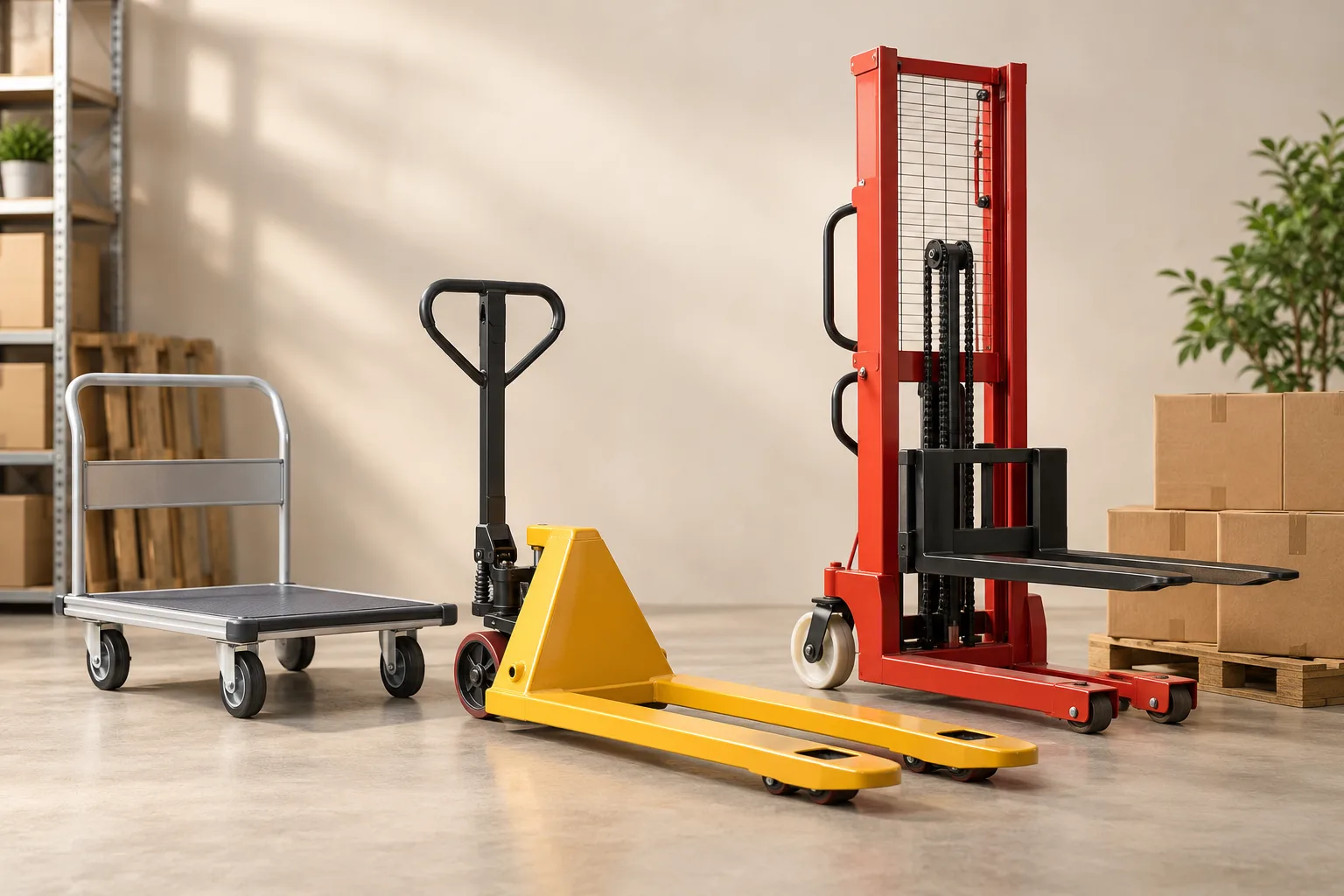
A product shot of a stacker tells an engineer nothing about whether it fits the aisle. Pages that state the load, lift height, span and the kind of site handled give a searcher a reason to call and give the search engine something specific to read.
“Old catalogues sit as unreadable files”
Some makers keep specifications in scanned catalogue files that search engines read poorly. The same information typed onto a page, with the drawing alongside, can be found, read and compared by the buyer.
“Names for the same machine differ by region”
A jib crane, a pillar crane and a swing arm hoist are one product to the workshop and three searches to the buyer. Listing the names buyers use in each region widens the searches the page can meet.
What we do
What we deliver for material handling equipment manufacturers.
The work available for this need. We agree the deliverables and responsibilities for your engagement in writing.
Equipment-type pages
A separate page for each crane, hoist, stacker, conveyor or storage product you make, built around the buyer's problem.
Result: Every product line has a page that can be searched for by name.
Specification tables
Load, span, lift height and duty typed onto the page, approved by your engineers before publishing.
Result: A buyer can judge fit without phoning first.
Industrial-area search pages
Pages for the estates and cities you supply, naming the factory types served there.
Result: Searches that include a place find a relevant page.
Search-name list
The terms buyers use for each machine, collected from enquiries and used in headings.
Result: The wording on the page matches the wording in enquiries.
Technical clean-up
Titles, descriptions, page speed on a phone and links between related equipment pages.
Result: The site is easier for a search engine to read and for a buyer to move through.
How the result is measured
- Ranking positions
- Organic traffic
- Enquiries from organic search
Recorded as a baseline before work starts, so every later report has an honest comparison.
Searches your buyers type
Buyers search by equipment, duty and place, in the words of the shop floor.
- eot crane manufacturer in Coimbatore
- An equipment and city page with capacity range, span and photographs of installed cranes. Buyers want a maker near enough to service them.
- 5 ton hoist price
- A page explaining what the price of a hoist depends on and inviting the buyer to send the figures. Do not hide behind a catalogue file.
- hydraulic stacker for warehouse
- A product page with lift height, load and floor condition. Warehouse buyers filter on these before price.
- jib crane for workshop
- A page showing sizes, mounting types and the bay height needed. The buyer wants to know if it fits their shed.
- crane inspection and annual maintenance
- A service page for owners of existing cranes. It also reaches buyers who are comparing makers on after-sales cover.
Who it is for
This is written for these material handling equipment manufacturers.
- EOT crane, gantry and jib crane makers
- Hoist and winch makers
- Stacker, pallet truck and trolley manufacturers
- Conveyor and roller track makers for factory lines
- Racking, platform and storage equipment makers
- Forklift attachment and special lifting tackle makers
- Dock leveller, lift table and tail-lift makers
- Makers who combine new supply with crane inspection and AMC
Before you decide
When this may not be the right fit.
- Your catalogue is a scanned file with no text, so converting it into pages has to come before any search work.
- Your machines are made to order and you cannot describe their range in figures, so pages would stay vague.
- You sell only through two dealers who handle all enquiries, and the dealers would hold the leads search brings.
Before you decide
Agree the work. Know how to judge it.
SEO for material handling equipment makers: use these checks to prepare, choose the scope, and review what changes.
Bring the right evidence
Bring the pages for the products or services you want to sell, the search queries available in your reports, and examples of enquiries from search. Separate branded searches from buyers discovering you for the first time.
Make the scope clear
Agree which pages and technical fixes come first, who can publish changes, and who supplies subject knowledge. Link search work to a relevant enquiry route on each priority page.
Check the work in use
Follow the trail from a relevant query to its landing page and then to an enquiry. Review whether those enquiries fit your offer, alongside indexing and search visibility.
Know when to change course
A ranking movement alone is not a buying signal. If traffic grows but relevant enquiries do not, revisit page intent and the offer before producing more pages.
These are discussion points, not a fixed package. GullySales confirms the deliverables, responsibilities, fee, and term in writing after reading your brief and speaking with you.
Before we start
What to have ready before the work starts.
The records, access and decisions this work needs from material handling equipment manufacturers. Anything missing is noted in the written scope, with who will supply it.
- Specification data for each model
- The load, span, duty, power, travel and dimensions for each model, as your works confirms them, are what a plant engineer searches for. A data sheet is acceptable. Without figures the pages remain descriptions, and we leave out any model whose data is unconfirmed.
- Admin access to the website and analytics
- We need a login that can edit pages and view search data, in your name. Hosting control is also needed. If a former vendor holds it, recovery comes first and the plan starts later.
- Old catalogues in editable form
- Word or design files are best, and clear PDFs are acceptable. Scanned photographs of printed pages slow the work and increase checking. If only prints exist, we retype with your engineer's review.
- Photographs of finished equipment on site
- Pictures of the machine installed, with the load and the bay visible, show scale and duty better than a studio shot. Phone photographs work. Without them the pages use drawings, which are less convincing.
- The list of estates and districts you serve
- Name the industrial areas where you have supplied and want more work. A list of places is enough. Without it we choose areas from your quotation register and ask you to correct them.
How it works
How the search engine optimisation work runs
The work itself, in order. How an engagement starts, from your brief to a written scope, is set out on our method page.
- 1
Collect the names buyers use for each machine
We sit with your sales engineer and list every name a buyer uses for each machine: the trade name, the regional term, the dealer's word and the code on a tender. You say which are accurate. What exists afterwards is a list of search names grouped by equipment, which tells us what each page must mention.
- 2
Take access and record the site's present state
We ask for the site admin, the analytics and the search tools, and we record which pages are indexed, which catalogues sit as unreadable files and which phrases bring visitors today. You choose who holds access. Afterwards a baseline sheet shows the position before any change, the figures we read against later.
- 3
Rank equipment pages by the order book
Using your quotation register, we put the equipment lines in the order that matters to the business, so pages for the machines you want to sell are done first. You decide the order. Afterwards each page has a place in the queue and a person responsible for supplying its specification.
- 4
Turn catalogue files into specification tables
Your engineer supplies the load, span, duty class, power and dimensions for each model, and we turn the old catalogue into readable tables on the page. Your engineer checks every figure before it is placed. Afterwards the technical details can be searched and compared, and no number appears that the works has not confirmed.
- 5
Publish by industrial area and check the pages
We build pages for the estates and districts you serve, link them to the equipment pages, repair broken links and slow pages, and publish after your approval. The dealer's name is used only where you decide. Afterwards the site is consistent and the pages point to one another.
- 6
Read searches and enquiries with your sales head
Once the pages are indexed we sit with your sales head and read the searches that brought visitors and the enquiries that followed against the baseline sheet. You judge which enquiries were real needs. We state what the records show and give no promise about position or orders.
Where this fits
Three pieces of sales work, in this order.
This work sits inside sales process design, at stage 1, prospecting and lead generation. The audit comes before it, and sales management keeps it running.
Step 1
Sales audit
Find where deals are being lost and what to fix first.
Start here if you cannot say where orders are lost.
Step 2 · you are here
Sales process design
One written way to sell, from first enquiry to repeat order.
Start here if every salesperson sells differently.
Step 3
Sales management
A target, a review routine and someone who owns the number.
Start here if the team has targets and no routine.
FAQ
Questions owners ask before they call.
Not here? More answers, or ask on WhatsApp.
Will a better ranking bring orders?
Do we need to rewrite the whole site?
Should we use the dealer's name or ours on the pages?
What do we do about differing names for the same machine?
Can one page cover all our crane and hoist models?
Do tender documents help us with search?
How much does it cost?
How long is the contract?
How soon will we see results?
Who will actually do the work?
More for material handling equipment manufacturers
Related work to consider.
Closest to this: search and visibility
Also for material handling equipment manufacturers
Or start from the overview: sales and marketing for material handling equipment manufacturers.
Your next practical step
Tell us what you are trying to grow, and we will read it before we call.
Eight short steps, mostly taps. Skip anything you would rather answer on the call.