Inverter, UPS and generator dealers · Branding
You sell somebody else's brand, so build your own on service.
Branding for a power backup dealer is what you stand for above a counter full of other companies' logos, carried by the van, the technician and the job card. GullySales fixes what your shop is known for, then builds the identity that a customer remembers when the battery dies.
Scope, fee, reporting and term are agreed in writing after we have read your brief and spoken to you.
What branding means
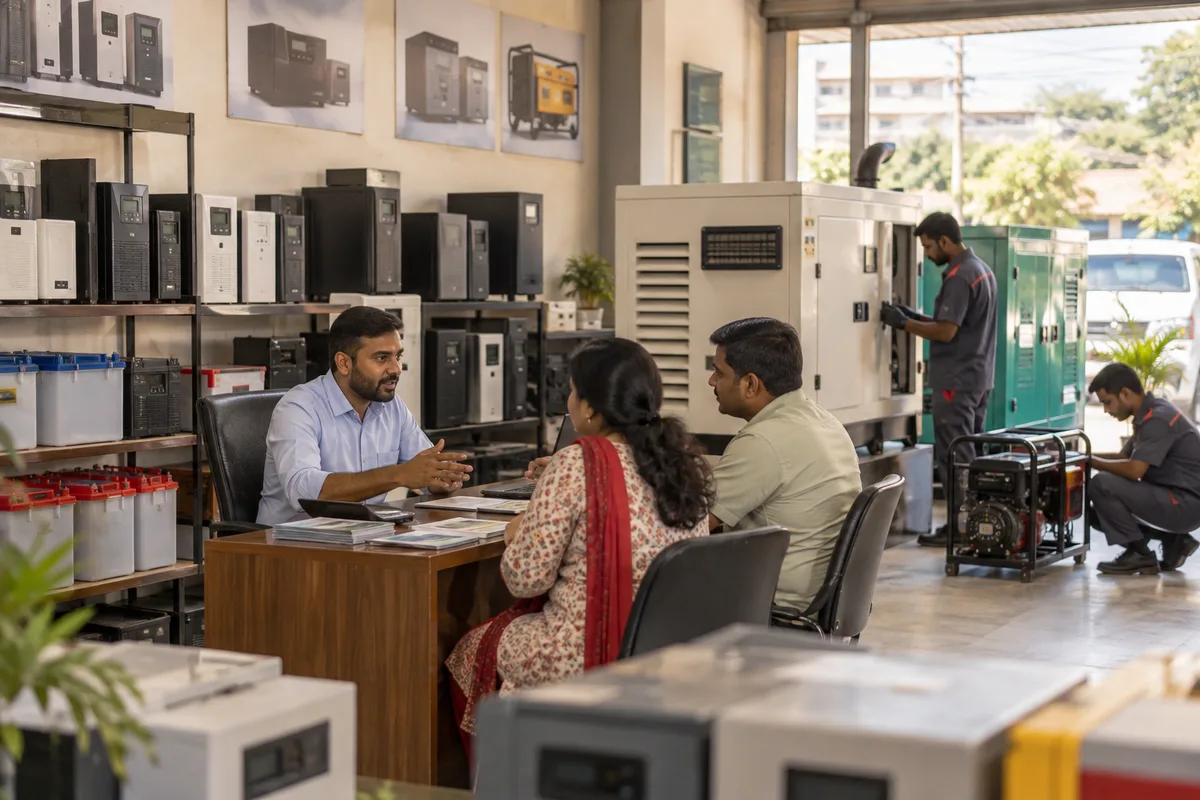
Branding is what a customer remembers about your business beyond the product, including your name, colours, tone of voice and what you are known for locally. GullySales sets or corrects this once and applies it consistently across your website, signage and adverts so the business looks like one company everywhere.
Also for inverter, UPS and generator dealers
- SEO for inverter, UPS and generator dealers
- PPC ads for inverter, UPS and generator dealers
- Lead generation for inverter, UPS and generator dealers
- Digital marketing for inverter, UPS and generator dealers
- Reputation management for inverter, UPS and generator dealers
- Local SEO for inverter, UPS and generator dealers
- Social media marketing for inverter, UPS and generator dealers
- Content marketing for inverter, UPS and generator dealers
Sales and marketing for inverter, UPS and generator dealers, the overview.
Last updated 5 Oct 2026.
For inverter, UPS and generator dealers
Where it usually goes wrong, and what we would do.
“The board outside is the manufacturer's, not yours”
Brand boards are supplied free and they make every dealer on the road look identical, so your own name has to appear somewhere a customer reads.
“The technician is the brand for two hours”
The person who drills the wall and explains the switch is the only part of the business most customers meet, and an unmarked shirt wastes that visit.
“Multi-brand dealers have to stand for judgement”
If you sell four brands, what a customer buys from you is honest advice about which one suits their load, and the identity should say that.
What we do
What we deliver for inverter, UPS and generator dealers.
Every deliverable, what it covers for you, and the result it is there to produce. Nothing here is an extra.
A statement of what the dealership is for
One page fixing the segments you want, the brands you back and the service standard you will hold to.
Result: The counter and the technicians work to one promise.
A name and mark that sit beside the brands
A wordmark that holds its own next to manufacturer boards, used on the shop front, the van and the uniform.
Result: Customers remember who installed it, not only what.
A branded job card and warranty folder
A job card recording the load, the sizing and the warranty terms, handed over in a folder with your number on it.
Result: Your number is in the drawer when the battery fails.
Technician presentation standards
Shirts, identity cards, shoe covers and a tidy-up routine written down and checked, since the visit is the whole customer experience.
Result: The installation visit sells the next one.
A quotation format of your own
Quotations laid out with the sizing, the scope, the compliance documents and your identity, rather than a brand's template.
Result: Your quote reads like a supplier, not a price slip.
How the result is measured
- Recognition in customer feedback
- Consistency across channels
- Repeat enquiries by name
Recorded as a baseline before work starts, so every later report has an honest comparison.
Positioning in one sentence
The one-line promise a power backup dealer can write down before repainting the shop.
We are the [home inverter, online UPS or generator] dealer for [type of customer] in [area], and unlike [the shop that only sells on price] we [one thing you do every time].
- Who it is for
- Choose home inverters for apartment owners, online UPS for clinics and offices, or generators for factories and buildings. Each asks different questions, and a board reading 'all power backup' answers none of them.
- What you do beyond selling the box
- Load calculation, installation, battery replacement, AMC. Say which you do yourself. A customer asking who comes when the battery fails is judging the dealer, not the brand on the carton.
- What the buyer gets that the cheapest shop does not
- It might be a load calculation at the customer's site, a spare battery lent during a replacement, or a technician who answers the evening call. Pick the one your staff do every time, and write it as a fact.
- The proof you can show
- Job cards with date, load and model fitted, a photograph of a tidy generator room, and an AMC customer who agrees to be a reference. Ask permission before showing any customer's name or address.
- The brands you stock
- Customers search by brand, so list those you are authorised for and say what you add that the carton cannot, such as sizing and service. Use a brand's logo only as its dealer rules allow.
- The name and tagline test
- A name saying 'power' or 'batteries' helps people find you but boxes you in once you add solar. Test the tagline on a fan shop: if it fits there as well, it says nothing.
Who it is for
This is written for these inverter, UPS and generator dealers.
- Home inverter and battery dealers
- Online UPS dealers for offices, clinics and IT setups
- Diesel and gas generator dealers
- Solar hybrid inverter and battery dealers
- Battery replacement and service centres
- Generator rental and AMC providers
- Industrial power backup and stabiliser suppliers
- Multi-brand power backup stores
How it works
From your first message to the first report.
No open-ended retainer. Every step gives you something in writing.
First
Your brief
You tell us what you need in a few short steps: your business, what you want, where enquiries come from and how they are handled.
After the brief
A conversation and a written scope
We read it, then talk with whoever handles your enquiries. If you want our help, the scope, the fee and the reporting come in writing, and nothing starts before you have read them.
Before work starts
Baseline recorded
The numbers this work is meant to move, such as enquiries, quotations, orders, visits or renewals, written down so every later report has an honest comparison.
After the baseline
The first fix goes live
The fix we agreed to start with is put in place and measured against the baseline, whether that is a reply, a follow-up, a page, a listing or the handover between marketing and sales.
As agreed
Report against the baseline
What moved, what did not, and what changes next, in plain words. How often you get it is set in writing before work starts.
At renewal
Renew on the numbers
The term ends and you decide whether to continue from the results. The length is agreed in writing before anything starts.
How the branding work runs
- 1
Interview customers and team
We talk to real buyers, won and lost, and to people inside the business who deal with customers daily.
- 2
Review the competitive field
We look at how the nearest competitors present themselves so the position is not accidentally identical.
- 3
Draft the position
A first version of the positioning statement and messaging pillars is written and checked against what customers actually said.
- 4
Test it against real conversations
The draft is tried out in a real sales call or two before it is finalised, since a position that does not survive a real conversation needs rework.
- 5
Hand over the rollout brief
The final position, pillars and not-for list are documented for your team and any agency to apply consistently.
Why us
Why owners pick GullySales over an agency.
Marketing and sales, as one job
Most agencies stop at the enquiry. We also fix what happens after it: the reply, the follow-up, the quote and the CRM.
The person on the first call does the work
No account managers in between. You are never handed to someone you have not met.
A baseline before anything starts
Your numbers are written down on day one, so every later report compares against something honest.
The fee in writing, split three ways
Our time, your media spend and production on separate lines. You always see what goes to us.
No guarantees we cannot keep
The term is agreed in writing and never a default twelve months. We never promise a ranking or a lead count, because nobody controls those.
One office, and we say so
Nagarbhavi, Bengaluru. We work across India by call and WhatsApp and travel when a session needs to be in person.
#257, 3rd floor, Sri Nanjundeshwara Complex, Nagarbhavi 8th Block, Outer Ring Road. How we work.
Your brief
Tell us what you need, and we will read it before we call.
Eight short steps about your business, what you want and who decides. Most questions are a tap, and you can skip any you would rather answer on the call.
FAQ
Questions owners ask before they call.
Not here? More answers, or ask on WhatsApp.
Why brand a dealership that sells known names?
Should our van and shirts carry our name or the brand's?
Should the AMC and service arm have a separate name from the shop?
Another dealer is trading under a name one letter different from ours. What can we do?
How much does it cost?
How long is the contract?
How soon will we see results?
Who will actually do the work?
What do you need from us?
What if we are not happy with the work?
From the blog
Further reading for inverter, UPS and generator dealers.
 6 min read · 6 Oct 2026Why power buyers hire the firm that explained the billHomes, societies and factories rarely plan to buy solar, a generator or an audit. This post shows how each buyer chooses between energy and utilities firms, and what the winner did first.
 5 min read · 8 Nov 2025Turning the technician into your best salesperson without upselling dishonestlyHow to train home service technicians to explain a finding, show the evidence and offer options in order of need, so customers decide freely and trust the firm more afterwards.
More for inverter, UPS and generator dealers
Everything else we would do for you.
- SEO for inverter, UPS and generator dealers
- PPC ads for inverter, UPS and generator dealers
- Lead generation for inverter, UPS and generator dealers
- Digital marketing for inverter, UPS and generator dealers
- Reputation management for inverter, UPS and generator dealers
- Local SEO for inverter, UPS and generator dealers
Or start from the overview: sales and marketing for inverter, UPS and generator dealers.
Your next practical step
Tell us what you are trying to grow, and we will read it before we call.
Eight short steps, mostly taps. Skip anything you would rather answer on the call.