Jewellery retailers · Radio advertising
Say the road on air, or she parks outside the showroom next door.
Radio advertising for a jewellery showroom buys a flight of spots on a station in the days before a festival or a wedding date. Gold moves every morning, so the spot carries the offer and the address rather than a price. GullySales plans the station, language and band, and puts a number on air the counter can count.
Scope, fee, reporting and term are agreed in writing after we have read your brief and spoken to you.
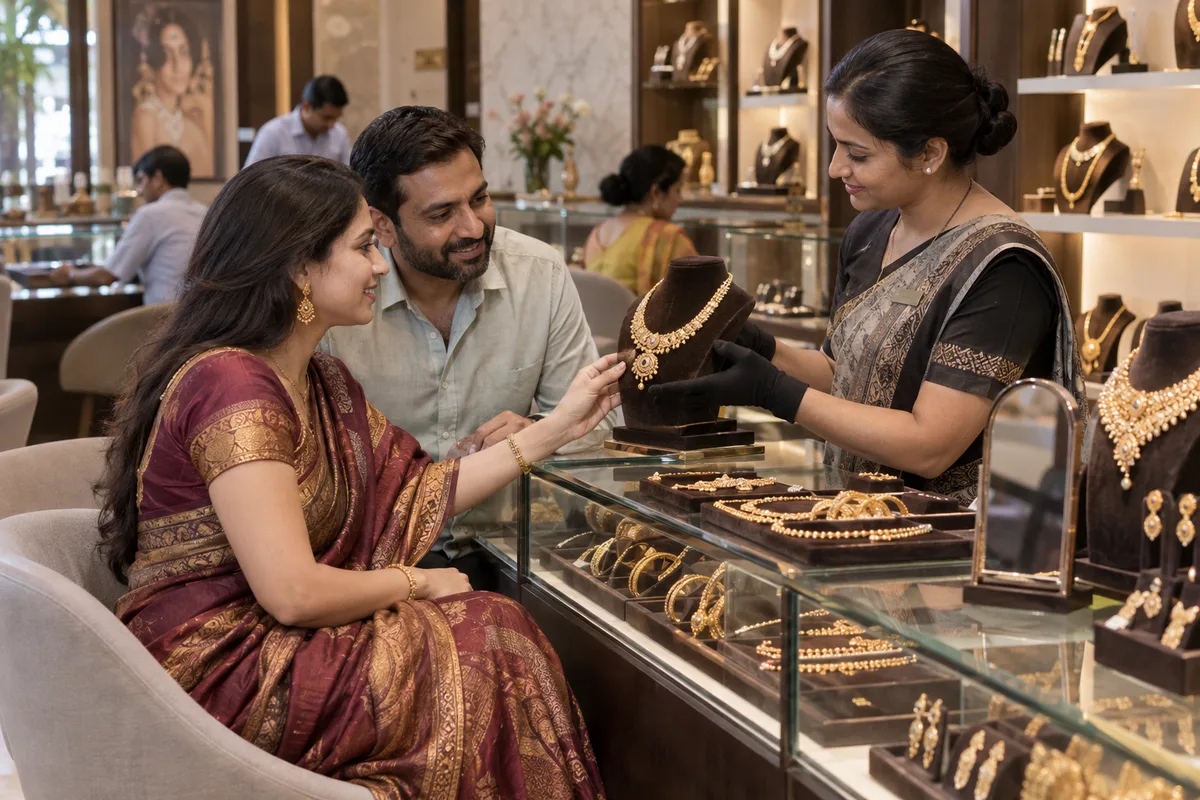
What radio advertising means
Radio advertising is a spot, a mention or a sponsorship on a station your buyers listen to on the way to work. GullySales plans the station, band and frequency, and runs search on your own name during the flight so the listener who looks you up afterwards finds you.
Also for jewellery retailers
- Cinema advertising for jewellery retailers
- Google Ads for jewellery retailers
- Newspaper advertising for jewellery retailers
- Outdoor advertising for jewellery retailers
- Sales and marketing strategy for jewellery retailers
- SEO for jewellery retailers
- Social media marketing for jewellery retailers
- Website design and development for jewellery retailers
Sales and marketing for jewellery retailers, the overview.
Last updated 5 Oct 2026.
For jewellery retailers
Where it usually goes wrong, and what we would do.
“The flight ends on the date, not after it”
Akshaya Tritiya and Dhanteras buying is settled in the days running up to the morning itself. A schedule that opens on the day and runs the week after pays for a decision already made.
“Name the road, because jewellers sit in a row”
Your competitors are on the same street, sometimes in the same building. A spot that gives the showroom name without the road and the landmark hands the listener to whoever is nearest the parking.
“The offer goes on air, the rate stays on the board”
A rate recorded on Monday is wrong by Thursday. Making charges on bridal sets, or an exchange term you will hold for the whole flight, is what a recorded spot can safely say.
“She hears it at a signal and searches that night”
The spot creates a search on your showroom name hours later. With nobody bidding on that name during the flight, a chain with a larger budget collects the visit you paid for.
What we do
What we deliver for jewellery retailers.
Every deliverable, what it covers for you, and the result it is there to produce. Nothing here is an extra.
Flight dated back from the festival
Spots concentrated in the days before the date, with the last of them on that morning and nothing left running the week after.
Result: The schedule sits inside the buying window.
Station, language and band for your buyer
The station a bridal family in your part of the city listens to, in the language spoken at home, in the band their driving hours fall in.
Result: Depth on one station beats a sighting on four.
Script that names the street
Thirty seconds carrying the offer, the showroom, the road and the landmark, with the number read twice and slowly at the end.
Result: A listener knows where to park before she leaves home.
Offer wording fixed for the whole flight
What the spot promises on making charges, exchange or certification, agreed with you and held to the last day so nobody argues at the counter.
Result: Every salesperson answers the advertisement the same way.
Search cover on the showroom name
Search ads on your name and your collections through the flight weeks, because a listener looks you up before she travels.
Result: The search your spot created lands on your own listing.
On-air number and a counter question
One number used on air alone, and a line on the counter slip asking each visitor where she heard about the offer.
Result: Radio is reported on walk-ins instead of on guesswork.
Spot log read against the booked band
The station's transmission log checked against the schedule, so bonus spots dropped into the midnight band are not counted as delivery.
Result: You know what aired inside the band you paid for.
How the result is measured
- Spots aired against spots booked
- Branded search volume during the flight
- Calls quoting the on-air number
Recorded as a baseline before work starts, so every later report has an honest comparison.
Settle this before booking
Fill in this sheet before you book a single radio spot.
A radio flight is bought in advance and cannot be edited once it airs. Decide these six points on paper first, so the station sells you what the showroom needs.
- Last date of the flight
- Write the date the flight must end on, such as Akshaya Tritiya or the start of a muhurat week, and count back from it. A spot aired after the date buys nothing.
- Station, band and language
- Ask which station your bridal buyer and her mother listen to at home or in the car, and book the language they speak at home, not the one the station is best known for.
- Street and landmark line
- Name the road, the nearest landmark and which side of the road the showroom stands. Jewellers sit in a row, so a driver needs the turn, not just the brand.
- One offer, fixed wording
- Choose one offer for the whole flight, such as an old-gold exchange benefit, and write it once. The board, the counter staff and the spot must all say the same thing.
- Counter question and slip
- Train every salesperson to ask how the customer heard of you and to tick radio on the bill slip. Without that tick the spot log cannot be compared with the counter.
- Rate stays off the air
- Keep the day's gold rate and making charges out of the script, since both can change before the spot airs. Point listeners to the board or the showroom number.
Who it is for
This is written for these jewellery retailers.
- Bridal and wedding jewellery showrooms
- Gold and diamond jewellery retail chains
- Silver and artificial jewellery stores
- Certified diamond and solitaire retailers
- Traditional and antique jewellery stores
- Single-showroom family jewellers
How it works
From your first message to the first report.
No open-ended retainer. Every step gives you something in writing.
First
Your brief
You tell us what you need in a few short steps: your business, what you want, where enquiries come from and how they are handled.
After the brief
A conversation and a written scope
We read it, then talk with whoever handles your enquiries. If you want our help, the scope, the fee and the reporting come in writing, and nothing starts before you have read them.
Before work starts
Baseline recorded
The numbers this work is meant to move, such as enquiries, quotations, orders, visits or renewals, written down so every later report has an honest comparison.
After the baseline
The first fix goes live
The fix we agreed to start with is put in place and measured against the baseline, whether that is a reply, a follow-up, a page, a listing or the handover between marketing and sales.
As agreed
Report against the baseline
What moved, what did not, and what changes next, in plain words. How often you get it is set in writing before work starts.
At renewal
Renew on the numbers
The term ends and you decide whether to continue from the results. The length is agreed in writing before anything starts.
How the radio advertising work runs
- 1
Fix the window
We agree what has to happen in these weeks, an admission deadline, a launch or a sale, because radio works in short flights.
- 2
Choose the station and the language
We match station, language and band to who you sell to, and cut the stations that only add a stray sighting.
- 3
Write and produce the spot
The script is written here and produced to the station's delivery format before the deadline, rather than on the station's template.
- 4
Book and hold the schedule
We coordinate the booking with the station or its agency and treat the written spot plan as the thing being bought.
- 5
Track and reconcile
Calls to the on-air number and brand search volume are watched through the flight, and the transmission proof is checked against the booking.
Why us
Why owners pick GullySales over an agency.
Marketing and sales, as one job
Most agencies stop at the enquiry. We also fix what happens after it: the reply, the follow-up, the quote and the CRM.
The person on the first call does the work
No account managers in between. You are never handed to someone you have not met.
A baseline before anything starts
Your numbers are written down on day one, so every later report compares against something honest.
The fee in writing, split three ways
Our time, your media spend and production on separate lines. You always see what goes to us.
No guarantees we cannot keep
The term is agreed in writing and never a default twelve months. We never promise a ranking or a lead count, because nobody controls those.
One office, and we say so
Nagarbhavi, Bengaluru. We work across India by call and WhatsApp and travel when a session needs to be in person.
#257, 3rd floor, Sri Nanjundeshwara Complex, Nagarbhavi 8th Block, Outer Ring Road. How we work.
Your brief
Tell us what you need, and we will read it before we call.
Eight short steps about your business, what you want and who decides. Most questions are a tap, and you can skip any you would rather answer on the call.
FAQ
Questions owners ask before they call.
Not here? More answers, or ask on WhatsApp.
Can we put the day's gold rate in the spot?
How do we know radio brought anyone to the counter?
Can the spot say our jewellery is hallmarked or the purest in town?
Is radio worth it for a single family showroom?
How much does it cost?
How long is the contract?
How soon will we see results?
Who will actually do the work?
What do you need from us?
What if we are not happy with the work?
From the blog
Further reading for jewellery retailers.
 8 min read · 21 Sept 2026Radio advertising in BengaluruWho is actually listening in this city, and where. The evening crawl, the auto driver's choice, the shop counter with FM on all day, and a signal that reaches past the city limits.
 7 min read · 21 Sept 2026How to write a radio scriptA spot is heard once, by somebody at the wheel who cannot look at anything or write anything down. Time the words with a stopwatch, not on the page.
 8 min read · 21 Sept 2026Tamil advertising creative: what actually changesTamil writes one way and speaks another, and the script cannot tell a b from a p. Both facts decide your line, your voice artist and the spelling of your own name.
More for jewellery retailers
Everything else we would do for you.
Closest to this: paid and media
Also for jewellery retailers
Or start from the overview: sales and marketing for jewellery retailers.
Your next practical step
Tell us what you are trying to grow, and we will read it before we call.
Eight short steps, mostly taps. Skip anything you would rather answer on the call.