Clothing stores and boutiques · E-commerce product description writing
Tell the online shopper how the garment fits, drapes and washes before they ask.
E-commerce product description writing for a clothing boutique is the text beside each garment in your online store: the short line near the buy button, the longer description, the fabric and care lines and the size information. GullySales writes these from your own garment facts, so a shopper who cannot touch the cloth still understands what arrives.
Scope, fee, reporting and term are agreed in writing after we have read your brief and spoken to you.
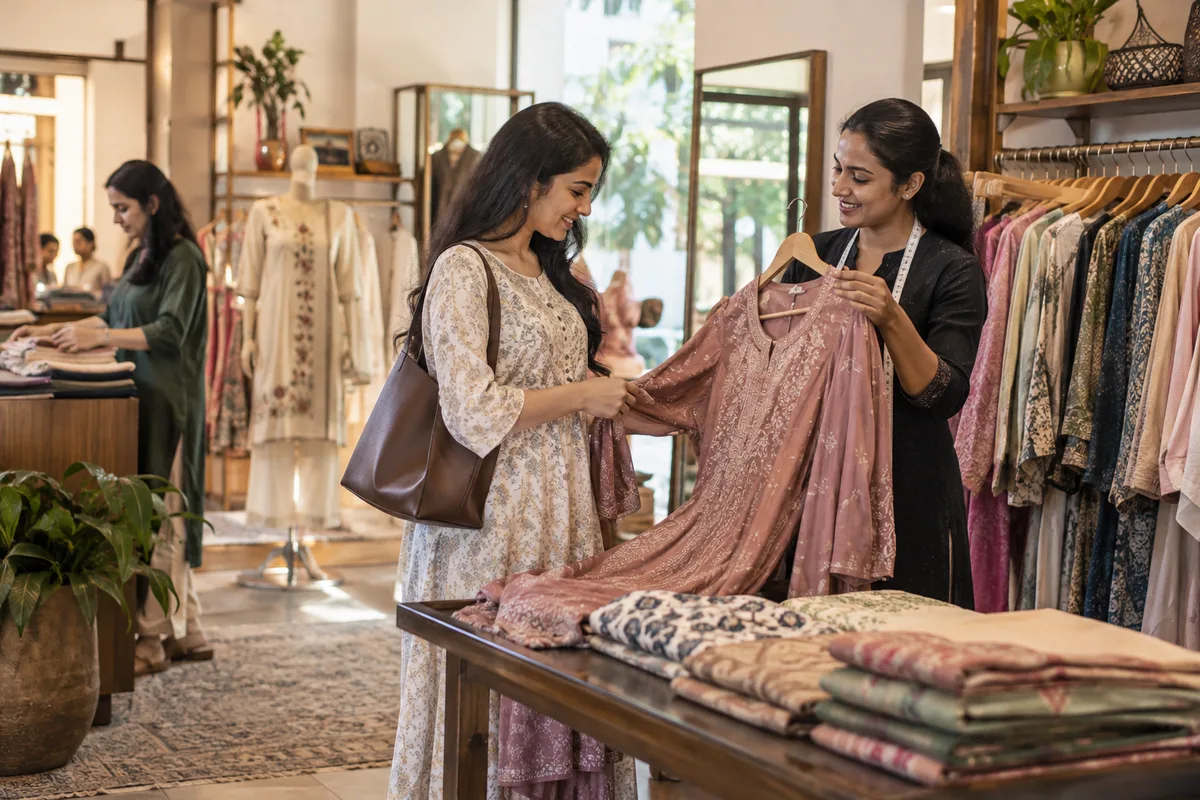
What E-commerce product description writing means
E-commerce product description writing is the writing of the text that sits beside each item in an online store: the short line near the buy button, the longer description, the feature list and the specification block. GullySales writes these in your voice from your own product facts, and you receive approved text ready for your team to load.
Also for clothing stores and boutiques
- Social media marketing for clothing stores and boutiques
- Content marketing for clothing stores and boutiques
- Instagram marketing for clothing boutiques
- Facebook marketing for clothing boutiques
- Instagram influencer marketing for clothing stores and boutiques
- Regional influencer marketing for clothing stores and boutiques
- Short-form video and reels production for clothing stores and boutiques
- Social media caption and post writing for clothing boutiques
Sales and marketing for clothing stores and boutiques, the overview.
Last updated 14 Nov 2026.
For clothing stores and boutiques
Where it usually goes wrong, and what we would do.
“The shopper cannot touch the cloth”
In the shop, a customer feels the fabric, holds the border to the light and tries the blouse. Online, the description has to do that work. A line that says beautiful and comfortable tells the shopper nothing. A line that names the fabric, its weight, how it falls and whether it needs lining lets the shopper judge without a fitting room.
“Size and fit generate the returns”
A shopper who orders a size and finds the shoulder tight returns the parcel, and the boutique pays for the trip and loses the sale. A description that states the garment's own measurements, the cut and how it sits on the person in the photograph prevents the wrong order. The size chart has to sit beside the text, not on a distant page.
“The photograph shows one colour, the cloth arrives another”
Screens differ, and a shade of green or maroon in the picture never matches the cloth exactly. Descriptions that give a plain colour name, mention the tone and say how the photograph was taken prevent the shopper from feeling misled. Names such as mehendi or onion pink are not enough unless they are explained.
“Occasion wear and everyday wear need different writing”
A bridal lehenga is bought with care over days, and the buyer wants the work, the lining, the dupatta and the stitching terms. A cotton kurta is bought on impulse and wants the fabric, the fit and the care. One template for both serves neither. Descriptions follow the buying mood of each garment.
What we do
What we deliver for clothing stores and boutiques.
The work available for this need. We agree the deliverables and responsibilities for your engagement in writing.
A description structure for your range
A fixed order of parts for your garments: the opening line, the fabric and fall, the fit, what is included, the care and the size note. You approve it on two sample garments before the full range is written, so the shape suits both a saree and a kurta.
Result: You see the structure working on two real garments before the rest is written.
A short line for the buy button
A line or two that says what the garment is and when it is worn, written to sit near the price. Your product owner confirms every statement against the stock you hold, so the line is something a shopper can rely on.
Result: Each product page has a short line that names the garment and the occasion it suits.
A full description for each garment
A longer text that explains the cut, the fabric and how it differs from the garment beside it in the range. It is written from your own facts and approved claims, never from invented benefits. The reader should be able to picture the garment.
Result: A shopper can say from the text alone how the garment fits and what it is made of.
Fabric, fit and care lines
A short block, in the same order for every garment, that states the fabric, the lining, how the cut sits, the care instructions and what is inside the parcel. Because the order never changes, a shopper comparing two pages finds the same fact in the same place.
Result: Two garments from your range can be compared line by line without hunting for facts.
Size and measurement text
The words around your size chart: how to measure, which size the model wears, how the garment is cut and what to do between sizes. The measurements come from your records and are confirmed by your product owner against a real garment.
Result: A shopper knows which size to order and what to do if they are between two.
Colour and variant lines
A plain name for each colour, with a note on how the screen may differ, and text for the choices inside one product such as size, colour and stitched or unstitched. Variants that need their own full description are flagged for you.
Result: A shopper sees what changes between variants and what stays the same.
How the result is measured
- Product questions your support team receives about size, fit or contents
- Returns recorded with the reason given as not as described
- Products in the range that have a complete description with every part filled
Recorded as a baseline before work starts, so every later report has an honest comparison.
Who it is for
This is written for these clothing stores and boutiques.
- Women's ethnic wear and saree boutiques
- Designer and occasion wear studios
- Multi-brand clothing and accessories stores
- Men's wear and ethnic wear stores
- Custom tailoring and blouse stitching studios
- Kids' wear stores
- School uniform retailers and suppliers
- Corporate, hospital and hospitality uniform suppliers
- Fashion accessories and jewellery boutiques
Before you decide
Agree the work. Know how to judge it.
E-commerce product description writing for clothing boutiques: use these checks to prepare, choose the scope, and review what changes.
Bring the right evidence
Choose a product group and follow its journey from the product page to delivery. Review cancelled orders and returns alongside completed purchases, with customer details removed.
Make the scope clear
Agree which catalogue items, payment steps, and sales channels are included. Account for fulfilment costs and returns when deciding what acquisition spend the order can support.
Check the work in use
Test a purchase on mobile, including the address, delivery charge, payment failure, and confirmation. For trade orders, test quotation requests and minimum-order information as well.
Know when to change course
If stock or delivery promises are unreliable, resolve those first. Increasing paid traffic to unavailable products wastes budget and creates avoidable complaints.
These are discussion points, not a fixed package. GullySales confirms the deliverables, responsibilities, fee, and term in writing after reading your brief and speaking with you.
Before we start
What to have ready before the work starts.
The records, access and decisions this work needs from clothing stores and boutiques. Anything missing is noted in the written scope, with who will supply it.
- Garment facts from your supplier or workshop
- The fabric, the lining, the length, the work on the border and the care instructions for each garment. Without them, a description borrows the supplier's generic line, and the shopper gets the same words that every other store uses for the same cloth.
- Measurements taken from a real garment
- The chest, waist, shoulder and length, measured on the garment, not copied from a template. Descriptions that quote a size chart nobody checked produce wrong orders and returns, and the boutique is blamed for the mistake.
- Your photographs and the model's size
- Send the pictures you will upload, and tell us which size the model wears and how tall they are. The description refers to the photograph, and it needs to say honestly what the shopper sees. Pictures edited for colour should be noted.
- Your returns and stitching terms
- State whether the garment can be returned, exchanged or altered, and whether a stitched order is final. We write the lines in plain words. If the terms are unclear, a shopper reads the description as a promise and argues about it later.
- A person who answers the shopper's questions
- Someone on your team who replies to questions from the product page and tells us which questions repeat. The repeated questions show what the description left out, and the next version answers them before they are asked.
How it works
How the e-commerce product description writing work runs
The work itself, in order. How an engagement starts, from your brief to a written scope, is set out on our method page.
- 1
Read the range and the garment records
We start with your product list, the supplier details you hold and your existing pages. We note which garments are close to each other, which facts buyers compare and which facts are missing, such as the lining or the stitching terms.
- 2
Choose the sample garments
We pick two or three that differ: a simple everyday kurta, a heavier occasion garment and one with stitched and unstitched options. They show whether the structure copes with the range before it is applied to every page.
- 3
Draft the structure and the samples
We write the sample descriptions in the proposed order, in your voice. You read a real page, not an outline, and mark what to keep, change or remove. The structure is then fixed in writing so every later page follows it.
- 4
Write the range and collect the gaps
Once the samples are approved, we write the rest of the agreed list. Facts we cannot find in your records, such as a garment's length or the lining, go into a question sheet instead of being guessed. Your product owner answers them in one pass.
- 5
Check facts, fabric names and care lines
Your product owner checks the fabric names, measurements and care lines against the garments. Terms such as pure or hand-woven are kept only where your supplier records support them. Anything that rests on a rule or a claim is marked for your own adviser.
- 6
Read the result against the returns record
After the pages go live, we read the outcome against what you recorded before the work: returns with a reason of fit or colour, questions sent to your team and pages where shoppers left at the size chart. The next batch is written from that reading.
Where this fits
Three pieces of sales work, in this order.
This work sits inside sales process design, at stage 1, prospecting and lead generation. The audit comes before it, and sales management keeps it running.
Step 1
Sales audit
Find where deals are being lost and what to fix first.
Start here if you cannot say where orders are lost.
Step 2 · you are here
Sales process design
One written way to sell, from first enquiry to repeat order.
Start here if every salesperson sells differently.
Step 3
Sales management
A target, a review routine and someone who owns the number.
Start here if the team has targets and no routine.
FAQ
Questions owners ask before they call.
Not here? More answers, or ask on WhatsApp.
Do you upload the descriptions to our store?
Can you write for the marketplaces as well as our own store?
Will you describe the fabric as pure silk or cotton?
How do you write for a long list of garments?
Can descriptions reduce returns?
Do you write the search titles and page tags too?
How much does it cost?
How long is the contract?
How soon will we see results?
Who will actually do the work?
From the blog
Further reading for clothing stores and boutiques.
 5 min read · 29 Sept 2026Festival and wedding-season stock and promotion timing for retailersHow a retailer lines up promotion with the stock cycle in festival and wedding season: what to announce before, during and after, and when to stop.
 6 min read · 21 Sept 2026Influencer marketing vs social media advertising: which one should you pay for?An ad is a message you control, shown to people you choose. A creator post is a recommendation you do not control, shown to people who chose the creator.
 8 min read · 21 Sept 2026How to write an influencer briefA brief fixes the claim, the offer and the disclosure, then leaves the creator alone. Hand over a script and you pay for a bad advertisement.
More for clothing stores and boutiques
Related work to consider.
Closest to this: content and social
- Social media marketing for clothing stores and boutiques
- Content marketing for clothing stores and boutiques
- Instagram marketing for clothing boutiques
- Facebook marketing for clothing boutiques
- Instagram influencer marketing for clothing stores and boutiques
- Regional influencer marketing for clothing stores and boutiques
- Short-form video and reels production for clothing stores and boutiques
- Social media caption and post writing for clothing boutiques
Also for clothing stores and boutiques
Or start from the overview: sales and marketing for clothing stores and boutiques.
Your next practical step
Tell us what you are trying to grow, and we will read it before we call.
Eight short steps, mostly taps. Skip anything you would rather answer on the call.