Clothing stores and boutiques · Product catalogue copywriting
Write each outfit once, so the shopper never has to ask what it is made of.
Product catalogue copywriting for a clothing shop is the written entry for every outfit, fabric and uniform: its name, the fabric, the fit, the occasion and the code a customer quotes. GullySales writes those entries from your own stock list and tags in one pattern, so the WhatsApp catalogue, the printed lookbook and the school price sheet all say the same thing.
Scope, fee, reporting and term are agreed in writing after we have read your brief and spoken to you.
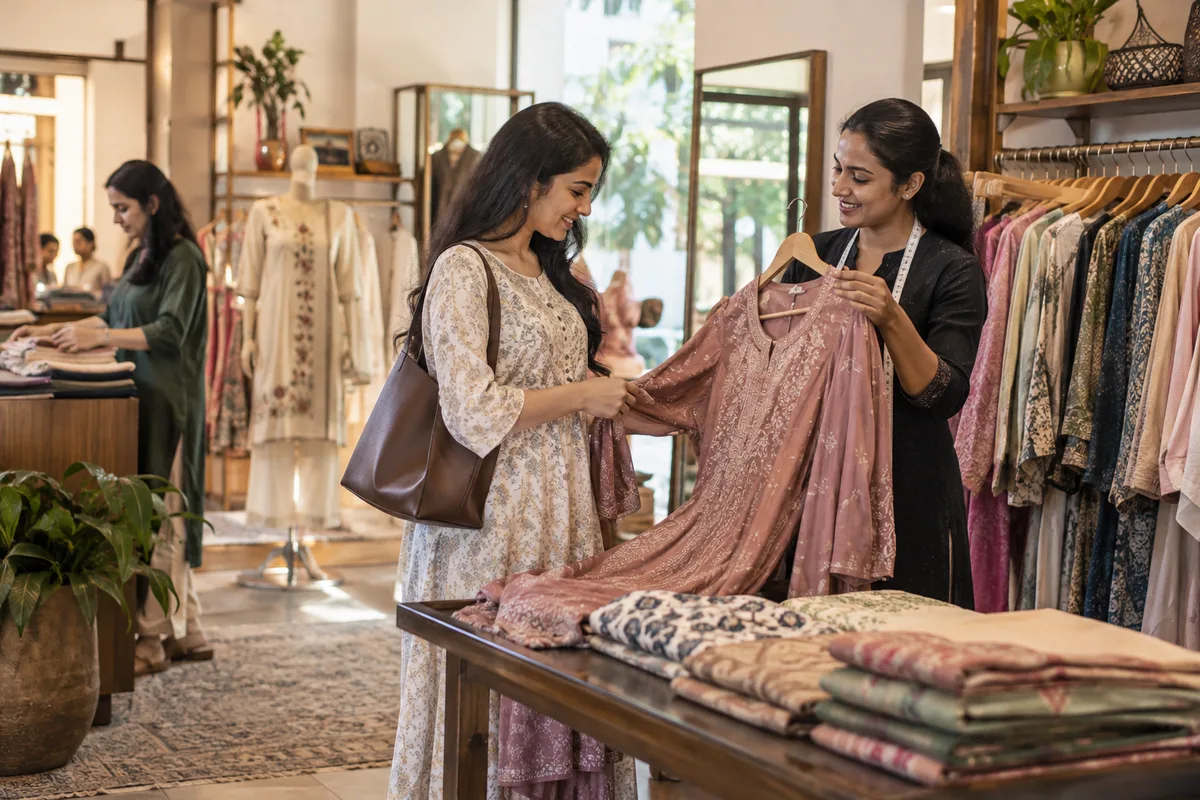
What product catalogue copywriting means
Product catalogue copywriting is the written content of a catalogue: the opening note, section introductions, every product entry, the how-to-order page and the notes on use. GullySales writes it from your approved product information in one consistent pattern and hands you finished copy for a designer or printer. Layout, artwork, data records and printing are separate scopes.
Also for clothing stores and boutiques
- Social media marketing for clothing stores and boutiques
- Content marketing for clothing stores and boutiques
- Instagram marketing for clothing boutiques
- Facebook marketing for clothing boutiques
- Instagram influencer marketing for clothing stores and boutiques
- Regional influencer marketing for clothing stores and boutiques
- Short-form video and reels production for clothing stores and boutiques
- Social media caption and post writing for clothing boutiques
Sales and marketing for clothing stores and boutiques, the overview.
Last updated 14 Nov 2026.
For clothing stores and boutiques
Where it usually goes wrong, and what we would do.
“The same saree has three names in three places”
The tag in the shop says one thing, the Instagram caption another and the WhatsApp message a third, because each was typed by whoever was free at the time. A customer who saw the outfit online asks for it at the counter and the staff cannot find it. Matching one written name and one code to each piece removes that search and lets a repeat customer ask for the outfit by the same words the shop uses.
“Shoppers ask about fabric, lining and fall before they ask the price”
A family buying for a wedding wants to know whether a blouse has margin to alter, whether the lehenga is lined, how heavy the work is and whether it needs dry cleaning. Staff answer these by hand, one chat at a time, and the answers drift. A written entry that carries those facts in a fixed order answers the question before it is typed and keeps the staff answer and the printed answer the same.
“A wedding party browses by occasion, not by garment type”
The bride's mother is looking for the reception outfit, the sangeet outfit and something for the cousins, not for kurtas or sarees as such. Several catalogues are sorted by garment, so the family scrolls past what it needs. Section introductions written around the occasion, with a short note on how to choose between two similar pieces, let a family find a shortlist before the visit and arrive knowing what to try on.
“Uniform buyers compare a sample, then judge the repeat order”
A school office, a hospital admin team or a hotel HR desk reads a uniform catalogue as a specification: fabric, colour reference, size range, trims and the ordering route. Vague phrases such as good quality cloth give them nothing to hold you to. Plain entries with measurable descriptions, and a note on how a repeat order is matched to the first batch, are what a procurement desk looks for when the renewal comes round.
What we do
What we deliver for clothing stores and boutiques.
The work available for this need. We agree the deliverables and responsibilities for your engagement in writing.
Entry pattern for a garment
A written order of facts for every piece: name, fabric, work or print, fit, lining, care, occasion and code. It is agreed with you first, so a saree, a blouse piece and a kids' set are each described to the same rule and new stock follows it.
Result: Any two entries for different garments list their facts in the same order.
Outfit entries from your stock list
Each piece in your stock list written up from your tags, supplier notes and your own description of the drape and finish. Where a fact is missing, such as the fabric blend, we log a question for you and do not guess it.
Result: Every entry matches a code on your stock list and carries no fact you did not supply.
Occasion and collection introductions
A short introduction for each occasion section, such as bridal, festive, everyday and custom stitching. It says what belongs there and how a shopper chooses between neighbouring pieces, written in plain words a family can read on a phone.
Result: Each section opens with a note that tells a shopper which entries to compare.
Size, fit and measurement notes
Plain text for the size chart, the alteration margin, the stitching options and what a customer should bring or send to be measured. It replaces the string of questions that arrives before a custom order.
Result: The questions your staff repeat about fit are answered on the page.
Uniform and bulk order pages
Entries for school, hospital and hospitality uniforms written as specifications, with the sizes offered, the trims, the sample route and how a repeat order is checked against the first batch. Prices and terms stay your own wording.
Result: A procurement desk can read the page and tell what to ask for in a sample.
How-to-order page and approved copy file
The page that explains how to enquire on WhatsApp, which code and size to quote and where to collect or receive the order, plus one editable file in page order with each claim matched to your source.
Result: A designer or your own team receives clean words and a list of sources for every claim.
How the result is measured
- Phone calls and messages asking which product fits
- Quotation requests that quote the catalogue code
- Entries that follow the agreed pattern
Recorded as a baseline before work starts, so every later report has an honest comparison.
Who it is for
This is written for these clothing stores and boutiques.
- Women's ethnic wear and saree boutiques
- Designer and occasion wear studios
- Multi-brand clothing and accessories stores
- Men's wear and ethnic wear stores
- Custom tailoring and blouse stitching studios
- Kids' wear stores
- School uniform retailers and suppliers
- Corporate, hospital and hospitality uniform suppliers
- Fashion accessories and jewellery boutiques
Before you decide
Agree the work. Know how to judge it.
Product catalogue copywriting for clothing boutiques and retailers: use these checks to prepare, choose the scope, and review what changes.
Bring the right evidence
Bring questions from sales calls and examples of objections that delay a decision. Choose a subject expert who can check the substance, and identify evidence that can be published.
Make the scope clear
Agree the reader, buying question, format, and distribution route for each piece. Set the approval process and distinguish new research from rewriting material you already have.
Check the work in use
Ask a colleague to use the draft in a real buyer conversation. It should answer the question, support its claims, and make the next step clear without requiring a sales pitch to explain it.
Know when to change course
If the same unanswered question appears in several articles, improve the strongest page before commissioning another. More words are not a substitute for missing evidence.
These are discussion points, not a fixed package. GullySales confirms the deliverables, responsibilities, fee, and term in writing after reading your brief and speaking with you.
Before we start
What to have ready before the work starts.
The records, access and decisions this work needs from clothing stores and boutiques. Anything missing is noted in the written scope, with who will supply it.
- A stock list with codes
- We need the pieces you sell with the code on your bill or tag, even in a rough spreadsheet. Without it, an entry cannot be matched to a real piece, and the catalogue risks describing an outfit your counter cannot find.
- Supplier notes on fabric and work
- Fabric blend, type of embroidery, lining and care instructions come from the weaver, wholesaler or tailor. Send tags, bills or messages. Where none exist, the entry stays short and factual and says nothing about the cloth that nobody can confirm.
- The last lookbook or catalogue
- Earlier editions, printed or on WhatsApp, show what shoppers already see and where names have drifted apart. A phone photograph of the pages is enough. If nothing earlier exists, we build the pattern from the stock list and your staff's own answers.
- Photographs of each piece
- Copy and picture must agree on colour, drape and detail, so we work beside your existing photographs and note any piece with no picture. A missing photograph is flagged, since a description that cannot be checked against an image invites a return.
- One person who approves product facts
- Name the owner or senior staff member who can confirm a fabric, a fit note or a care instruction. When several people answer differently, entries are held back and reduced to the facts that sit on a document.
How it works
How the product catalogue copywriting work runs
The work itself, in order. How an engagement starts, from your brief to a written scope, is set out on our method page.
- 1
Read the stock list and the tags
We start with what the shop already holds: the stock list, the hang tags, the supplier bills and any lookbook or WhatsApp catalogue now in use. We note where one piece carries two names and where a fabric is never mentioned, before any new wording is written.
- 2
Choose how shoppers browse your range
We ask how families actually shop with you, by occasion, by fabric, by price band or by garment, and propose an order of sections to match. You settle that order first, because the section introductions and the selection notes depend on it.
- 3
Write three sample entries
We write one saree or occasion piece, one custom stitching option and one uniform item and send them for your review. You find out early whether the pattern carries the facts your shoppers ask for, and we adjust before the whole range is drafted.
- 4
Draft the full range
The remaining entries, the occasion introductions, the fit notes and the how-to-order page are written to the approved pattern. A piece with an unclear fabric or an unconfirmed care instruction is held on a question list, not filled with a convenient phrase.
- 5
Check names, codes and care wording
Every entry is read against your stock codes and supplier information. Names are matched to the bills your team already uses, units and sizes are made consistent, and care or fabric statements without a source are removed or put back to you.
- 6
Hand over the copy and the source list
You receive the approved copy file, the style sheet for adding new pieces and the source list. Your photographer, designer or counter staff take it from there, and any later change follows the written scope. We then compare the questions staff still answer by hand with the list noted at the start.
Where this fits
Three pieces of sales work, in this order.
This work sits inside sales process design, at stage 1, prospecting and lead generation. The audit comes before it, and sales management keeps it running.
Step 1
Sales audit
Find where deals are being lost and what to fix first.
Start here if you cannot say where orders are lost.
Step 2 · you are here
Sales process design
One written way to sell, from first enquiry to repeat order.
Start here if every salesperson sells differently.
Step 3
Sales management
A target, a review routine and someone who owns the number.
Start here if the team has targets and no routine.
FAQ
Questions owners ask before they call.
Not here? More answers, or ask on WhatsApp.
Does a boutique with a small range need a written catalogue?
Can you write catalogue entries without seeing the garments?
Will you use fashion words that shoppers do not understand?
Do the entries work for the WhatsApp catalogue as well as a printed one?
Can you describe sizes and custom stitching without promising a fit?
Who owns the finished catalogue copy?
How much does it cost?
How long is the contract?
How soon will we see results?
Who will actually do the work?
From the blog
Further reading for clothing stores and boutiques.
 5 min read · 29 Sept 2026Festival and wedding-season stock and promotion timing for retailersHow a retailer lines up promotion with the stock cycle in festival and wedding season: what to announce before, during and after, and when to stop.
 6 min read · 21 Sept 2026Influencer marketing vs social media advertising: which one should you pay for?An ad is a message you control, shown to people you choose. A creator post is a recommendation you do not control, shown to people who chose the creator.
 8 min read · 21 Sept 2026How to write an influencer briefA brief fixes the claim, the offer and the disclosure, then leaves the creator alone. Hand over a script and you pay for a bad advertisement.
More for clothing stores and boutiques
Related work to consider.
Closest to this: content and social
- Social media marketing for clothing stores and boutiques
- Content marketing for clothing stores and boutiques
- Instagram marketing for clothing boutiques
- Facebook marketing for clothing boutiques
- Instagram influencer marketing for clothing stores and boutiques
- Regional influencer marketing for clothing stores and boutiques
- Short-form video and reels production for clothing stores and boutiques
- Social media caption and post writing for clothing boutiques
Also for clothing stores and boutiques
Or start from the overview: sales and marketing for clothing stores and boutiques.
Your next practical step
Tell us what you are trying to grow, and we will read it before we call.
Eight short steps, mostly taps. Skip anything you would rather answer on the call.