Website design and development companies · Website
Make your own site the strongest proof of the sites you build.
A website for a web design company has to do for the studio what it promises to do for clients: explain the offer, show the work and bring in the right enquiries. GullySales reviews and rewrites your site's structure, copy and project pages so a visitor knows what you build and whom you build it for.
Scope, fee, reporting and term are agreed in writing after we have read your brief and spoken to you.
What website means
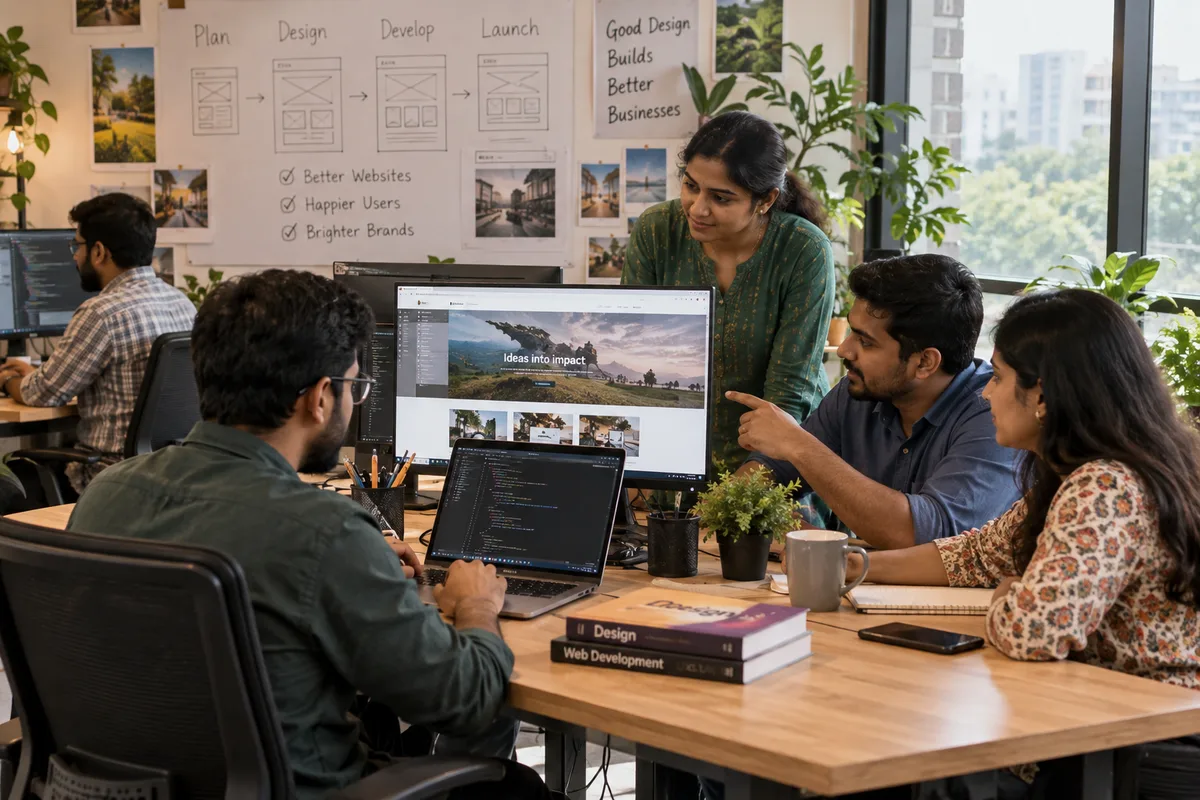
A website is the page a customer lands on after searching, clicking an advert or scanning a code, and it decides whether they call or leave. GullySales builds and maintains sites that load quickly, explain the offer plainly and make the enquiry form or phone number easy to find.
Also for website design and development companies
- PPC ads for website design and development companies
- Lead generation for website design and development companies
- Digital marketing for website design and development companies
- Reputation management for website design and development companies
- Branding for website design and development companies
- Social media marketing for website design and development companies
- Content marketing for website design and development companies
- Email marketing for website design and development companies
Sales and marketing for website design and development companies, the overview.
Last updated 5 Oct 2026.
For website design and development companies
Where it usually goes wrong, and what we would do.
“The homepage names a craft but not a customer”
A line about creative, responsive, modern websites fits every studio. A visitor who runs a clinic or a pump factory cannot tell whether you have built for their kind of business, and leaves to find a studio that says so.
“Prices are hidden and so are the people”
Owners who suspect a high quote or a faceless team hesitate. A page that explains what drives cost, offers starting points for common site types and shows who will do the work answers the doubt before the call.
“The ownership question appears only in the contract”
Who holds the domain, the hosting account and the code is the question that closes deals. A clear statement on the site, repeated in the proposal, turns a worry into a reason to choose you.
“There is nowhere to go after launch”
Studio sites sell the build and say nothing of upkeep. A visitor who has a site from someone else, and a problem with it, finds no page for them, though a maintenance plan is the offer that keeps clients.
What we do
What we deliver for website design and development companies.
Every deliverable, what it covers for you, and the result it is there to produce. Nothing here is an extra.
A homepage rewritten around site types and trades
A message that says what you build, for which kinds of business, with the next step clear.
Result: A visitor can say in a sentence what you do and for whom.
Project pages with the brief and the outcome
Case pages that describe the client, the problem, the platform and what the owner now does on the site, in plain language.
Result: Each project reads as evidence with a stated purpose.
A page on how a project runs
The steps from scoping call to handover, what you need from the client and who owns what at the end.
Result: The ownership question is answered in writing on your site.
A maintenance and support page
What a maintenance plan covers, what falls outside it and how to ask for a change.
Result: A visitor with an existing site sees a clear way to hire you.
Enquiry forms that ask what you need to know
A short form asking site type, trade, pages wanted and content readiness, with a phone and a chat option beside it.
Result: Enquiries arrive with enough detail to prepare for the call.
How the result is measured
- Page load time
- Bounce rate
- Enquiries from the website
Recorded as a baseline before work starts, so every later report has an honest comparison.
Searches your buyers type
The pages a web company's own site needs to prove its work.
- website design for [trade]
- A trade page with a finished site, the brief and what the owner now does through it. The best proof for an owner of that trade.
- how much does a website cost
- A page explaining what changes the price, with a starting figure you are willing to publish and the scoping form.
- who owns my website after it is built
- A page on domain, hosting and code ownership at handover. Many owners worry before they ask.
- website content checklist
- A published list of what the client supplies and by when it blocks the launch. It sells order and saves chasing.
- website maintenance and support
- A page for after launch, stating what is covered and how a request is made.
- how a website project runs
- A process page with the steps from scoping to handover, the client's tasks and the studio's, without invented timings.
Who it is for
This is written for these website design and development companies.
- Small web design studios for local businesses
- WordPress and WooCommerce developers
- Shopify and e-commerce website builders
- Custom web application developers
- UI and UX design firms
- Web companies focused on one industry, such as healthcare or real estate
- Hosting and website maintenance providers
- Freelance web developers building a team
Not for
It is not the right fit if.
- You have no finished project you may show, so project pages would carry mockups only.
- You cannot publish a starting price and your clients expect to be quoted by call, so a cost page would invite disputes.
- No one will update the portfolio, and a site showing old work would undercut what you sell.
How it works
How the website work runs
The work itself, in order. How an engagement starts, from your brief to a written scope, is set out on our method page.
- 1
Confirm structure and content
We agree the page list, what each page must answer, and who supplies the text and photographs, before any design starts.
- 2
Design the templates
The home page, a service page, a location page and the enquiry page are designed first, on phone and desktop, and shown to you.
- 3
Build and test
The site is built and checked on real phones and the common browsers. Every form, call button and WhatsApp link is tested end to end.
- 4
Load real content
Actual copy, images and information replace placeholders. Pages are read through once by you, since you spot wrong details we cannot.
- 5
Check before launch
Tracking, page titles, the sitemap and the privacy page are checked on the staging site. If an old site exists, its addresses are mapped so old links still land somewhere.
- 6
Launch and hand over access
The site goes live and we record the domain, hosting, content login and analytics in your name. The first live enquiry is traced to confirm tracking works.
Where this fits
Three pieces of sales work, in this order.
This work sits inside sales process design, at stage 1, prospecting and lead generation. The audit comes before it, and sales management keeps it running.
Step 1
Sales audit
Find where deals are being lost and what to fix first.
Start here if you cannot say where orders are lost.
Step 2 · you are here
Sales process design
One written way to sell, from first enquiry to repeat order.
Start here if every salesperson sells differently.
Step 3
Sales management
A target, a review routine and someone who owns the number.
Start here if the team has targets and no routine.
FAQ
Questions owners ask before they call.
Not here? More answers, or ask on WhatsApp.
Should we show prices on our website?
How many projects should the portfolio show?
Should we show prices on our website?
How many projects should the portfolio show?
How long is the contract?
How soon will we see results?
Who will actually do the work?
What do you need from us?
What if we are not happy with the work?
More for website design and development companies
Everything else we would do for you.
- PPC ads for website design and development companies
- Lead generation for website design and development companies
- Digital marketing for website design and development companies
- Reputation management for website design and development companies
- Branding for website design and development companies
- Social media marketing for website design and development companies
Or start from the overview: sales and marketing for website design and development companies.
Your next practical step
Tell us what you are trying to grow, and we will read it before we call.
Eight short steps, mostly taps. Skip anything you would rather answer on the call.