Temples · Buyer journey
Trace the path from a search for the deity to a booked seva.
The devotee journey runs from a search for the deity and the town, through the timings and the festival calendar, to a booked seva or an offering sent from another city. GullySales maps that path for your temple and finds the point where a devotee gives up and closes the page.
A 90-minute audit call and a written, scored report. Turnaround, reporting and term are agreed in writing after the audit.
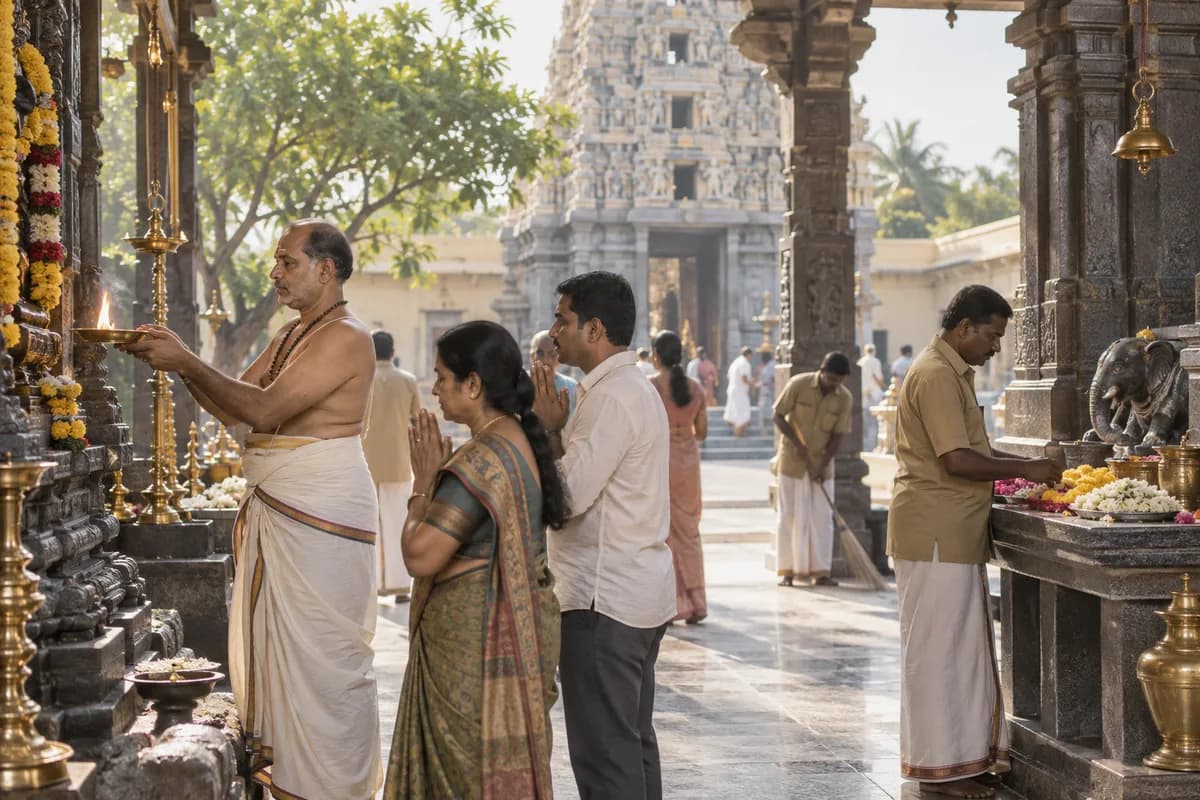
What buyer journey means
The buyer journey is the sequence of steps a customer actually takes, from first hearing about you to deciding to buy, which is rarely a single visit or call. GullySales maps this sequence for your business and checks that something useful happens at each step instead of only at the final call.
For temples
Where it usually goes wrong, and what we would do.
“The journey starts weeks before the festival, not on the day”
A family travelling for the brahmotsavam books their tickets well ahead. They are looking for the dates, the timings and whether a seva can be reserved, and a calendar not yet published sends them to a temple whose calendar is.
“A local devotee and a family abroad travel different paths”
Somebody in the next street checks nothing and walks in. A family in another country needs the date, a payment page that works, a receipt, and afterwards some sign that the ritual was performed.
“Many journeys end at a phone number”
A page that answers a question with call the office loses the devotee reading it at eleven at night, or from another time zone, or who simply will not ring a stranger to ask the cost of an archana.
What we do
What we deliver for temples.
Every deliverable, what it covers for you, and the result it is there to produce. Nothing here is an extra.
The devotee's path written out, search to offering
The steps a devotee takes, named and put in order, from the first search to the receipt for a seva or a donation.
Result: The trust can see the journey instead of guessing at it.
The drop-off points found in your own pages
Where visitors leave: the timings page, the seva list, the payment step or the receipt, counted rather than assumed.
Result: You know which page is losing the visit.
A separate path for the family living away
What an out-of-town or overseas family needs at each step, including the confirmation that the ritual took place.
Result: A distant family is planned for rather than improvised around.
A festival path prepared ahead of the calendar
What a devotee needs in the weeks before a brahmotsavam: dates, travel information, accommodation and the seva booking page.
Result: The information exists before devotees start planning.
A first-time visitor path
Where to park, which entrance, what is expected of a visitor, whether photography is allowed and how long darshan usually takes.
Result: A first visit is clear enough that the family comes again.
How the result is measured
- Drop-off rate by step
- Time from first contact to sale
- Steps with no content
Recorded as a baseline before work starts, so every later report has an honest comparison.
Who it is for
This is written for these temples.
- Ancient and heritage temples with high pilgrim footfall
- Neighbourhood and community temples
- Temple trusts managing more than one shrine
- Shrines with a strong NRI devotee base overseas
- A temple known for one festival or utsavam
- Temples running annadanam and community welfare programmes
Not for
It is not the right fit if.
- You want a guaranteed Google ranking or a guaranteed number of leads. Nobody honest can promise either.
- You need enquiries by next week and have nobody to answer them.
- You want posts and reach reported, not enquiries and orders.
How it works
From your first message to the first report.
No open-ended retainer. Every step gives you something in writing.
01 · First
Free audit call
90 minutes with whoever handles your enquiries: how they arrive, how fast they are answered, where they are lost.
02 · After the call
Written, scored report
Six areas scored, fixes ranked by return and cost. If you want our help, the scope, the fee and the reporting come with it, in writing.
03 · Before work starts
Baseline recorded
Enquiries by source, reply time, conversion and cost per order, written down so every later report has an honest comparison.
04 · After the baseline
The first fix goes live
Usually the cheapest one on the report: reply time, a follow-up sequence or the marketing-to-sales handover.
05 · As agreed
Report against the baseline
What moved, what did not, and what changes next, in plain words. How often you get it is set in writing before work starts.
06 · At renewal
Renew on the numbers
The term ends and you decide whether to continue from the results. The length is agreed in writing before anything starts.
How the work runs for temples
- 1
Audit the devotee journey
We check what a devotee sees when they search for the temple and the town, how sevas are booked today, and how offerings from outside the town are received.
- 2
Build the site and the calendar
Timings, the deity's history, the festival calendar for the year and a page for each major seva, kept current rather than left from the last update.
- 3
Set up online booking and donation
A seva booking and donation flow that works on a phone, with an automatic receipt, so a family living away can offer from anywhere.
- 4
Reach devotees before the festival
WhatsApp and social reminders sent ahead of the brahmotsavam or a monthly special pooja, timed to when devotees actually plan their visit.
- 5
Record every offering
A simple record of who booked what seva and when, so a returning donor is recognised and thanked rather than treated as a stranger each visit.
Proof
What happened when owners fixed this.
Real clients, the work we did, and the result as it was recorded. Where no number was recorded, none is claimed.
LL Trust
- Situation
- The trust had no identity of its own, so nothing in how it presented itself distinguished it from comparable organisations competing for the same donors.
- What we did
- Comparable organisations reviewed
- Logo and branding
- A palette that carries the values
- Reviewed with the trust
- Result
- No numbers were recorded for this engagement. The work is described in full in the case study.
Chord Road Hospital
- Situation
- Patients who knew the hospital trusted it. Patients who searched for a department or a treatment in the area did not find it.
- What we did
- Website rebuilt around patient needs
- Search visibility
- Social media on a schedule
- Review management
- Result
- Organic traffic increased 60% within six months
- Online appointment bookings increased 40%
- Social following grew 45%, and engagement on it rose 70%
Also worked with
Curtain Label · Difesa Security Services · Felicity Inn · Hands On CSR · Implevista · Kambar Group · Kalessi · Kerur Pain Clinic · Lucky Deals · Natural Gases · NavaShakthi Souhardha · NewCom Logistics · Proton Technical Services · SB Engineering · Shakthi Foundation · Shakthi Group · Urbanest · Insyde Studio · Venkateshwara Laser Tech · Vivara Studios
Why us
Why owners pick GullySales over an agency.
Marketing and sales, as one job
Most agencies stop at the enquiry. We also fix what happens after it: the reply, the follow-up, the quote and the CRM.
The person on the first call does the work
No account managers in between. You are never handed to someone you have not met.
A baseline before anything starts
Your numbers are written down on day one, so every later report compares against something honest.
The fee in writing, split three ways
Our time, your media spend and production on separate lines. You always see what goes to us.
No guarantees we cannot keep
The term is agreed in writing and never a default twelve months. We never promise a ranking or a lead count, because nobody controls those.
One office, and we say so
Nagarbhavi, Bengaluru. We work across India by call and WhatsApp and travel when a session needs to be in person.
#257, 3rd floor, Sri Nanjundeshwara Complex, Nagarbhavi 8th Block, Outer Ring Road. How we work.
The offer
Start with a free audit of how you sell.
It is useful on its own, whether or not you hire us.
What you receive
- A 90-minute call with the person who will do the work
- A written, scored report on the six places orders leak
- Every fix ranked by what it returns and what it costs
- The one thing to do first, and why
- An honest line on whether you need outside help at all
- If you do, the scope and the fee in writing
No invoice. No obligation. No sales script.
FAQ
Questions owners ask before they call.
Not here? More answers, or ask on WhatsApp.
Is this not the same as building a website?
Our devotees are mostly local. Is it still worth doing?
Can a temple trust really run online bookings?
Is it appropriate to market a temple?
How much does it cost?
How long is the contract?
How soon will we see results?
Who will actually do the work?
What do you need from us?
What if we are not happy with the work?
More for temples
Everything else we would do for you.
- Branding for temples
- Content marketing for temples
- CRM for temples
- Online booking and donation tools for temples
- Paid advertising for temples
- SEO for temples
- Social media for temples
- Website for temples
- Follow-up systems for temples
- Review generation for temples
- Devotee retention for temples
- Word of mouth and referrals for temples
- WhatsApp for temples
Or start from the overview: sales and marketing for temples.
Your next practical step
Get a free audit of how you sell, and a scored report of where the work is.
90 minutes. A written, scored report. No invoice and no obligation.