Airport advertising · Marketing
An airport panel is a reputation buy, and dwell time decides what it is worth.
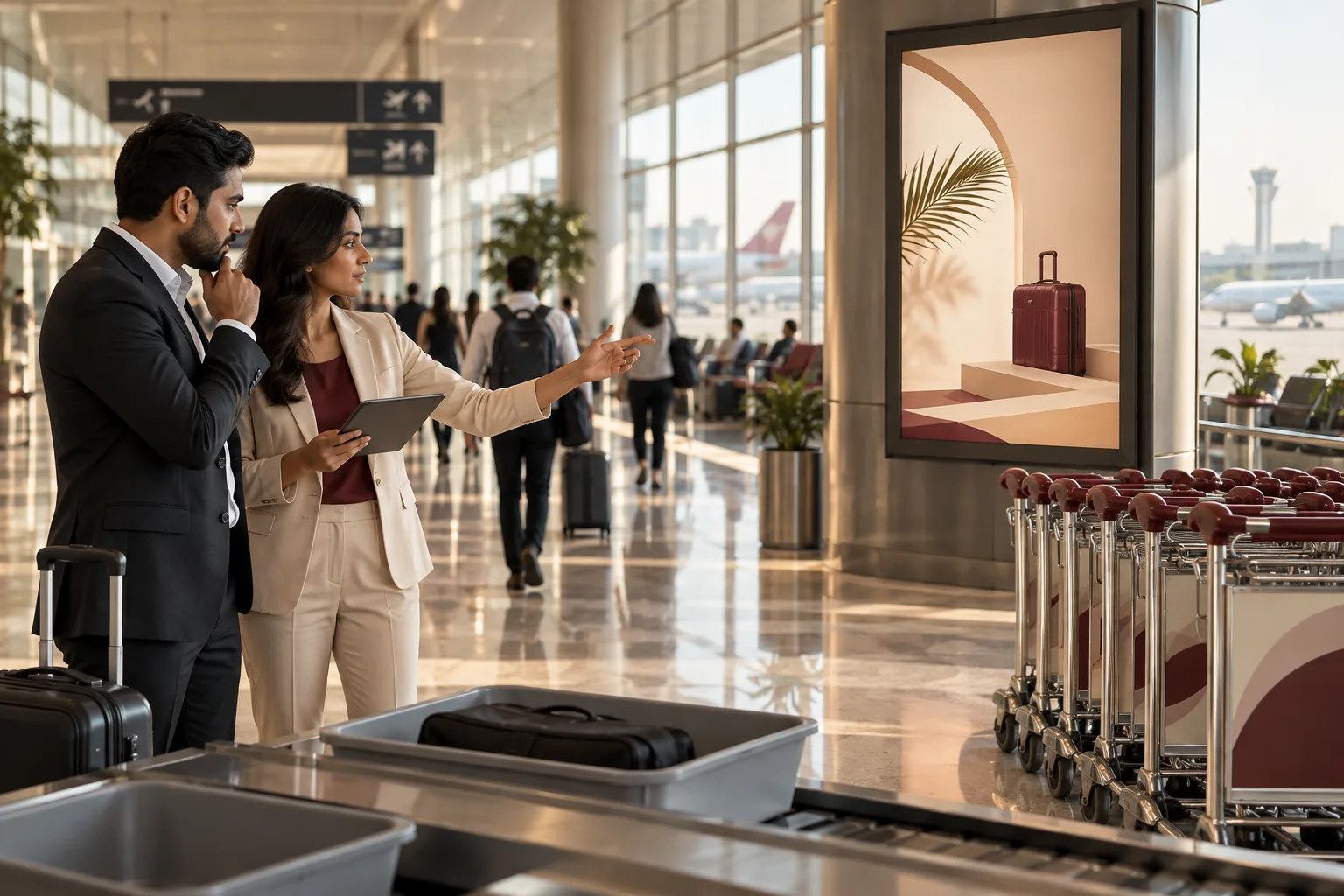
Dwell time is the whole argument, and it differs wildly inside one terminal. A security tray is held for a minute by a person with nothing to do and both hands occupied. A panel in the corridor between gates is passed in four seconds by somebody who is late.
Scope, fee, reporting and term are agreed in writing after we have read your brief and spoken to you.
In one paragraph
Airport advertising buys a named site inside a terminal for a month or a quarter: a backlit panel, a slot in a digital loop, trolleys or security trays. GullySales works out which zones your buyer actually stops in and coordinates the booking with the media owner who holds those rights. It builds standing, not enquiries.
So the baggage belt, the check-in queue, the tray and the lounge are worth paying for. The corridor is not, at the same money. When a package is quoted across a terminal, the question to ask is how much of it is corridor.
This is a branding buy. Nobody enquires from an airport panel on the spot, and a seller who presents it as a lead source is selling you something else. What it does is make your name familiar to people who fly every week, which is a narrow and expensive audience to reach any other way.
Who it is for
This is written for you if these sound familiar.
- B2B companies whose buyers fly weekly and whose sales team is already meeting them
- Premium property sold to people who travel, where the name has to be known before the site visit
- Financial services, private hospitals and corporate brands who need to look established to a corporate audience
- A brand already advertising to the same people on LinkedIn, where the terminal repeats what they saw at their desk
- Businesses opening in a city where nobody has heard the name and the corporate market matters
Not for
It is not the right fit if.
- Any business that needs enquiries this quarter, because this buy will not produce them
- Local businesses whose customers live within a few kilometres and pass an airport twice a year
- A cycle shorter than a quarter, since the same traveller has to pass the site more than once for it to register
The problem
Does this sound like your business?
What owners tell us on the first call, in their words.
“The site was bought on price, not on whether anyone stands there”
Two sites in the same terminal are quoted close to each other, and one faces a queue while the other faces a corridor. A rate on its own cannot tell them apart.
“The artwork was rejected a week before installation”
Airport sites are installed to the operator's specification and the operator approves what goes up. A design signed off in your office is not signed off there.
“Somebody called the campaign a failure because no calls came”
There was no way for a call to arrive. An airport panel judged on enquiries is judged on the wrong thing, and the cycle gets cancelled before it has done its actual job.
“The screen slot turned out to be one of many in a loop”
Digital sites are sold as a slot inside a rotating loop, so your ten seconds comes round every few minutes. That is a different product from a panel lit all day, and it is not always quoted as one.
What we do
Everything that is included.
Each deliverable, and what it gets you. Nothing here is an extra.
Zone and dwell mapping
Where people stop inside the terminal, matched against where sites are available, so the buy sits in the waiting rather than the walking.
Site shortlist with photographs
Every proposed site seen in a photograph with whatever faces it, rather than picked off a list of names.
Format comparison
A backlit panel, a slot in a digital loop, trolleys and trays priced against each other for the same cycle. The cheap unit is not automatically the better buy.
Boarding pass and cabin formats
Advertising also sells on the back of a boarding pass, on an e-boarding pass, on baggage-belt wraps and on trolley branding. Inside the aircraft it is headrest covers, seat-back branding and the cabin bulkhead, and those come from the airline's media agency.
Booking coordination
The buy placed with the media owner holding rights to that terminal, with the site, the cycle and the installation date confirmed in writing. Sites are sold on a month at the least, and approval and fabrication typically put the start about a month after the order.
Artwork to the operator's spec
Creative produced to the exact site dimensions and submitted for the airport operator's approval with time left to change it.
A route worth having
A short web address or a QR code used nowhere else, opening a page written for somebody standing at a belt with a phone in hand.
Installation proof
Dated photographs once the site is up and again during the cycle, because you are not going to be standing there.
How the result is measured
- Sites installed and photographed against the booking
- Branded searches during the cycle
- Visits to the campaign address or QR page
- Recognition your sales team reports in meetings
- Cost per month of the cycle against the other channels running
Recorded as a baseline before work starts, so every later report has an honest comparison.
How it works
How the airport advertising work runs
The work itself, in order. How an engagement starts, from your brief to a written scope, is set out on our method page.
- 1
Agree what this is for
We put in writing that the goal is recognition among people who travel, and where this quarter's enquiries are actually coming from instead.
- 2
Map the terminal
We work through the zones by how long a person is held in each, then shortlist sites in the ones that hold people.
- 3
Compare and book
Formats and cycle lengths are compared on the same basis, and the booking is coordinated with the media owner for that terminal.
- 4
Produce and clear the artwork
Creative is built to the site dimensions and put through the operator's approval ahead of the installation date.
- 5
Check and report
Installation photographs, the brand search trend and anything arriving at the campaign address go into the report against the cycle.
Where this fits
Three pieces of sales work, in this order.
This work sits inside sales process design, at stage 1, prospecting and lead generation. The audit comes before it, and sales management keeps it running.
Step 1
Sales audit
Find where deals are being lost and what to fix first.
Start here if you cannot say where orders are lost.
Step 2 · you are here
Sales process design
One written way to sell, from first enquiry to repeat order.
Start here if every salesperson sells differently.
Step 3
Sales management
A target, a review routine and someone who owns the number.
Start here if the team has targets and no routine.
FAQ
Questions owners ask before they call.
Not here? More answers, or ask on WhatsApp.
Will airport advertising bring us enquiries?
Which part of the airport is worth paying for?
How long should we book it for?
Do you own the airport sites?
Is a hoarding on the airport road the same buy as a panel inside the terminal?
What does an airport campaign cost?
How long is the contract?
Who will actually do the work?
What do you need from us?
What if we are not happy with the work?
By industry
Airport advertising, written for your industry.
Related services
Often bought with this, or instead of it.
Your next practical step
Tell us what you are trying to grow, and we will read it before we call.
Eight short steps, mostly taps. Skip anything you would rather answer on the call.