Bus advertising · Marketing
The bus you booked spends half its day on a route you never asked for.
Transit advertising is the whole category: buses, autos, taxis, metro pillars and station panels. This page is only the bus, because a bus has a depot and a roster, and nothing else in transit works that way.
Scope, fee, reporting and term are agreed in writing after we have read your brief and spoken to you.
In one paragraph
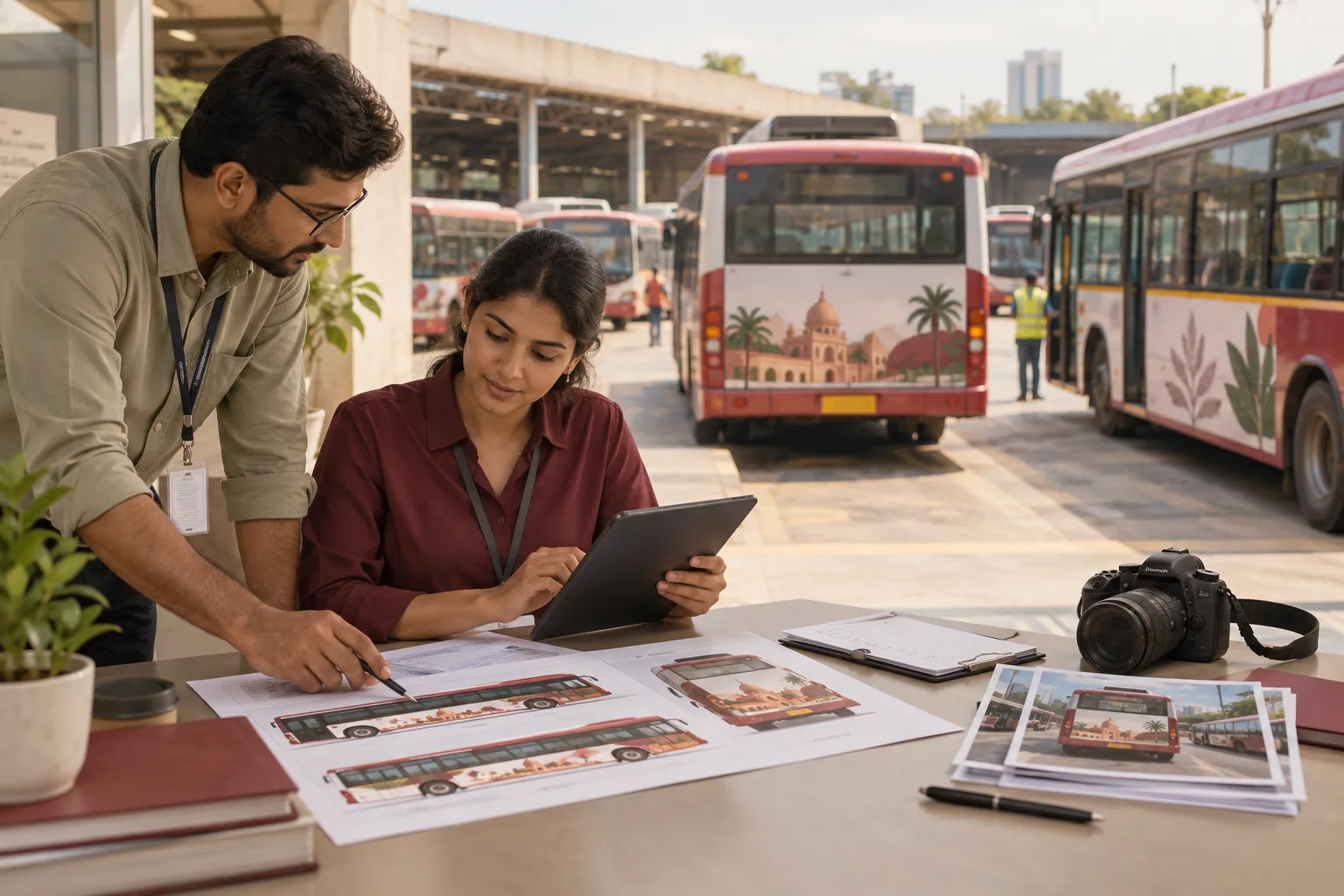
Bus advertising buys a panel on named vehicles for a month, as a back panel, a side panel, a full wrap or a card inside the saloon. GullySales checks which depot each vehicle belongs to before booking, coordinates with the operator or the transport authority's appointed agency, and collects dated photographs.
You are not buying a route. You are buying a panel on a vehicle, and the depot decides where that vehicle runs each day. Ask which depot it is allotted to, and what the operator will do if the roster changes mid-month.
A back panel is read by whoever is stuck behind it at a signal. So a city route with traffic lights every kilometre is worth more than a highway service where nothing stops. That is the opposite of how most rate cards are arranged.
Who it is for
This is written for you if these sound familiar.
- Coaching centres and colleges advertising on the routes their students already ride
- Hospitals and diagnostic chains wanting their name along one corridor of the city
- A builder whose project sits on a road buyers pass twice a day
- Retail chains opening in a suburb and buying the routes that terminate there
- Brands that want a full month in front of the same commuters rather than one week
- Anyone who paid for a bus wrap and never saw the vehicle again after mounting day
Not for
It is not the right fit if.
- Businesses that must prove which enquiry the panel produced, because a bus records nothing about who read it
- A campaign that needs one fixed route guaranteed for the month, since vehicles are reallocated between depots
- Sellers whose buyers are a few hundred named companies, where a road full of commuters is the wrong crowd
The problem
Does this sound like your business?
What owners tell us on the first call, in their words.
“The bus we paid for runs somewhere else now”
Vehicles are moved between depots and routes during the month. Your panel is still up, and the people you wanted never see it.
“Nobody has photographed the vehicle since mounting day”
A wrap gets torn at the depot wash and a back panel is scraped in traffic. The first anyone hears of it is when the cycle ends.
“The design was made for a hoarding”
A back panel is read from ten metres by a driver in stopped traffic, who has time for a second line. The half-empty layout that suits a hoarding wastes the space.
“The bus sleeps at the depot from eight at night”
Half the display period you pictured is a parked vehicle behind a gate. Running hours per day is a question to ask before the order, not after.
What we do
Everything that is included.
Each deliverable, and what it gets you. Nothing here is an extra.
Route and depot check
Which depot each vehicle is allotted to, the route it works now, and what the operator will put in writing if that allotment changes.
Panel type chosen for the read
Back panel, side panel, full wrap or an inside card, picked for whether your buyer is behind the bus, beside it or sitting in it.
The right booking route
Corporation buses go through the transport authority's appointed agency. Private, contract and staff buses are booked with the operator direct, and we work whichever one applies.
Artwork built to the vehicle
Every panel has its own size, its own curve and a strip the frame covers. The file is made to the measurement rather than resized from a poster.
Registration numbers on the order
Vehicles listed by registration number, so photographs coming back can be matched against exactly what you paid for.
Mounting and mid-cycle photographs
Dated pictures of each bus with the number plate visible, at the start and again during the cycle, so a torn panel is replaced while the month is still running.
Inside cards for captive routes
On school, staff and contract buses, the card a seated passenger reads for forty minutes. That is a longer message than a back panel can carry.
A response route you can count
A campaign number or a counter code on the panel, plus enquiries from that corridor before and during the cycle. It shows a direction and never a count.
How the result is measured
- Vehicles running with the panel intact, by registration number
- Display days delivered against display days paid for
- Rate booked against the first quote
- Calls to the campaign number during the cycle
- Enquiries and walk-ins from the corridor before and during
Recorded as a baseline before work starts, so every later report has an honest comparison.
How it works
How the bus advertising work runs
The work itself, in order. How an engagement starts, from your brief to a written scope, is set out on our method page.
- 1
Pick the corridor before the vehicle
We agree which roads and which end points matter. A coaching centre in Vijayanagar needs the routes that terminate there, not a fleet spread across the city.
- 2
Ask what is actually running
Availability is checked with the operator or the appointed agency: which vehicles are free, from which depot, and on which route today.
- 3
Compare panel against panel
Cost is weighed against running hours, how much the route stops and starts, and the size of the panel. Fleet size in a proposal decides nothing.
- 4
Book, then print to the vehicle
The booking is coordinated with the media owner, and printing begins only once the exact panel measurements for those vehicles are confirmed.
- 5
Photograph and chase
We collect mounting and mid-cycle pictures, then take up anything torn, faded or missing with the operator while the cycle still has days left in it.
Where this fits
Three pieces of sales work, in this order.
This work sits inside sales process design, at stage 1, prospecting and lead generation. The audit comes before it, and sales management keeps it running.
Step 1
Sales audit
Find where deals are being lost and what to fix first.
Start here if you cannot say where orders are lost.
Step 2 · you are here
Sales process design
One written way to sell, from first enquiry to repeat order.
Start here if every salesperson sells differently.
Step 3
Sales management
A target, a review routine and someone who owns the number.
Start here if the team has targets and no routine.
FAQ
Questions owners ask before they call.
Not here? More answers, or ask on WhatsApp.
Can I choose the route my bus runs on?
Back panel or full wrap?
How do I know the panel is still up there?
Can you tell me how many people saw it?
Do you own bus panels, or have a tie-up with the corporation?
How much does it cost?
How long is the contract?
How soon will we see results?
Who will actually do the work?
What do you need from us?
By industry
Bus advertising, written for your industry.
Related services
Often bought with this, or instead of it.
Read before you buy
- How to design bus advertising for each panelThe rear panel is read for minutes by a driver stuck behind it. The side panel gets three seconds from a footpath. Same bus, same campaign, two different pieces of artwork.
- Bus advertising in Bengaluru: who the panel actually reachesThe back of a BMTC bus is read by the people stuck behind it, not by the people on it. Routes, depots, Volvo services, airport shuttles and shelters are five different buys with different audiences.
Your next practical step
Tell us what you are trying to grow, and we will read it before we call.
Eight short steps, mostly taps. Skip anything you would rather answer on the call.