Billboard advertising · Marketing
Your billboard should be read in three seconds by the people who can buy.
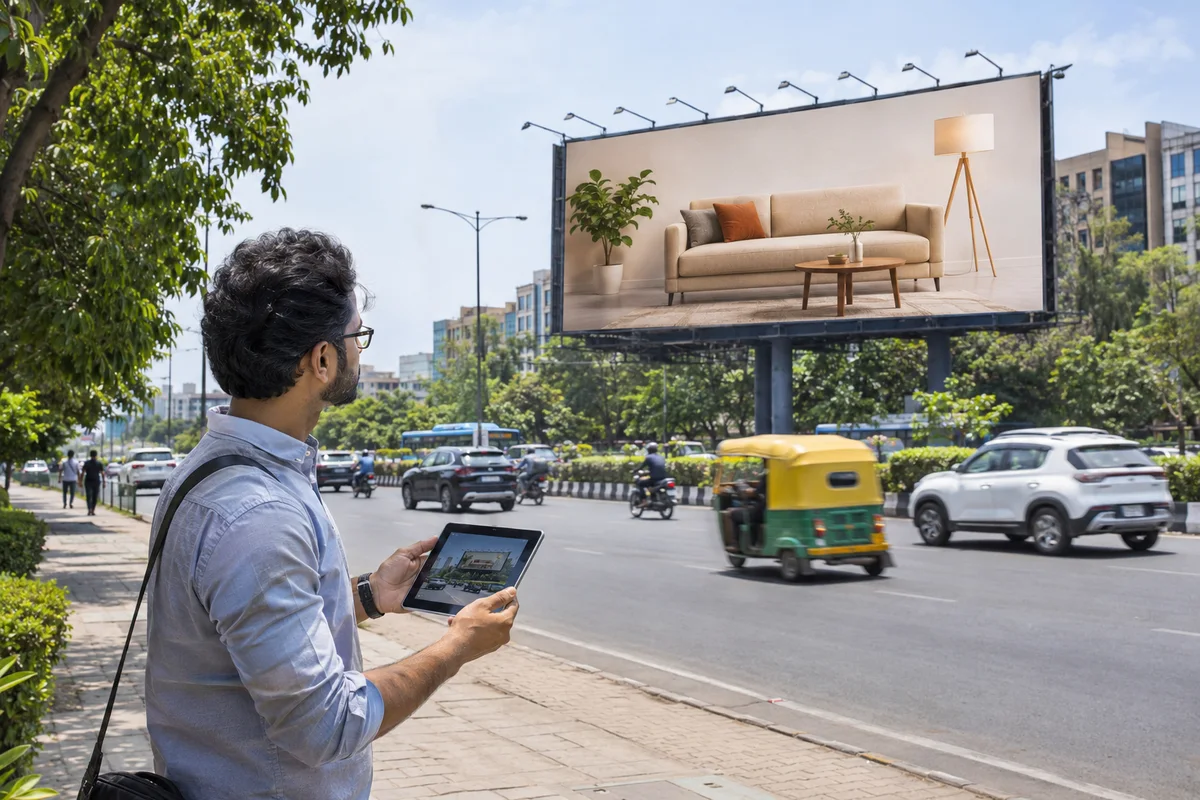
A billboard is read from a moving bike, car or bus. The reader has a few seconds, no pen and no patience. A site that looks good in a proposal can fail on the actual road.
Scope, fee, reporting and term are agreed in writing after we have read your brief and spoken to you.
In one paragraph
Billboard advertising rents a named hoarding or unipole on a road for a fixed display period, so passing buyers see your name and one message. GullySales picks sites by who passes and what they can read, checks the media owner's permission papers, prepares the artwork, and sets up a response route you can count.
This service is for one decision: which hoardings to rent, in what form, and what they should say. Wider outdoor planning across several media types sits with outdoor advertising. Screens that change their message sit with digital out of home advertising, and advertising on vehicles sits with transit advertising.
A billboard builds recognition first. Response comes only if the board gives people something easy to act on, and you record it.
Who it is for
This is written for you if these sound familiar.
- Showrooms and dealers who want their name known on the road their buyers drive
- Builders and plotted developers directing people to a site office or sales gallery
- Clinics, schools, coaching centres and shops that serve one catchment
- Jewellers and furniture stores planning a festive or launch period
Not for
It is not the right fit if.
- Sellers whose buyers are a short list of purchasing teams in different cities, where a roadside board reaches the wrong people
- Owners who want every order traced to one board, which no billboard can do
- Anyone who expects GullySales to apply for the permission itself, since the media owner holds it
The problem
Does this sound like your business?
Common situations this work addresses.
“The site looked great on the map”
The board faces away from your buyers, sits behind a tree, or is read only at speed. A pin and a dated photograph do not show who can read it.
“Nobody can read the message”
The design carries a logo, an offer, three lines and an address. At road speed that is noise, and nobody remembers the number.
“The board was lit on paper only”
You paid for a lit site, but the lights fail after dark or switch off early. Without an evening photograph you cannot raise it.
“We do not know if it worked”
Calls rise and fall for several reasons. With no code, number or search term tied to the board, the renewal is a guess.
What we do
The work we can include.
Each deliverable and the purpose it serves. Your written scope confirms what is included, who is responsible, and what it costs.
Site shortlist with traffic notes
Each site is checked at the hours your buyers travel: facing direction, signal queues, slow bends and obstructions. Photographs come from the viewing position, not the brochure.
Lit or unlit comparison
A written note on whether evening reading justifies a lit panel for you. A showroom open after dark and a school that closes at four do not need the same thing.
Permission paper check
The papers asked of the media owner: permission for that structure, its validity dates, and the structure's safety certificate. Gaps are flagged before you pay. The media owner holds the permit.
Booking sheet
Site address, panel size, dates, lighting hours and rate in one place. Printing, mounting and GST are separate lines, so two quotes compare fairly.
Three-second artwork
One idea, a short line, your name and one way to respond, set to the media owner's size and safe area. You see a proof, and a mock-up at reading distance, before production.
Proof-of-display file
Dated photographs at mounting, one mid-period check and one after dark for lit sites. Torn, blocked or dark panels go to the media owner in writing.
Response route and tally
A QR code, a dedicated phone line or a search term printed on the board, and a sheet where your team notes what callers and visitors say. Billboard response is counted apart from other channels.
How the result is measured
- Sites displayed as booked, with dated photographs
- Lit hours checked after dark
- Calls on the campaign line
- QR code scans
- Branded searches and walk-ins that mention the board
- Enquiries and orders traced to a recorded response
Recorded as a baseline before work starts, so every later report has an honest comparison.
Before you decide
Agree the work. Know how to judge it.
Billboard advertising: use these checks to prepare, choose the scope, and review what changes.
Bring the right evidence
State the buyer group, catchment, and dates that matter to the offer. Ask for the proposed inventory and available evidence about its audience, with the source and date shown.
Make the scope clear
Agree the exact placements, formats, booking period, and proof of delivery. Separate media charges from design, production, permissions, and installation where these apply.
Check the work in use
Compare delivery evidence with the agreed booking and record enquiries through a distinct response route where practical. Treat audience estimates separately from measured responses.
Know when to change course
Do not buy a placement only because it is discounted. If the location or audience does not fit the buyer, revisit the plan before committing production costs.
These are discussion points, not a fixed package. GullySales confirms the deliverables, responsibilities, fee, and term in writing after reading your brief and speaking with you.
How it works
How the billboard advertising work runs
The work itself, in order. How an engagement starts, from your brief to a written scope, is set out on our method page.
- 1
Buyer and route brief
You tell us who you want to reach and where they travel. A clinic in Nagarbhavi needs a few local roads, not the whole city.
- 2
Site visits and shortlist
We view candidate sites at the right hours and send you a shortlist. You choose; we do not book on our own.
- 3
Paper and terms check
We ask each media owner for the permission and safety papers and compare written terms. Anything missing is raised before you commit.
- 4
Artwork and response route
We write the line, set the layout to the panel and prepare the QR code or phone line. Your proof is approved before printing.
- 5
Display and checks
Mounting and lighting are photographed against the booking. Faults go back to the media owner while the display period is still running.
- 6
Review and renewal
Display evidence and response records are read side by side. You decide whether to keep a site, change the message or stop.
Before you hire anyone
Do this first yourself.
Spend an hour on the road before you ask anyone for a site list.
- Drive or ride the routes your buyers use, at the hours they use them, and note where traffic slows or queues.
- Write one sentence saying who the board is for and the one thing they should do after reading it.
- Decide which response you can count: a new phone line, a QR code to one page, or a search term.
- Ask your team to log how every caller or visitor heard of you, starting before the board goes up.
- Check whether your own offer or claim needs a regulator's or professional body's approval before it is printed.
Judge any provider
What to ask any provider of this service.
Useful whoever you choose, including us.
- Which papers does the media owner hold for this exact structure, and what are the validity dates?
- Can I see current photographs from the road, and one taken after dark for a lit site?
- Are rent, printing, mounting and GST quoted as separate lines?
- Who is responsible if the panel is torn, blocked or unlit during the period?
- How will you show me the board was displayed as booked?
- How will response be counted apart from other advertising?
Where this fits
Three pieces of sales work, in this order.
This work sits inside sales process design, at stage 1, prospecting and lead generation. The audit comes before it, and sales management keeps it running.
Step 1
Sales audit
Find where deals are being lost and what to fix first.
Start here if you cannot say where orders are lost.
Step 2 · you are here
Sales process design
One written way to sell, from first enquiry to repeat order.
Start here if every salesperson sells differently.
Step 3
Sales management
A target, a review routine and someone who owns the number.
Start here if the team has targets and no routine.
FAQ
Questions owners ask before they call.
Not here? More answers, or ask on WhatsApp.
Do I need permission to put up a billboard?
Can you get the municipal approval for me?
How many words should the board carry?
Is a lit board worth it?
How do I know people saw my board?
What will it cost and how long will it run?
How long is the contract?
Who will actually do the work?
What do you need from us?
What if we are not happy with the work?
By industry
Billboard advertising, written for your industry.
Related services
Often bought with this, or instead of it.
Your next practical step
Tell us what you are trying to grow, and we will read it before we call.
Eight short steps, mostly taps. Skip anything you would rather answer on the call.