Door-to-door promotional campaigns · Marketing
Our team should meet households and shops face to face, and know which visits became enquiries.
A water purifier dealer, a solar installer, a coaching centre and a home-cleaning firm all want the same thing: a conversation at the doorstep with someone who can buy. The conversation only works if the household agreed to it, the area was worth the walk and every visit was written down.
Scope, fee, reporting and term are agreed in writing after we have read your brief and spoken to you.
In one paragraph
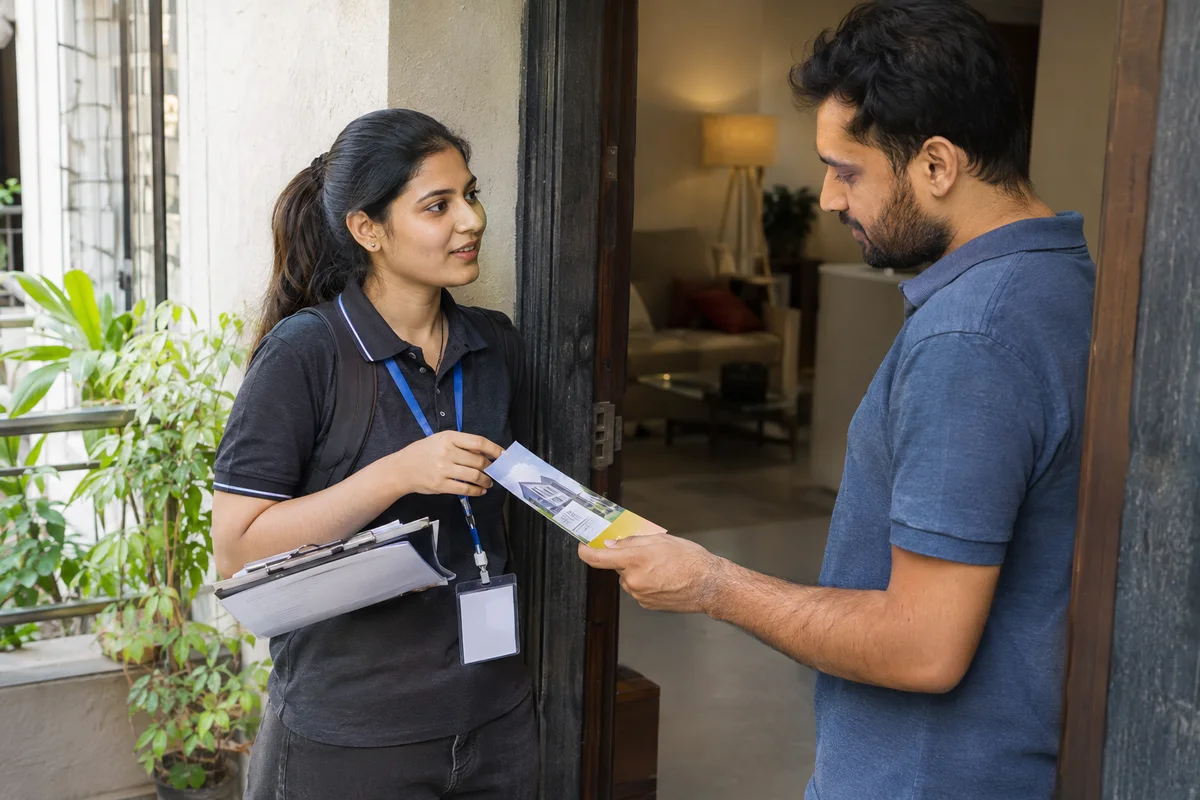
Door-to-door promotional campaigns send briefed people to chosen streets, societies and shops with a leaflet, an offer or a demonstration, and a way to record who showed interest. GullySales selects the areas, prepares permissions and the visit kit, and sets up the visit record.
Courtesy and consent are part of the method. Societies set their own rules for visitors and canvassers, and a resident who says no is a record, not a failure to overcome.
This page covers visits on foot. Wider local media sits under hyperlocal advertising, panels and stalls inside buildings sit under apartment advertising, and mail and messages sit under direct marketing.
Who it is for
This is written for you if these sound familiar.
- Home-service firms such as cleaning, pest control, solar and water treatment that need households in a defined area
- Coaching centres, clinics and salons introducing a new branch to the streets around it
- Builders and interior firms holding a site visit or a showroom day for nearby residents
- Dealers and distributors who need to meet shopkeepers on a market street
- Product brands that need a household to see the product demonstrated
Not for
It is not the right fit if.
- Sellers whose buyers are spread across cities and gain nothing from a street-by-street visit
- Businesses that cannot answer a household enquiry within the day it is recorded
- Anyone who wants canvassers to continue after a society or a resident has refused entry
The problem
Does this sound like your business?
Common situations this work addresses.
“We handed out thousands of leaflets and got a few calls”
A leaflet with no visit record cannot say which street, which canvasser or which offer produced the call. The next round repeats the same guess.
“The security guard turned our team away”
Gate entry belongs to the society committee. Without a written go-ahead and a named contact, the team stands outside while the day's plan fails.
“Our canvassers say different things at the door”
The offer, the price conversation and the claims drift from person to person. A residents' group notices and the complaint reaches your name.
“People gave their number, then complained about the calls”
The household shared a number for one purpose and received another. Consent and the reason for contact were never recorded at the door.
What we do
The work we can include.
Each deliverable and the purpose it serves. Your written scope confirms what is included, who is responsible, and what it costs.
Area and household selection sheet
Streets, societies and market lanes chosen against where your buyers live and where you can serve them. Each row notes housing type, access and the day the area is visited.
Permission file
A written request to each society committee, its reply and a named contact at the gate. Areas without a reply stay off the route.
Canvasser briefing note
A one-page script of the opening line, the offer, the claims allowed and the answers to common objections, with what to say when a household declines.
Conduct rules
Visit timings, dress and identity card, how to take no for an answer, and what never to promise at the door. You approve these before the first visit.
Offer sheet
A single sheet or leaflet carrying one offer, your address and one response route such as a number or a QR code. Claims are checked with you before printing.
Lead capture form
Paper or phone fields for name, address, interest, preferred time and a consent line stating who will contact the household and why.
Visit record
A sheet or sheet-based tracker logging each door as no answer, declined, interested or appointment, with the canvasser, date and street.
Handoff list
Interested households passed to your sales owner with the visit note, so the first call refers to what was said at the door.
How the result is measured
- Doors visited and households spoken to, kept separate from leaflets handed out
- Interested households and appointments by street and by canvasser
- Refusals, complaints and areas withdrawn
- Reply time from capture to first call
- Orders traced to a visit
- Cost per order against the starting baseline
Recorded as a baseline before work starts, so every later report has an honest comparison.
Before you decide
Agree the work. Know how to judge it.
Door-to-door promotional campaigns: use these checks to prepare, choose the scope, and review what changes.
Bring the right evidence
State the buyer group, catchment, and dates that matter to the offer. Ask for the proposed inventory and available evidence about its audience, with the source and date shown.
Make the scope clear
Agree the exact placements, formats, booking period, and proof of delivery. Separate media charges from design, production, permissions, and installation where these apply.
Check the work in use
Compare delivery evidence with the agreed booking and record enquiries through a distinct response route where practical. Treat audience estimates separately from measured responses.
Know when to change course
Do not buy a placement only because it is discounted. If the location or audience does not fit the buyer, revisit the plan before committing production costs.
These are discussion points, not a fixed package. GullySales confirms the deliverables, responsibilities, fee, and term in writing after reading your brief and speaking with you.
How it works
How the work runs
The work itself, in order. How an engagement starts, from your brief to a written scope, is set out on our method page.
- 1
Area and offer decision
You share where customers come from and what you can serve. GullySales proposes the streets and one offer, and you approve both.
- 2
Permission round
Requests go to society committees and market associations. You hold the replies, and any refusal removes that area from the route.
- 3
Kit and briefing
The offer sheet, capture form and conduct rules are approved by you. Canvassers are briefed from the note, then practise the opening and the refusal.
- 4
Visits
The team works the approved route and logs every door the same day. Complaints and refusals are written down as they happen.
- 5
Handoff and follow-up
Interested households reach your sales owner with the visit note. The owner records the appointment, quotation or order against each visit.
- 6
Route review
Streets are compared by enquiries and orders, not by leaflets given out. You decide which streets to repeat, change or drop.
Before you hire anyone
Do this first yourself.
Walk one street yourself before you brief anyone else to walk fifty.
- Mark on a map the streets and societies where your last twenty customers live.
- Write the single offer and the one number or QR code a household should respond to.
- Ask the society secretary or committee in writing whether visitors may canvass, and file the reply.
- Knock on twenty doors yourself and log each as no answer, declined, interested or appointment.
- Name the person who will call every interested household the same day.
Judge any provider
What to ask any provider of this service.
Useful whoever you choose, including us.
- Which societies have given written permission, and can I see the replies?
- Who briefs and supervises the canvassers, and what do they say when a household declines?
- What does the visit record look like, and do I own it?
- How is consent recorded when a household shares a phone number?
- How are complaints handled and reported to me?
- How are visits tied to enquiries and orders, not only to leaflets handed out?
Where this fits
Three pieces of sales work, in this order.
This work sits inside sales process design, at stage 1, prospecting and lead generation. The audit comes before it, and sales management keeps it running.
Step 1
Sales audit
Find where deals are being lost and what to fix first.
Start here if you cannot say where orders are lost.
Step 2 · you are here
Sales process design
One written way to sell, from first enquiry to repeat order.
Start here if every salesperson sells differently.
Step 3
Sales management
A target, a review routine and someone who owns the number.
Start here if the team has targets and no routine.
FAQ
Questions owners ask before they call.
Not here? More answers, or ask on WhatsApp.
Do we need society permission to canvass?
Who supplies the canvassers?
How is a phone number collected without breaking the rules?
Is this the same as leaflet printing or mailers?
What does it cost, and how do we begin?
How long is the contract?
How soon will we see results?
Who will actually do the work?
What do you need from us?
What if we are not happy with the work?
By industry
Door-to-door promotional campaigns, written for your industry.
Related services
Often bought with this, or instead of it.
Your next practical step
Tell us what you are trying to grow, and we will read it before we call.
Eight short steps, mostly taps. Skip anything you would rather answer on the call.