Notes for owners · Digital marketing
Meta ads for a local business: audience, radius and the creative that gets a call
How to set the radius and audience for a local Meta ad, what the first line should say, and a simple rule for choosing a lead form or a landing page.
The GullySales team · Updated 17 Oct 2026 · 5 min read
On this page
For a local business, set the radius to the roads your team or customers can actually reach. Say what you do and where in the first line, and choose a lead form or WhatsApp over a long page. A local Meta ad works when the person scrolling is a neighbour with a need and the ad reads like a notice from someone nearby.
How do you set the radius for a service you travel to?
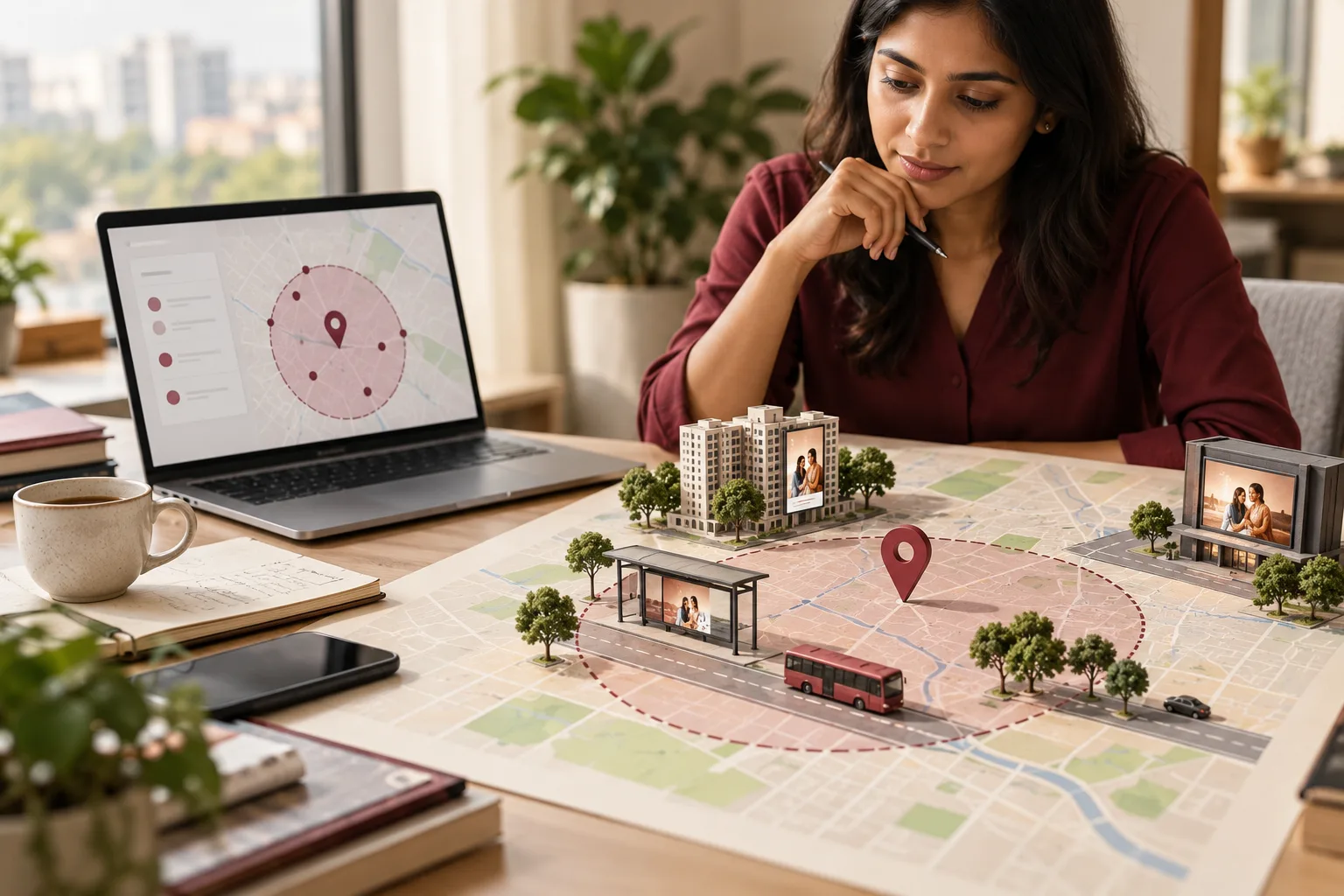
Start from the travel time you can honestly serve, not from a map circle you like the look of. A plumber who can reach a customer in twenty minutes on a bike covers an odd shape, not a circle. Draw the localities you would drive to, and set the radius to the farthest of them, or add the areas by name or pin code.
Two settings trip people up. The first is "people living in this location" against "people recently in this location". For a home service, choose living. For a hotel or restaurant near a highway, recently in is the point. The second is the radius around a pin. In a city, a small radius holds lakhs of people. In a district town it may hold a few thousand, and the same ones will see your ad again and again. Widen it by one locality, not by a whole city.
A shop has a different question, which hyperlocal advertising for a shop covers. This post is about services and bookings.
Does the audience need interests?
No. The place does the main selecting. Add an age range if your service has an obvious one (a home tutor's buyers are parents, in a band you know) and leave the rest wide. Heavy interest stacking sounds clever and shrinks a small audience until the ad has nobody new to reach. If the first results are poor, look at the first line before you narrow the audience.
What should the first line say?
The first line of the caption shows before "see more". It has to carry the service, the place and the reason to act.
| Weak first line | Stronger first line |
|---|---|
| "Best driving school in town" | "Learn to drive in Vidyanagar, Hubballi. Pick-up from your lane." |
| "Quality service you can trust" | "Washing machine not draining? We repair at your home across Keshwapur." |
| "Special offer this week" | "Trial class for children aged 5 to 12 in Gokul Road. Ask us the fee." |
The stronger lines name the locality in the words people use, name the problem or the person, and promise only what the business can deliver. Leave out superlatives such as "best", which buyers have heard from everyone, and claims a regulator might question in health, education and finance.
The picture should be real: your team, your vehicle, your premises, your work. Stock photos look like adverts and are easy to scroll past. If you have a short clip of a real job, use it.
Lead form or landing page?
If the customer can decide to ask with what is already in the ad, use a lead form. If they need to read something first, send them to a page.
| Situation | Better choice | Reason |
|---|---|---|
| Quick quote, call-back for a repair | Lead form | Low effort, mobile friendly, nothing to read |
| Price list, menu, package comparison, areas covered | Landing page | The buyer needs the information |
| Booking that needs a date and a slot | Landing page or WhatsApp | A form cannot hold a calendar |
| Your team cannot reply promptly | Neither is enough | Fix the reply first |
Some lead-form submissions are casual taps. Add one question that takes thought, such as "Which road do you live on?", to filter them. A named person should call every submission quickly, because a form tap is a lighter commitment than a call and interest fades. If you also use WhatsApp, the comparison is in Instagram lead forms or WhatsApp click ads.
An invented example: a driving school in Hubballi
Imagine a driving school with two instructors and three cars. Its first ad shows a smiling stock-photo family, says "Best driving school", targets a 25 km circle that includes villages it never visits, and sends people to a form with eight fields. Submissions come in, but half are from Dharwad, outside the area its cars cover.
The school corrects three things. It redraws the area to the four localities its cars can reach. It rewrites the first line to "Learn to drive in Vidyanagar. Pick-up from your lane, car with dual control." and uses a photo of its own car outside a Keshwapur lane. It cuts the form to name, phone and "Which locality?". Somebody rings each submission and notes in a sheet which ones booked a first lesson.
Submissions fall by about half, which looks like a loss until the sheet shows that the rest are within reach. A few book a first lesson. A fair number stall on the question of fee, and the school has to decide whether to put a starting fee in the caption.
When is it better not to run a Meta ad at all?
If your trade is found by search, such as an emergency plumber, people are already asking Google, and an ad that interrupts them does less. If you cannot answer enquiries promptly, the money buys cold leads. If your service needs trust before the first call, as a clinic does, begin with reviews and a good profile.
What to do this week
Pick the one locality where you already have the most customers. Run one real photo and one first line there, with a form of three questions, and record every enquiry with its source. Our Meta advertising service is where the account side is described, and the marketing hub lists the other routes. If you would like help with yours, tell us what you need.