Tailoring shops · Lead generation
Bring in new stitching customers before the festival counter is already full.
Lead generation for a tailoring shop means giving a family that has never walked into your lane a reason to send the first blouse, shirt or suit. GullySales works on the places those families look, the enquiry route they use and the record that keeps a first order from being the last.
Scope, fee, reporting and term are agreed in writing after we have read your brief and spoken to you.
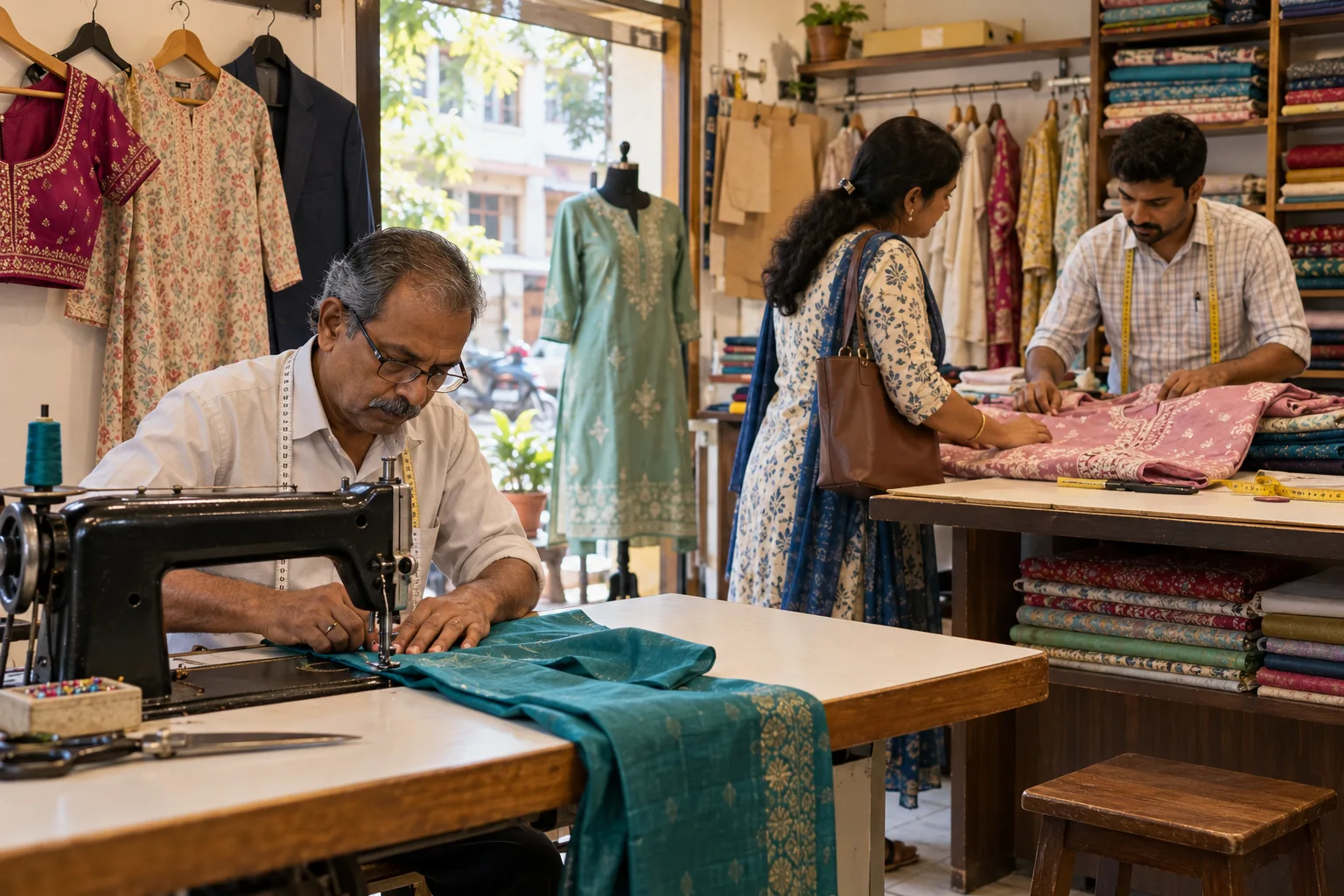
What lead generation means
Lead generation is the combined work of every channel that brings in a new enquiry, whether from search, adverts, referrals or a stall at an exhibition. GullySales runs these channels together and reports the number of enquiries each one produced, not the activity behind it.
Plan the next part of the work
Last updated 21 Nov 2026.
For tailoring shops
Where it usually goes wrong, and what we would do.
“The first order is a trial piece”
A new customer rarely hands over a wedding blouse as the opening job. They send a plain kurta or an alteration to see whether the fit and the delivery date hold. A shop that treats that small job as a lead to be recorded earns the bigger one later.
“The family is the real lead”
A mother who is happy with a blouse brings the daughters, the sisters and the husband's shirts. If the shop records only the person at the counter, the rest of the household stays unknown and the next referral is left to chance.
“Photo enquiries arrive without a name”
A customer sends a picture of a neckline from Instagram and asks the price. If nobody replies with questions about cloth, date and measurement, the conversation ends there. A short set of replies turns that picture into a booked order.
“Institutions buy in bulk and never come in”
A school office or a hospital purchase desk will not appear at the counter. They are leads that must be approached with a sample and a rate, and a shop that waits for them to call will never hear from them.
What we do
What we deliver for tailoring shops.
The work available for this need. We agree the deliverables and responsibilities for your engagement in writing.
Enquiry route for each garment
A short route for blouses, kurtas, shirts and suits that asks for cloth, occasion and date before quoting.
Result: Every enquiry in the register carries a garment, an occasion and a date.
Source column in the order book
A plain column noting whether the customer came from Maps, Instagram, a neighbour or a walk-in.
Result: You can see which door the new customers actually used.
Family record
One entry per household listing who else is stitched for, so a second order is a conversation and not a cold start.
Result: A returning customer is greeted with the household already known.
Institution approach pack
A list of nearby schools, offices and clinics with a sample set and a rate sheet, ready to send.
Result: The list shows who was approached and who replied.
Off-season reason to come
A reason for regular customers to visit between festivals, such as alterations, a wardrobe refit or a school-term uniform check.
Result: Orders are recorded in the months that were empty last year.
How the result is measured
- Relevant enquiries by source
- Duplicate and unsuitable enquiries
- Time to the first response
- Accepted enquiries reaching an agreed next step
Recorded as a baseline before work starts, so every later report has an honest comparison.
What to capture first
What to note when a new stitching enquiry arrives, so a first order can become a regular one.
- Garment and occasion
- Blouse, kurta, shirt or suit, and the event it is for. A wedding blouse and a daily kurta need different cloth advice, trials and dates.
- Date the garment is needed
- Ask for the function or festival date before quoting. A date the shop cannot meet is better said at the counter than found out on collection day.
- Cloth: the customer's own or the shop's
- Record who supplies it. A customer's own silk needs a careful cut and a note of the length handed over, so there is no dispute later.
- Who else the family stitches for
- Add sisters, daughters and the husband's shirts to the family record. The next referral is already in that list.
- How they found the shop
- Maps, Instagram, a neighbour or a walk-in. The source column shows which door new customers actually use.
- Photo of the design wanted
- Save the picture sent on WhatsApp against the order. It settles which neckline or sleeve was asked for.
Who it is for
This is written for these tailoring shops.
- Ladies' tailoring shops for blouses, kurtas and salwar suits
- Boutiques with designer blouse and bridal stitching
- Gents' tailors for shirts, trousers and formal wear
- Suit, sherwani and wedding wear tailors
- Uniform tailoring for schools, hospitals and offices
- Children's clothing and school uniform stitching
- Home-based tailors working on WhatsApp orders
- Alteration-heavy shops near markets and railway stations
Before you decide
When this may not be the right fit.
- The shop is booked solid through the festival, so new enquiries would be turned away or promised dates you cannot keep.
- You have no register that records an order's date and garment, so leads from several sources would blend into one pile.
- The master cannot take on new customers' fits at present, and one bad first fit would lose the whole family.
Before you decide
Agree the work. Know how to judge it.
Lead generation for tailoring shops: use these checks to prepare, choose the scope, and review what changes.
Bring the right evidence
Define the organisations or buyers you can serve and the reasons they would consider a conversation. Bring examples of accepted and rejected prospects so the selection rule is visible.
Make the scope clear
Agree the research sources, contact approach, qualification rules, and handover. Clarify which meetings count as accepted and what happens to replies that are not ready to buy.
Check the work in use
Review why a prospect was selected and what was learned from the response. Count held, relevant conversations separately from contacts found, messages sent, or meetings booked.
Know when to change course
If the same objection appears repeatedly, adjust the offer or buyer group before increasing outreach. Respect a request to stop contact and keep the exclusion in the record.
These are discussion points, not a fixed package. GullySales confirms the deliverables, responsibilities, fee, and term in writing after reading your brief and speaking with you.
Before we start
What to have ready before the work starts.
The records, access and decisions this work needs from tailoring shops. Anything missing is noted in the written scope, with who will supply it.
- The order book for the past season
- Bring the notebook or sheet with dates, names and garments. Torn pages are fine. We read it for repeat orders and sources. Without it, we judge from memory, and memory favours the last busy week.
- A decision on garments you want more of
- State which garments pay best and which you stitch only to oblige. The routes then promote the first group. If bridal blouses fill your time in some months, say so, and we shall not push work you cannot take.
- Photographs of finished garments with permission
- Pictures of delivered pieces carry the enquiry, but each customer must agree. Give us what you hold and mark those you are unsure of. Where no permission exists, we use the garment on a hanger with no face.
- A sample uniform set
- Institution buyers ask for a sample. If you have a recent uniform set, tell us who owns the design and whether it may be shown. If you have none, we plan to make one before approaching a school or office.
How it works
How the lead generation work runs
The work itself, in order. How an engagement starts, from your brief to a written scope, is set out on our method page.
- 1
Read the order book for first-time customers
We start with your order book and pick out the customers whose first order was a single blouse, shirt or alteration and who came back, and those who never did. You tell us how each first customer found the shop: a friend, the lane, a photograph. What exists afterwards is a note of which first orders turned into regular customers and which source brought them.
- 2
Photograph the counter and the trial room
A family sending a photo of a design wants to see a real shop behind the message. We spend a visit at the counter and the trial room, photographing the cutting table, the finished rack and the signboard, with your permission and with customers kept out of frame. You choose which pictures represent the shop. They become the base for every enquiry route.
- 3
Write one enquiry route for each garment
A blouse enquiry asks for the design picture, the cloth in hand and the date of the function. A shirt enquiry asks for the fit and the fabric. We write a short message for each, to be used on WhatsApp, the Maps listing and a form. You and your counter staff edit them until they sound like the shop. A source line and a family line are added to the order book beside it, so counter staff note how the customer found you and whose household the order belongs to.
- 4
Prepare the approach for schools and offices
For uniform buyers we put together a sample set, a rate sheet for a full set of sizes and a one-page note on how orders are measured and handed over. You decide what you can stitch in bulk and what you decline. A named person visits or calls the purchase head. The pack is tested on one institution before others.
- 5
Compare first orders and returns with the old book
Against the count of first-time customers and returns noted at the start, we read the new source column with you after a few weeks of orders. You see which route brought customers who ordered again, and which brought only a price question. The decision is which route to repeat and which garment needs its own message.
Where this fits
Three pieces of sales work, in this order.
This work sits inside sales process design, at stage 1, prospecting and lead generation. The audit comes before it, and sales management keeps it running.
Step 1
Sales audit
Find where deals are being lost and what to fix first.
Start here if you cannot say where orders are lost.
Step 2 · you are here
Sales process design
One written way to sell, from first enquiry to repeat order.
Start here if every salesperson sells differently.
Step 3
Sales management
A target, a review routine and someone who owns the number.
Start here if the team has targets and no routine.
FAQ
Questions owners ask before they call.
Not here? More answers, or ask on WhatsApp.
Should we advertise for every garment?
A customer asks the price from a photo. What do we reply?
Can we find uniform buyers ourselves?
What do we say to a design we cannot stitch?
How do we find the family behind a single order?
Should we advertise on social platforms for new customers?
How long is the contract?
How soon will we see results?
Who will actually do the work?
What do you need from us?
More for tailoring shops
Related work to consider.
Closest to this: leads and follow-up
Also for tailoring shops
Or start from the overview: sales and marketing for tailoring shops.
Your next practical step
Tell us what you are trying to grow, and we will read it before we call.
Eight short steps, mostly taps. Skip anything you would rather answer on the call.