Tailoring shops · Search engine optimisation
Let a family searching for a blouse tailor find your shop's name first.
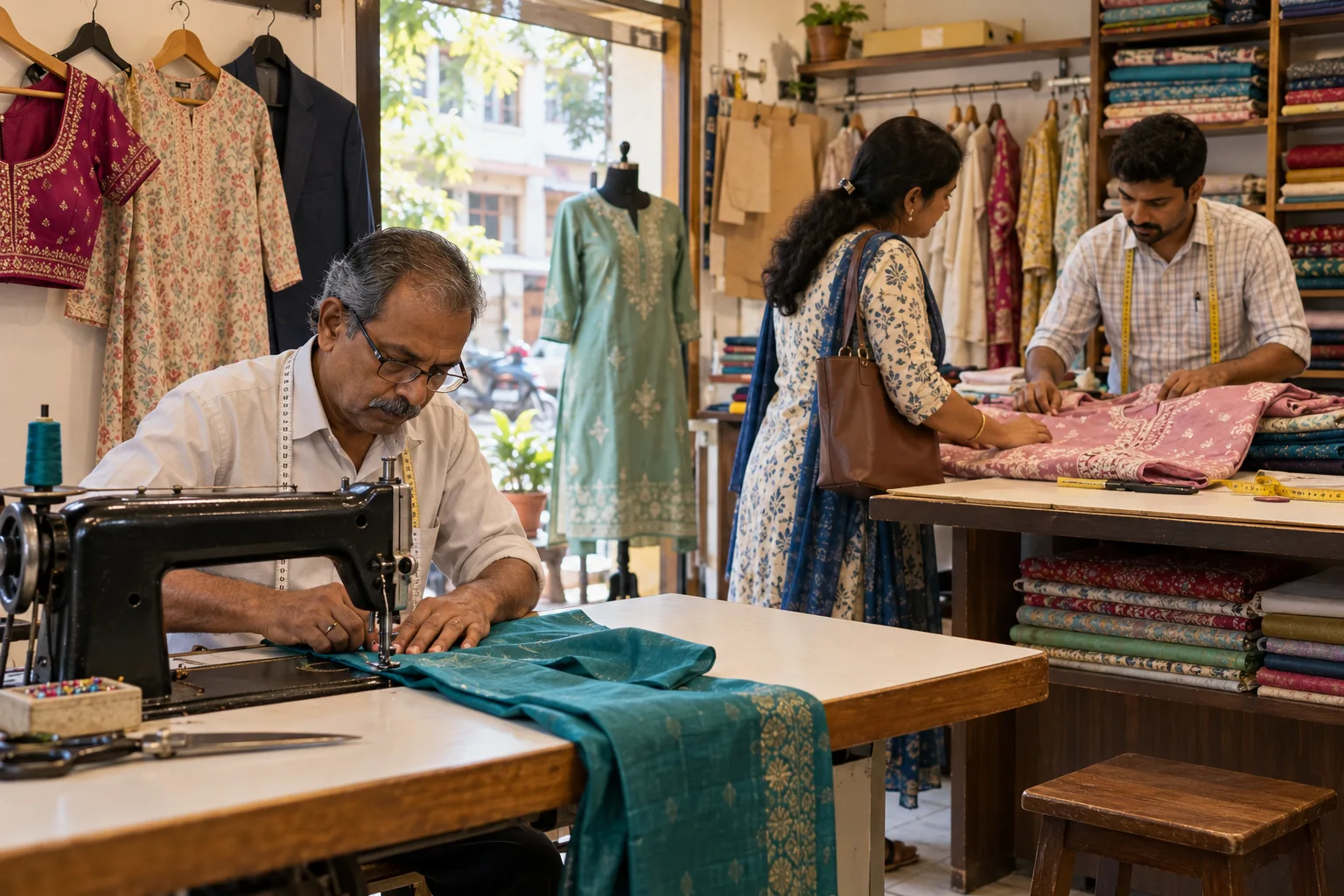
SEO for a tailoring shop is the work of making your site answer the words a customer types when they need a garment stitched. GullySales works on the pages, the titles and the structure so that each garment you stitch has a page that says so.
Scope, fee, reporting and term are agreed in writing after we have read your brief and spoken to you.
What search engine optimisation means
Search engine optimisation (SEO) is the work of getting your website to appear when a buyer searches Google for what you sell. GullySales builds pages around real search terms, fixes technical issues that block ranking, and tracks which searches actually bring enquiries.
Last updated 14 Nov 2026.
For tailoring shops
Where it usually goes wrong, and what we would do.
“Customers search by garment and place”
Someone types the garment, the word tailor and a locality, in English or in the local language. A single home page that mentions tailoring in general matches none of those searches, while a page for each garment can match one.
“Design words differ from the shop's words”
The customer writes boat neck, princess cut or churidar, while the shop's page says ladies' tailoring. If the page never uses the customer's own names for necklines, sleeves and fits, the search engine has nothing to match.
“Photos carry no text”
A gallery of delivered blouses looks rich to a visitor and reads as blank to a search engine. Without a caption naming the garment, the cloth and the style, the best proof the shop has is invisible to search.
“Language choice changes the results”
A customer who searches in Hindi, Kannada, Tamil or Telugu sees different results from one who searches in English. A shop that writes in one language only is absent from the other searches.
What we do
What we deliver for tailoring shops.
The work available for this need. We agree the deliverables and responsibilities for your engagement in writing.
Garment page for each stitch
A page each for blouses, kurtas, salwar suits, shirts, trousers, suits and alterations, written in the words customers use.
Result: Each garment you stitch has its own address on the site.
Title and heading rewrite
Page titles and headings that name the garment, the shop and the area.
Result: A search result shows what the page is about before the click.
Captioned work gallery
Delivered pieces grouped by neckline, sleeve and garment, each with a plain caption and the customer's written yes.
Result: The gallery can be read by a search engine, not only seen by a visitor.
Local language pages
Key pages written in the language your neighbourhood searches in, not translated word for word.
Result: A customer searching in their own language reaches a page that reads naturally.
Search report in plain words
A short note on which pages were found, for which searches, and what changed.
Result: You can see the searches that led to the site.
How the result is measured
- Ranking positions
- Organic traffic
- Enquiries from organic search
Recorded as a baseline before work starts, so every later report has an honest comparison.
Searches your buyers type
What a family types when it needs a blouse, kurta or suit stitched, and the page that answers.
- blouse stitching near me
- A blouse page with the neckline and sleeve styles you cut, the cloths you work with, the trial and the areas you serve.
- ladies tailor for kurta and salwar suit
- A garment page for each stitch, naming the cloths, what the fittings involve and a booking button.
- back neck blouse designs
- A gallery page of your own delivered blouses with captions. Searchers use design words, so use the names your customers say.
- tailor for wedding blouse stitching
- A bridal page. Say how the date is agreed, what the lining and padding work involves and who supplies the cloth.
- school uniform stitching
- A bulk page for school offices, giving the sample process, the sizes and a contact route for the purchase desk.
- shirt alteration near me
- An alteration page. State which changes you make, such as sleeve and waist, and what cannot be done on a finished garment.
Who it is for
This is written for these tailoring shops.
- Ladies' tailoring shops for blouses, kurtas and salwar suits
- Boutiques with designer blouse and bridal stitching
- Gents' tailors for shirts, trousers and formal wear
- Suit, sherwani and wedding wear tailors
- Uniform tailoring for schools, hospitals and offices
- Children's clothing and school uniform stitching
- Home-based tailors working on WhatsApp orders
- Alteration-heavy shops near markets and railway stations
Before you decide
When this may not be the right fit.
- Your shop is full and cannot take more work, so searchers who find you would be turned away.
- You have no photographs of your own delivered work, and a page of copied images would mislead the visitor.
- Nobody can update the page when your hours or festival closures change, so searchers would arrive at a shut shop.
Before you decide
Agree the work. Know how to judge it.
SEO for tailoring shops: use these checks to prepare, choose the scope, and review what changes.
Bring the right evidence
Bring the pages for the products or services you want to sell, the search queries available in your reports, and examples of enquiries from search. Separate branded searches from buyers discovering you for the first time.
Make the scope clear
Agree which pages and technical fixes come first, who can publish changes, and who supplies subject knowledge. Link search work to a relevant enquiry route on each priority page.
Check the work in use
Follow the trail from a relevant query to its landing page and then to an enquiry. Review whether those enquiries fit your offer, alongside indexing and search visibility.
Know when to change course
A ranking movement alone is not a buying signal. If traffic grows but relevant enquiries do not, revisit page intent and the offer before producing more pages.
These are discussion points, not a fixed package. GullySales confirms the deliverables, responsibilities, fee, and term in writing after reading your brief and speaking with you.
Before we start
What to have ready before the work starts.
The records, access and decisions this work needs from tailoring shops. Anything missing is noted in the written scope, with who will supply it.
- Photographs of work with the garment named
- Each page needs good pictures with a name: princess-cut blouse, bridal blouse, school uniform. A phone image in daylight is acceptable. Without names, a gallery is only decoration.
- Access to the website and the domain
- Search work edits pages and titles. Give us login details or the name of the person who has them. If nobody does, we start by recovering control, and the pages wait.
- The list of garments and what each involves
- Say what you stitch, how many trials each needs and what the customer must bring. This content calms a first-time customer. Leave out garments you do not want to stitch.
- A word list in the local language
- Customers use language that differs from the written one. Give us ten or twenty words your counter hears for garments, necklines and sleeves. We use them in titles, which is where a search engine reads first.
- Your festival and wedding diary
- Tell us when orders rise, such as before festivals or the wedding months. Pages for blouses and kurtas are timed to appear before those weeks. If the diary is only in your head, write down the main dates.
How it works
How the search engine optimisation work runs
The work itself, in order. How an engagement starts, from your brief to a written scope, is set out on our method page.
- 1
Write down garments the way customers say them
We sit at the counter and list every garment name customers use: blouse, princess-cut blouse, kurta set, salwar, lining blouse, alteration, shirt, trouser. Spelling and language variations are noted. You tell us which garments you stitch well. The list becomes the search words, since customers rarely use the shop's own terms.
- 2
Check what your Instagram posts say in words
Photos carry no text a search engine can read. We go through your Instagram or Facebook posts and your WhatsApp catalogue, noting which designs get asked for and which captions describe them. You choose the strongest pieces. Their descriptions become the written content of the garment pages.
- 3
Confirm who controls the site and its login
We ask who made the website, who pays for the domain and who holds the password. Some small shops find a cousin or a former agency does. You collect the details, or we help recover them. The step is done when we can edit the pages and see the site's search history.
- 4
Write a page for each garment you stitch
We draft a page per garment, with the cloth choices, the number of trials, the measurements taken and a gallery with captions. Your cutting master reads each page for accuracy and strikes any promise the shop cannot keep. You approve the page before it goes live.
- 5
Add local language titles and captions
Customers also search in Kannada, Hindi, Tamil or another language of the area. With someone who knows your customers' words, we write titles and captions in that language for the garments that need them. You decide which languages the counter can answer in.
- 6
Read the search visits against walk-ins and calls
Against the figures noted before the work began, we see which garment pages were visited and ask the counter which customers mentioned finding the shop online. You decide which page to extend and which garment to photograph next. The test is whether new orders mention the website, not the rank.
Where this fits
Three pieces of sales work, in this order.
This work sits inside sales process design, at stage 1, prospecting and lead generation. The audit comes before it, and sales management keeps it running.
Step 1
Sales audit
Find where deals are being lost and what to fix first.
Start here if you cannot say where orders are lost.
Step 2 · you are here
Sales process design
One written way to sell, from first enquiry to repeat order.
Start here if every salesperson sells differently.
Step 3
Sales management
A target, a review routine and someone who owns the number.
Start here if the team has targets and no routine.
FAQ
Questions owners ask before they call.
Not here? More answers, or ask on WhatsApp.
Is Instagram enough, or do we need a website as well?
Will we reach the first result?
Does the festival season change what we write?
Do we write garment names the way customers say them?
Should each garment page show a price?
Should the shop have a page in the lane's own language?
How long is the contract?
How soon will we see results?
Who will actually do the work?
What do you need from us?
More for tailoring shops
Related work to consider.
Closest to this: search and visibility
Also for tailoring shops
Or start from the overview: sales and marketing for tailoring shops.
Your next practical step
Tell us what you are trying to grow, and we will read it before we call.
Eight short steps, mostly taps. Skip anything you would rather answer on the call.