Tailoring shops · Home services
Keep the festival rush from being the only month your tailoring shop is full.
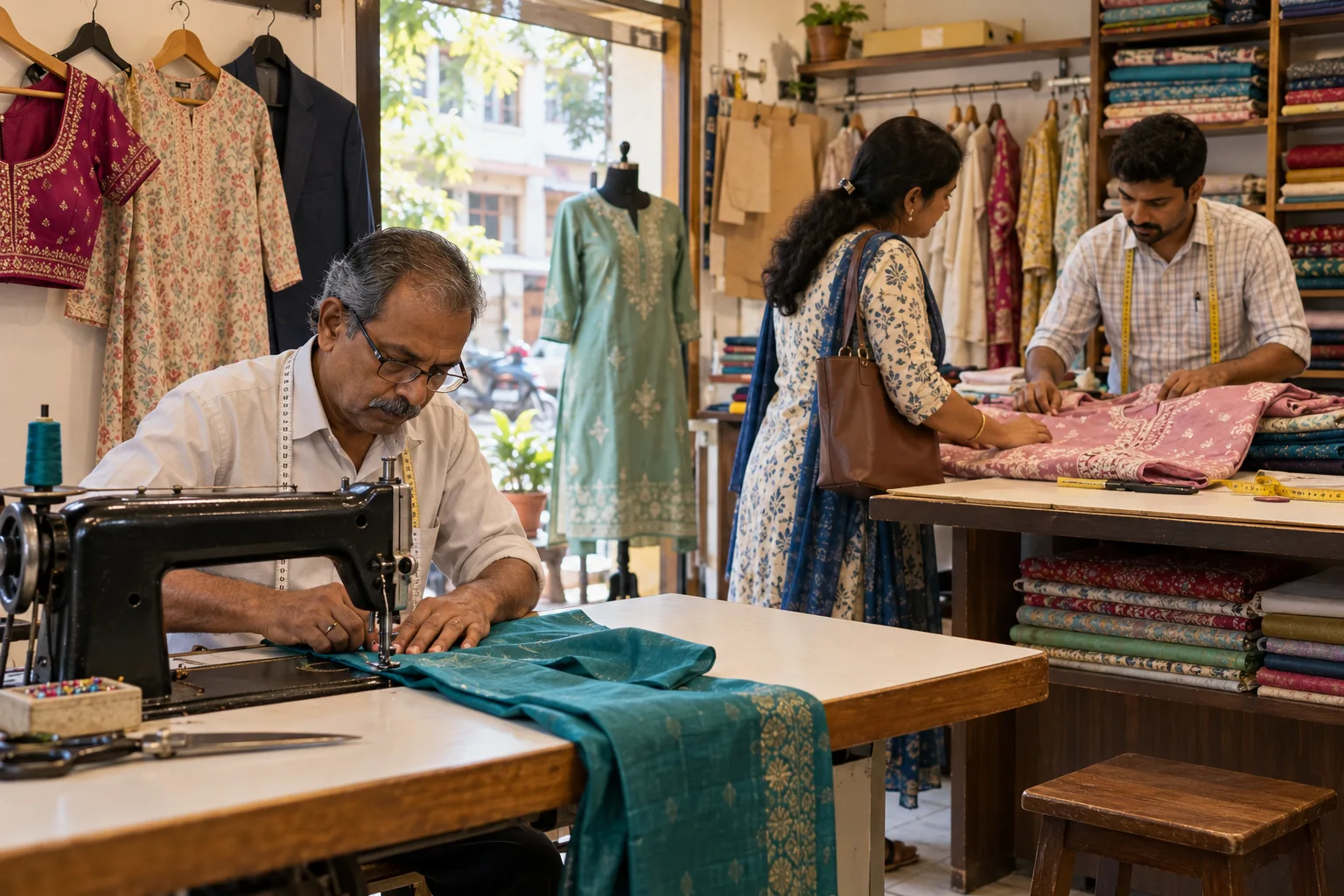
Three days before Diwali a tailor has forty blouses and kurtas promised for the same evening and a customer standing at the counter with a photo from Instagram. Half of the delivery dates were agreed over the phone, and the register says two things. The shop is full for a fortnight and almost empty in July.
Scope, fee, reporting and term are agreed in writing after we have read your brief and spoken to you.
In one paragraph
Tailoring shop marketing is how women who want blouses and kurtas, men who want shirts and trousers, and families before a festival find the right tailor. Tailoring sales turns a first stitch into a measurement record, a repeat order and a referral. GullySales prepares your Maps listing, a WhatsApp design-and-delivery flow and the Instagram work gallery.
Tailoring is bought on measurement, fit and a delivery date kept. A blouse that fits on the first try brings the sisters and the mother to the same shop, and a shirt that fits ends ready-made buying for that customer. A missed date before a wedding is remembered for years.
Some shops are known only in their lane. They have skill and a long list of loyal customers, and they have no way to be found by the family that has just moved into the next locality.
Last updated 14 Nov 2026.
How buyers decide
How tailoring shops are chosen.
A ladies' tailor or boutique is chosen on recommendation first and on photographs second. Friends are asked, the shop's Instagram or WhatsApp status is checked for blouse and kurta designs, and the customer wants to know whether the tailor will copy a picture brought to the counter. Fit on the first try and the delivery date are the deciding points.
A gentleman's tailor is chosen on fit, fabric and convenience. The customer wants a shirt or trouser stitched from own cloth or the shop's, with measurements kept so the next order is a phone call. Office-goers and grooms ask about alterations and quick turnaround before a function.
Schools, hospitals and businesses buy uniforms in numbers. The purchase person asks for a sample, a rate for the full set and a date by which every size is ready, and sends the order to the shop that can show similar work.
The problem
What usually goes wrong for tailoring shops.
Common situations to check against your own enquiry records.
“We are full before festivals and idle in between”
Orders pile up for weeks and then drop, so the shop cannot plan staff or cloth purchases.
“Delivery dates are promised on the phone and lost in the rush”
A customer arrives on the day and the garment is not ready, and the customer does not return.
“Measurements live in a notebook”
When the page is lost or the master is away, a regular customer has to be measured again.
“Customers bring pictures and we have no way to show our own work”
Our best blouses and suits are delivered and never photographed, so the shop looks the same as every other.
“Ready-made and online brands are taking the easy orders”
Simple shirts and kurtas are bought online, and the shop is left with the hard fits and last-minute jobs.
“Uniform orders go to a supplier we have never approached”
Schools and offices near us buy in bulk, but nobody there has our rate or samples.
What we do
What we do for tailoring shops.
Possible deliverables for tailoring shops. Your written scope confirms what is included.
A design gallery that looks like a boutique
Photographs of delivered work sorted by blouse neck, sleeve, kurta and suit style, with permission from the customer and no face shown where the customer prefers that. We plan the shoots and the captions with your team.
A WhatsApp order-and-delivery flow
A message that collects the design photo, the cloth, the date it is needed and the measurement slot, then confirms the delivery date. A reminder message is drafted for the customer ahead of it.
A measurement record
A simple digital or printed card per customer with measurements, preferences and past orders. We design the card and a routine to fill it.
A Maps listing for the neighbourhood
A Google Business Profile naming the localities you serve, photos of the shop and the work, and each kind of stitching listed.
A uniform quote pack
A sample set, a rate for a typical order size and a delivery plan, written for a school office or a hospital admin head.
Lean-season offers for existing customers
Reasons to message in the slow months, such as work shirts, school uniforms, alterations after weight changes and monsoon salwars.
How the result is measured
- Orders by source, Maps, Instagram and referral
- Festival bookings made before the cut-off date
- Deliveries on the promised date
- Repeat orders against first-time customers
- Uniform quotes sent against orders won
- Orders in the slowest months against the busiest
Recorded as a baseline before work starts, so every later report has an honest comparison.
Every service, written for tailoring shops
Each has its own page: what it involves for tailoring shops, what you get, and what it is measured on.
- Lead generationBring in new stitching customers before the festival counter is already full.
- SEOLet a family searching for a blouse tailor find your shop's name first.
- Local SEOMake the shop the tailor a customer finds on the map from the next street.
- Social media marketingTurn delivered blouses and suits into the proof that the next customer scrolls past.
- Content marketingWrite down what your master already tells customers at the trial.
- Buyer personasKnow whether the customer is a bride, a mother, an office-goer or a purchase desk.
- CRMKeep every measurement, order and delivery date where the shop can find it.
- Follow-up systemsMake sure no trial, delivery or enquiry is left waiting on someone remembering.
- WhatsApp marketingTake the design photo, the measurement and the delivery date on one chat thread.
- Digital marketingChoose the few online channels that bring in stitching orders and drop the rest.
- WebsiteGive the shop an address online where a customer can see the work and book a fitting.
- Sales processSales process for tailoring shops defines the evidence for each next step.
- Sales managementSales management for tailoring shops gives every open enquiry a responsible owner.
- Sales strategySales strategy for tailoring shops starts with choosing which opportunities to pursue.
Worth a page and a campaign of their own
Blouse stitching, including bridal and designer blouses · Kurta and salwar suit stitching · Shirt and trouser stitching for men · Suit and sherwani stitching for weddings · School and office uniforms · Children's festival wear · Fall, pico and finishing work for sarees · Fitting and alteration of ready-made clothes
Priority campaigns
Campaigns for what tailoring shops most want to sell.
Each one planned around when your buyers decide, and measured against the baseline.
Festival and wedding booking campaign
A booking window announced well before Diwali, Ugadi, Eid and the wedding months, with a cut-off date on posts and WhatsApp broadcasts.
Bridal blouse showcase
Photographs and short videos of bridal and designer blouse work, with a consultation slot for the bride's family.
School uniform season campaign
A note to school offices and parents' groups before term, with measurement days and a rate per set.
Work shirt and trouser campaign
A message to office-goers and small business staff on custom-fitted shirts, with a repeat order on file.
Alteration campaign
A simple page and poster for hem, waist and sleeve changes, with the charge for each written beside it by your shop.
Beyond search
Where we reach buyers of tailoring shops, beyond Google.
Search matters, but it is rarely the only way this industry's buyers find a supplier.
Schools, hospitals and offices
The institutions near you, listed, with the uniform quote pack addressed to their purchase or admin person.
Fabric and saree shops
A referral arrangement with shops whose customers buy cloth and need someone to stitch it.
Wedding planners and bridal boutiques
An introduction for planners whose client families need several outfits stitched against one wedding date.
Apartment communities
A note for residents' groups, proposing a measurement day in the community hall once a handful of orders are in.
Fashion students and local designers
Designers who need dependable stitching for small runs, with a first conversation prepared for each.
Why GullySales
Tailoring shops need one firm that turns a photograph on the counter into a repeat customer.
A tailor can pay for photographs or for a way to remember every customer's measurements and festival date. GullySales builds the design gallery, the WhatsApp order flow and the lean-season messages as one routine that brings people back to the counter.
From the picture brought in to the delivery date
A customer brings a photograph and wants the blouse to fit on the first try by the date promised. We set up the WhatsApp order and delivery flow and the measurement record, so the promise is written at the counter and the next order becomes a phone call, not a new fitting.
Recommendation first, then the gallery
A boutique or ladies' tailor is chosen on a friend's word, then on the Instagram or status photographs. A gents' tailor is chosen on fit, fabric and convenience, and uniform buyers want quantities and a quote. We plan each reader's route, with a gallery that looks like a boutique.
Orders counted by source, festival and slow season
Your order book gives the starting counts: orders by source, festival bookings before the cut-off date, deliveries on the promised date, repeat orders against first-time customers, uniform quotes against orders and the slowest months against the busiest. Afterwards we read the movement from the same book, line by line.
Fee and scope written before the gallery shoot
The scope and the fee are written before the first gallery photograph is taken. No order count is promised. We take no order count as a promise, and no festival booking either. If a uniform quote pack would not suit a shop with two machines and one cutting table, we say so and leave it out.
Sales and channel services
Choose the sales work your business needs.
Review the sales and channel catalogue in the context of tailoring shops. Each page states what the service covers and when it is unsuitable. A specialist programme is not assumed to fit every industry.
210 services available.
Sales strategy and process (29)
- Account-based selling (check programme fit)
- Appointment setting
- Bid or no-bid decision framework
- Business development strategy
- Competitive intelligence
- Dedicated sales team services
- Enterprise and solution selling (check programme fit)
- Inside sales
- Institutional and government sales strategy
- Outbound sales prospecting
- Outsourced sales and business development
- Precast and construction materials tender-to-order programme (check programme fit)
- Pricing and packaging strategy
- Pricing waterfall and discount leakage analysis
- Product and service launch strategy
- Quotation and proposal follow-up
- Quotation management
- Retail sales conversion consulting
- RFP and tender management
- Sales audit
- Sales discount management
- Sales margin improvement
- Sales performance improvement
- Sales strategy and consulting
- Sales strategy, management and enablement
- Sales transformation consulting
- Sales turnaround consulting
- Technical presales and sales engineering support
- Win-loss analysis
Sales training and enablement (29)
- Capability statement writing
- Consultative selling implementation
- Field sales support
- Negotiation and closing support
- Negotiation training
- Objection handling training
- Product and service brochure copywriting
- Product one-pager writing
- Product specification sheet writing
- Proposal development
- Sales certification programme design
- Sales closing training
- Sales coaching
- Sales collateral development
- Sales competency assessment
- Sales discovery process design
- Sales enablement
- Sales leadership development
- Sales manager training
- Sales messaging, scripts and follow-up sequences
- Sales playbook development
- Sales presentation and demo improvement
- Sales presentation and demo script writing
- Sales team onboarding
- Sales team training programme
- Sales training and development
- Sales training needs assessment
- Value-based selling implementation
- WhatsApp sales process
CRM, sales operations and RevOps (46)
- Conversation intelligence
- CPQ consulting
- CRM administration and support
- CRM adoption and training
- CRM consulting and selection
- CRM data cleansing, deduplication and governance
- CRM data migration
- CRM implementation and customisation
- Deal desk services
- Deal risk assessment
- Engineering college admissions enquiry management (check programme fit)
- Enquiry response starter
- Field sales beat planning
- Hospital enquiry-to-appointment conversion programme (check programme fit)
- Lead capture and lifecycle management
- Lead database management
- Lead leakage analysis
- Lead qualification
- Lead response and follow-up
- Lead routing and assignment
- Lead scoring
- Lead-to-order process design
- Marketplace lead management programme
- Order booking process improvement
- Pipeline hygiene and governance
- Pipeline management
- Revenue and sales operations
- Revenue operations, CRM data and AI
- Revenue process documentation
- Revenue technology stack audit and architecture
- RFQ management
- Sales activity management
- Sales administrative support
- Sales approval workflow design
- Sales call auditing and conversation quality assessment
- Sales cycle optimisation
- Sales escalation process design
- Sales handoff process design
- Sales metrics and KPI development
- Sales process design and implementation
- Sales productivity improvement
- Sales to operations order handover design
- Sales workflow automation
- Stalled opportunity recovery
- Territory planning
- Truck and commercial vehicle dealer lead-to-booking programme (check programme fit)
Customer success and retention (42)
- Account management and key account growth
- Account whitespace and contract expansion analysis
- B2B customer reference programme (check programme fit)
- Churn analysis and reduction
- Complaint and escalation management
- Customer adoption programmes
- Customer advocacy and proof marketing
- Customer advocacy programmes
- Customer case studies
- Customer education and knowledge base development
- Customer engagement campaigns
- Customer experience strategy and journey mapping
- Customer experience, success and retention
- Customer health scoring
- Customer lifecycle marketing
- Customer loyalty programmes
- Customer onboarding
- Customer onboarding implementation assurance
- Customer reactivation
- Customer referral campaign copywriting
- Customer referral programmes
- Customer renewal, re-engagement and upsell message writing
- Customer research and voice of customer
- Customer retention and reactivation campaigns
- Customer retention strategy
- Customer satisfaction, NPS and feedback programmes
- Customer segmentation
- Customer service strategy
- Customer success automation
- Customer success consulting
- Customer support process design
- Customer testimonials
- Customer welcome and onboarding content writing
- Digital customer journey design
- Helpdesk and contact centre setup
- Referral and loyalty campaign creative design
- Referral marketing
- Renewal management
- Repeat sales management
- Service recovery programmes
- Strategic account management (check programme fit)
- Upselling and cross-selling
Fractional leadership and audits (22)
- Annual revenue planning
- Founder to sales team transition
- Founder-led sales advisory
- Fractional chief revenue officer (CRO)
- Fractional head of sales
- Interim sales leadership
- Management dashboards and reporting
- Quota and capacity planning
- Revenue analytics and intelligence
- Revenue growth audit
- Revenue leadership and management reviews
- Revenue model and monetisation strategy
- Revenue planning and fractional leadership
- Revenue target planning
- Sales compensation and incentive design
- Sales forecasting
- Sales management
- Sales organisation design
- Sales profitability analysis
- Sales recruitment and candidate assessment
- Sales review management
- Sales team structure and role definition
Dealers, distributors and partners (42)
- Channel governance and conflict management (check programme fit)
- Channel opportunity generation and follow-up (check programme fit)
- Channel partner engagement campaigns (check programme fit)
- Channel partner franchise and retail growth (check programme fit)
- Channel partner recruitment (check programme fit)
- Channel performance management (check programme fit)
- Channel sales strategy and route to market execution (check programme fit)
- Channel territory planning (check programme fit)
- Cloud marketplace listing and co-sell (check programme fit)
- Co-operative partner marketing (check programme fit)
- Dealer and distributor audits (check programme fit)
- Dealer and distributor programme (check programme fit)
- Dealer co-funded lead generation programmes (check programme fit)
- Dealer development (check programme fit)
- Dealer lead generation (check programme fit)
- Dealer network brand visibility (check programme fit)
- Dealer sell-through analytics (check programme fit)
- Distributor development (check programme fit)
- Distributor onboarding digital academy (check programme fit)
- Distributor sales force effectiveness (check programme fit)
- Export and international market development (check programme fit)
- Franchise development, recruitment and expansion (check programme fit)
- Industrial distributor dealer sell-through programme (check programme fit)
- Market development fund management (check programme fit)
- Outsourced dealer sales support (check programme fit)
- Partner compensation and incentive design (check programme fit)
- Partner enablement, training and certification (check programme fit)
- Partner onboarding (check programme fit)
- Partner portal and PRM implementation (check programme fit)
- Partner programme design (check programme fit)
- Partner relationship management (check programme fit)
- Partner segmentation and tiering (check programme fit)
- Partnership and co-marketing (check programme fit)
- Point-of-sale marketing (check programme fit)
- Referral partner programmes (check programme fit)
- Reseller programme development (check programme fit)
- Retail execution and merchandising (check programme fit)
- Retailer marketing (check programme fit)
- Route to market and distribution strategy (check programme fit)
- Secondary sales tracking (check programme fit)
- Trade and dealer marketing (check programme fit)
- Trade promotion planning (check programme fit)
A practical starting point · Tailoring shops
Start with one buying journey.
Use a real enquiry to find the first useful change. You do not need to buy every service listed on this page.
- The record to review
- Review an anonymised job enquiry from first contact to visit, quote, and completion. Retain the service area, job type, urgency, and reason the booking was won or lost.
- The buyer's question
- Check that customers can tell what work you cover and what needs an inspection before pricing. Match the advertised service area to the team's actual capacity.
- The handover to agree
- Agree who schedules the visit and who can confirm a price or technical solution. Keep the customer informed when the original enquiry needs a different specialist.
Who it is for
This is written for these tailoring shops.
- Ladies' tailoring shops for blouses, kurtas and salwar suits
- Boutiques with designer blouse and bridal stitching
- Gents' tailors for shirts, trousers and formal wear
- Suit, sherwani and wedding wear tailors
- Uniform tailoring for schools, hospitals and offices
- Children's clothing and school uniform stitching
- Home-based tailors working on WhatsApp orders
- Alteration-heavy shops near markets and railway stations
Before you decide
When this may not be the right fit.
- You want a guaranteed Google ranking or a guaranteed number of leads. Nobody honest can promise either.
- You need enquiries by next week and have nobody to answer them.
- You want posts and reach reported, not enquiries and orders.
How it works
How the work runs for tailoring shops
The work itself, in order. How an engagement starts, from your brief to a written scope, is set out on our method page.
- 1
Read the order register
The order register is read for the Diwali pile-up and the July gap, and for the garments that were not ready when the customer arrived.
- 2
Fix the dates and the measures
Each customer gets a measurement card, and every order message writes the delivery date down where the customer can see it too.
- 3
Show the work
Delivered blouses and kurtas are photographed with the customer's yes in writing, then sorted by neckline, sleeve and garment for the gallery.
- 4
Book the season early
A cut-off date goes on the festival and wedding posts, and the school or hospital purchase desk receives a sample set with the rate.
- 5
Message the family before the next wedding season
A family that came for one blouse gets a message when the wedding season nears, and a mother is asked whether the daughter would like the same tailor.
Where this fits
Three pieces of sales work, in this order.
Start by finding where enquiries and orders are being lost. Agree the changes to your sales process, then decide who will manage the work and review the results.
Step 1
Sales audit
Find where deals are being lost and what to fix first.
Start here if you cannot say where orders are lost.
Step 2
Sales process design
One written way to sell, from first enquiry to repeat order.
Start here if every salesperson sells differently.
Step 3
Sales management
A target, a review routine and someone who owns the number.
Start here if the team has targets and no routine.
FAQ
Questions tailoring shops ask before they call.
Not here? More answers, or ask on WhatsApp.
We are a home-based tailor. Can we still be found online?
How do we use customer photographs without trouble?
Can marketing smooth out the festival rush?
Can you get us uniform contracts?
Do you help with cutting, stitching or pattern making?
How much does it cost?
How soon will we see results?
Who will actually do the work?
What do you need from us?
What if we are not happy with the work?
Part of Home services. See the other industries in the sector.
Your next practical step
Tell us what you are trying to grow, and we will read it before we call.
Eight short steps, mostly taps. Skip anything you would rather answer on the call.