Tailoring shops · Digital marketing
Choose the few online channels that bring in stitching orders and drop the rest.
Digital marketing for a tailoring shop is the combination of Maps, Instagram, WhatsApp and a website that lets a customer find the shop and book a stitch. GullySales reads your order register first and then decides where effort should go.
Scope, fee, reporting and term are agreed in writing after we have read your brief and spoken to you.
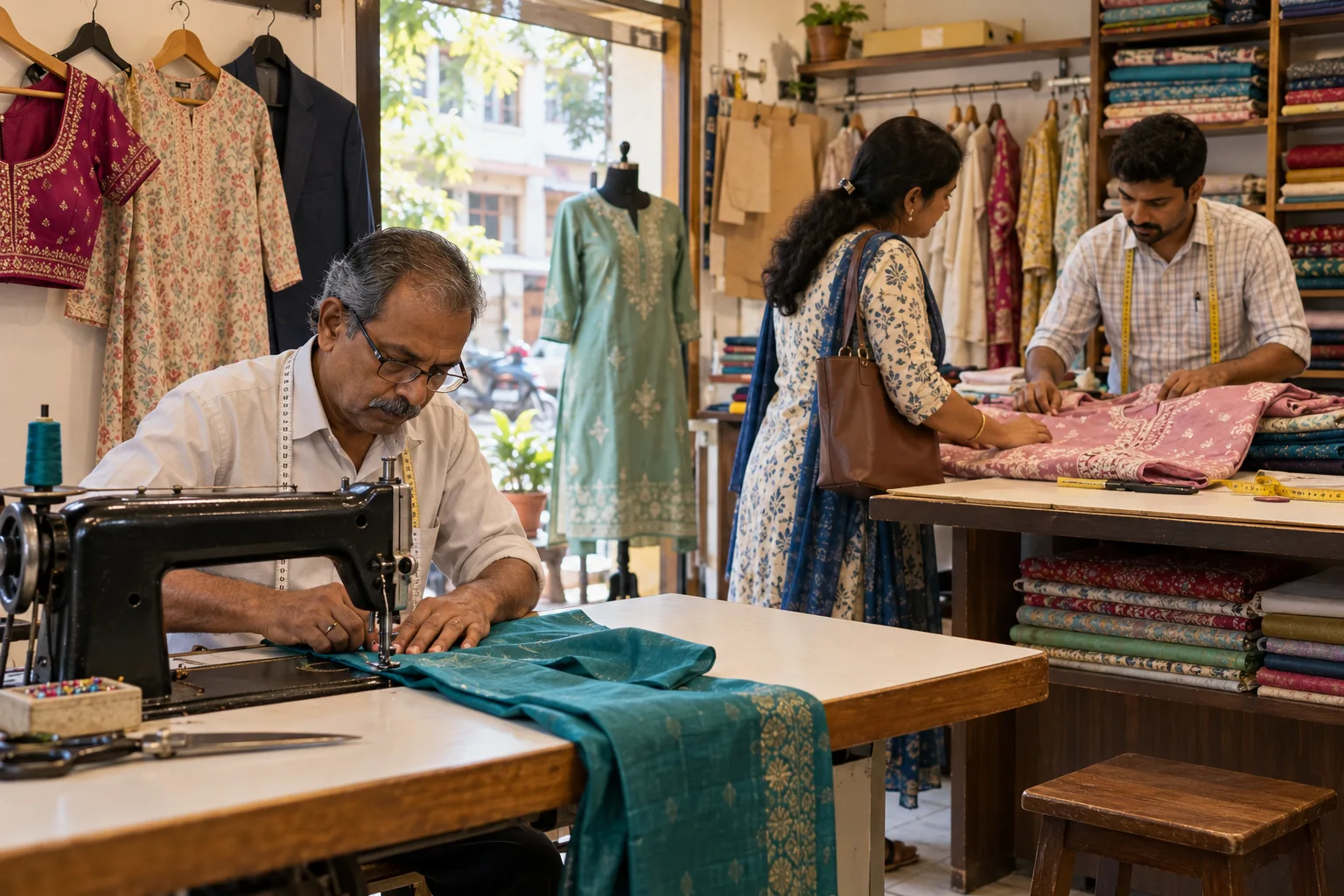
What digital marketing means
Digital marketing is the combined work of search, social media, advertising and website channels running together rather than as separate projects with separate people. GullySales runs these as one connected system so a change in one channel, such as a new offer, is reflected everywhere at once.
Last updated 14 Nov 2026.
For tailoring shops
Where it usually goes wrong, and what we would do.
“A tailor does not need every channel”
A shop with one master and a small counter cannot run five accounts. Picking the two or three that bring orders, and doing them steadily, beats a scatter of half-kept pages.
“The order register shows what works”
Asking each new customer how they found the shop costs nothing. After a season the register shows whether Maps, a neighbour, Instagram or a school brought them. Spend follows that answer, not a trend.
“Paid promotion needs capacity”
Money spent bringing orders just before the festival fills a counter that is already full. Paid effort belongs in the empty months, with a clear offer for regular customers.
“Online and counter must match”
A customer who finds a bridal blouse post and walks in expects to see it discussed, priced and booked. If the staff are unaware of the post, the online work is wasted at the door.
What we do
What we deliver for tailoring shops.
The work available for this need. We agree the deliverables and responsibilities for your engagement in writing.
Channel review from the register
A look at where recent customers came from and which garments they ordered.
Result: The shop knows which channels to keep.
Basic presence set-up
Maps profile, WhatsApp business account, Instagram page and a simple site, all with matching details.
Result: The shop appears the same everywhere.
Season and off-season plan
A plan that places effort ahead of the festival and offers in the quiet months.
Result: Work is spread across the year, not squeezed into one fortnight.
Staff briefing
A short sheet telling the counter what is being posted and what offer is running.
Result: Staff can speak to what the customer saw online.
Review after each season
A note on which activity brought orders and which did not.
Result: The next season starts from what was learnt.
How the result is measured
- Enquiries across channels
- Cost per enquiry overall
- Channel mix by contribution
Recorded as a baseline before work starts, so every later report has an honest comparison.
Searches that bring orders
The searches a tailoring shop can afford to answer, and the page behind each one.
- tailor near me
- The widest search. Answer with a Maps profile naming garments, hours and area before spending on anything else.
- blouse stitching near me
- A garment page and a gallery. Blouses are the festival-heavy work, so a page showing delivered pieces earns the call.
- wedding blouse tailor
- A bridal page with how dates are agreed, the lining work and the trial, with the customer's consent for photos.
- school uniform stitching
- A bulk page a purchase desk can find, with samples, sizes and a contact route.
- shirt stitching for men
- A gents page with cloth, fit and the process, aimed at the office-goer who orders a few shirts.
- alteration tailor near me
- A repair page for quick jobs, which bring walk-ins who place stitching orders later.
Who it is for
This is written for these tailoring shops.
- Ladies' tailoring shops for blouses, kurtas and salwar suits
- Boutiques with designer blouse and bridal stitching
- Gents' tailors for shirts, trousers and formal wear
- Suit, sherwani and wedding wear tailors
- Uniform tailoring for schools, hospitals and offices
- Children's clothing and school uniform stitching
- Home-based tailors working on WhatsApp orders
- Alteration-heavy shops near markets and railway stations
Before you decide
When this may not be the right fit.
- The shop has no spare capacity before the festival, so paid reach would only fill a queue you cannot serve.
- The order register does not record a source, so you could not tell which channel brought customers.
- Your counter and your online listing show different hours and prices, so buyers would be disappointed on arrival.
Before you decide
Agree the work. Know how to judge it.
Digital marketing for tailoring shops: use these checks to prepare, choose the scope, and review what changes.
Bring the right evidence
Bring a recent won order and an enquiry that went nowhere. Trace how each buyer found you, what they asked, and who handled the next step. A channel list alone will not explain the difference.
Make the scope clear
Choose one offer and one buyer group first. Agree which part needs attention: being found, getting a useful enquiry, or turning an enquiry into an order. Separate recommendations from the work required to carry them out.
Check the work in use
A useful plan names the first change, its owner, the evidence behind it, and the number that will show whether it worked. Ask what has deliberately been left out and why.
Know when to change course
If your team cannot answer the enquiries it already receives, improve that handover before buying more traffic. If the offer itself is unclear, test it with buyers before adding channels.
These are discussion points, not a fixed package. GullySales confirms the deliverables, responsibilities, fee, and term in writing after reading your brief and speaking with you.
Before we start
What to have ready before the work starts.
The records, access and decisions this work needs from tailoring shops. Anything missing is noted in the written scope, with who will supply it.
- The order register or notebooks
- Without the order record, we do not know what works. Bring whatever you have for the last season. Approximate counts are acceptable if marked as such. Mark which entries came through an online message and which through the lane.
- Your festival and wedding calendar
- Write the dates when orders rise and the weeks that are slack. The plan depends on it. If the calendar is in your head, take ten minutes to write the main weeks. Include the date of any local exhibition or market day that brings customers.
- Your capacity during busy weeks
- Say how many extra orders the shop can accept. Promoting beyond capacity brings disappointed customers. If you can add a helper in the season, tell us. Say how many extra trials the master can handle on one working day.
- A phone and a person for the online side
- Someone must reply to messages and update the listing. Name them. Without a named person, the plan has to stay very small. Name a second person for days when the first is away.
- Photographs and permissions
- Every channel uses pictures. Gather delivered-garment photographs with the customer's yes, and a few of the shop. Where consent is missing, we use garments on hangers. Check with the cutting master which pieces are fine to show.
How it works
How the digital marketing work runs
The work itself, in order. How an engagement starts, from your brief to a written scope, is set out on our method page.
- 1
Read the order register for what already works
We begin with the register. For a season we mark how each customer found the shop, which garments repeat and which weeks are slack. You help us explain the entries. What exists afterwards is a plain account of where orders come from, which decides where effort goes. We also mark the weeks when orders came in only because of a festival, so they are not read as a sign of lasting demand.
- 2
Choose channels the shop can keep up
From the account, we pick the channels that suit your shop: the Maps listing, WhatsApp, Instagram or a website. A tailor does not need all of them. You decide how much time the counter can give. The plan names each channel and the order it is set up in. We write down what is left out and why, so a later staff member does not reopen a channel the shop cannot staff.
- 3
Set up the basics: listing, number and catalogue
We claim the Business Profile, set up a business number and build a small catalogue from delivered garments. Each is tested by a customer you trust, who finds the shop, sends a message and gets a reply. You approve what is public, and we note any detail, such as the home address of a home-based tailor, that stays off the profile.
- 4
Plan the busy and quiet weeks
We lay the festival and wedding diary against the slack weeks. Busy weeks need capacity messages and trial slots, while slack weeks are for alterations, uniforms and reminders. You tell us when the shop is full. The plan avoids promoting work you cannot take. A date after which new bridal orders are declined is written on the plan, so promotion stops before the shop is full.
- 5
Brief the counter staff on what online customers expect
A customer who found you online expects the same words at the counter. We talk through the replies, the price answers and the permission note with the staff. You decide who answers messages. A short written sheet is kept at the counter. We also agree what a staff member says when a customer asks to be remembered for next season.
- 6
Review the season against the register
After a season we read the register again against the starting account. You see which channel brought new customers, which brought repeats and which brought only price questions. The decision is which channel to keep, which to drop and what to prepare for the next festival.
Where this fits
Three pieces of sales work, in this order.
This work sits inside sales process design, at stage 0, foundation. The audit comes before it, and sales management keeps it running.
Step 1
Sales audit
Find where deals are being lost and what to fix first.
Start here if you cannot say where orders are lost.
Step 2 · you are here
Sales process design
One written way to sell, from first enquiry to repeat order.
Start here if every salesperson sells differently.
Step 3
Sales management
A target, a review routine and someone who owns the number.
Start here if the team has targets and no routine.
FAQ
Questions owners ask before they call.
Not here? More answers, or ask on WhatsApp.
What should a small shop do first?
How much should we spend?
Will digital marketing replace word of mouth?
Should we plan around the festival diary?
Do we need to run paid promotion?
How do we know if digital work is helping the shop?
How long is the contract?
How soon will we see results?
Who will actually do the work?
What do you need from us?
More for tailoring shops
Related work to consider.
Closest to this: strategy and research
Also for tailoring shops
Or start from the overview: sales and marketing for tailoring shops.
Your next practical step
Tell us what you are trying to grow, and we will read it before we call.
Eight short steps, mostly taps. Skip anything you would rather answer on the call.