Tailoring shops · Buyer persona
Know whether the customer is a bride, a mother, an office-goer or a purchase desk.
A buyer persona for a tailoring shop describes who orders which garment, what worries them and how they decide. GullySales writes these from your order register and your counter conversations, not from guesses.
Scope, fee, reporting and term are agreed in writing after we have read your brief and spoken to you.
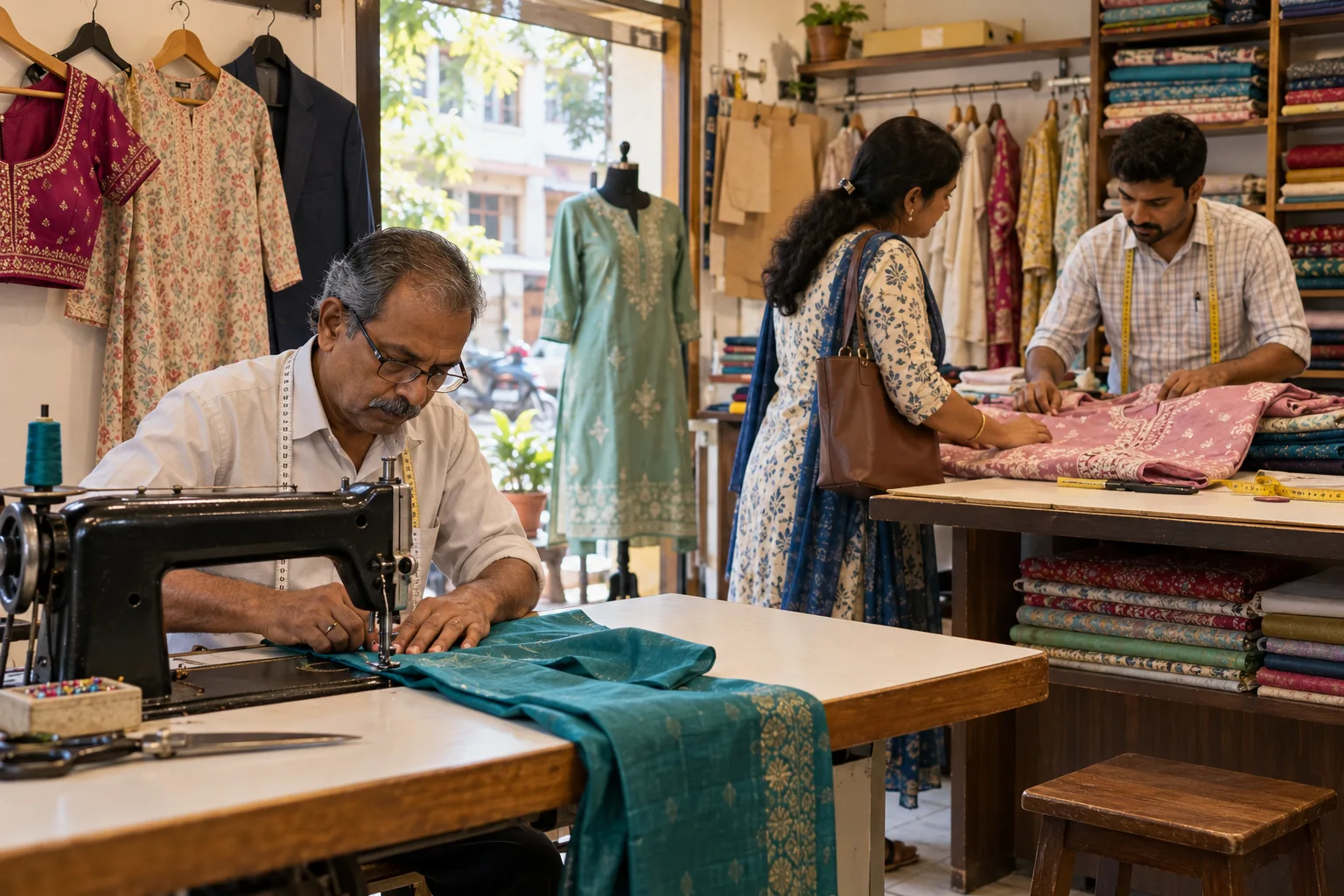
What buyer persona means
A buyer persona is a plain description of the kind of customer who actually buys from you. It includes what they search, what worries them and who else they ask before deciding. GullySales builds this from real enquiries and past sales rather than a generic template, then uses it to write every page and advert.
Last updated 14 Nov 2026.
For tailoring shops
Where it usually goes wrong, and what we would do.
“The bride's family decides on date and trust”
A wedding order is placed by a mother or an aunt along with the bride. They want a master who has stitched for the family before or comes recommended, and they judge the shop on whether the delivery date is kept.
“The regular woman customer wants the fit remembered”
A customer who orders blouses and kurtas through the year wants the measurement remembered and the design ready to repeat. For this buyer the shop's memory is the product.
“The office-goer wants shirts that fit and arrive”
A gents' customer buys few garments and wants them ready on a stated day. Style comes second to fit and finish. Missing one date loses the customer to ready-made.
“The institution buyer wants a rate and a sample”
A school office or hospital purchase desk wants to see cloth, stitching and a price, and to know the order will finish on time. The buyer is an administrator, not a fashion customer.
What we do
What we deliver for tailoring shops.
The work available for this need. We agree the deliverables and responsibilities for your engagement in writing.
Persona sheets
One page each for the bride's family, the regular customer, the gents' customer, the parent buying uniforms and the institution buyer.
Result: Each buyer has a written description the whole shop can read.
Question list per buyer
What each buyer asks before ordering, taken from the register and messages.
Result: Replies are ready for the questions that actually come.
Offer and message per persona
The booking route and wording suited to each buyer.
Result: A bride's mother and a school office get different messages.
Register tags
Simple tags in the order book for the buyer type.
Result: You can count which kind of customer you stitch for most.
Persona review
A look at the sheets after a season against what the register shows.
Result: The descriptions are corrected by the orders that followed.
How the result is measured
- Enquiry match to persona
- Conversion rate by persona
- Content aligned to persona
Recorded as a baseline before work starts, so every later report has an honest comparison.
Who is asking
The customers who walk in or message, and what each wants to know before ordering.
- The bride's family
- Decides on date and trust. Wants to see bridal work, know who cuts the blouse and have the delivery date written down.
- The regular woman customer
- Wants the fit remembered and the neckline from last time repeated. Asks whether measurements are on file.
- The office-goer
- Wants shirts and trousers that fit and arrive on a stated date. Asks about alterations and visiting hours, as work time is tight.
- The parent ordering for children
- Wants growth room, function dates and a price to plan around. Asks whether hems and seams can be let out later.
- The institution purchase desk
- Wants a rate, a sample and a billing route. The person at the desk is not the wearer and cannot come for fittings.
- The customer sending an Instagram photo
- Wants a price and a date from a picture. Needs the shop to ask about cloth, date and measurement before quoting.
Who it is for
This is written for these tailoring shops.
- Ladies' tailoring shops for blouses, kurtas and salwar suits
- Boutiques with designer blouse and bridal stitching
- Gents' tailors for shirts, trousers and formal wear
- Suit, sherwani and wedding wear tailors
- Uniform tailoring for schools, hospitals and offices
- Children's clothing and school uniform stitching
- Home-based tailors working on WhatsApp orders
- Alteration-heavy shops near markets and railway stations
Before you decide
When this may not be the right fit.
- You have not looked at the register to see who your customers are, so a persona would be an invention.
- The shop serves only walk-in regulars, so a persona sheet would describe people you already know by name.
- Nobody at the counter will use the sheets when a customer arrives, so they would sit in a drawer.
Before you decide
Agree the work. Know how to judge it.
Buyer personas for tailoring shops: use these checks to prepare, choose the scope, and review what changes.
Bring the right evidence
Write the decision the research must support, such as entering a market or choosing a buyer group. Separate what you know from sales records from what the team currently assumes.
Make the scope clear
Agree which buyers to speak to, which sources to review, and what access you can provide. Include lost enquiries and people who chose another supplier, where they are willing to take part.
Check the work in use
Look for source dates, sample limitations, and evidence that disagrees with the preferred answer. A recommendation should show how it follows from the findings.
Know when to change course
Do not treat a few positive conversations as proof of demand. Test the proposed offer with an actual buying decision before committing to a wider launch.
These are discussion points, not a fixed package. GullySales confirms the deliverables, responsibilities, fee, and term in writing after reading your brief and speaking with you.
Before we start
What to have ready before the work starts.
The records, access and decisions this work needs from tailoring shops. Anything missing is noted in the written scope, with who will supply it.
- The order register for two seasons
- Bring the book with customer, garment and date. Gaps are fine. It shows who repeats and when. Without it we rely on talk alone. Add the advance paid on each order if you record it, because it shows how firmly a buyer commits.
- A day at the counter
- Pick a normal working day, not a festival rush and not a dead day. We observe quietly. If the counter is too small for a visitor, tell us and we shall sit nearby. Choose a day that includes both a first-time visit and a collection.
- Introductions to regular customers
- Give us a few names of regulars who will talk. We do not contact anyone without your say-so. If nobody wants to talk, we use your staff's account and mark the sheets as less certain.
- A word on customers you prefer
- Tell us whom you want more of: bridal families, office-goers, institutions. Sheets take shape around your choice. A shop can serve all types but cannot grow all at once.
- Time with the cutting master and the counter staff
- These two know the customers best. Block an hour for them to read the sheets and mark errors. Sheets the staff have not read are not used. Also name who speaks to institutions.
How it works
How the buyer persona work runs
The work itself, in order. How an engagement starts, from your brief to a written scope, is set out on our method page.
- 1
Sort the order register by who ordered what
We go through your register and sort orders into groups: bridal and function blouses, regular blouse and kurta orders, office shirts and trousers, uniforms. Under each we count repeat customers. You help us by naming the people behind each group. What exists afterwards is a first outline of four buyer types. We also note the garments a group never orders, since an absence tells us as much about a buyer as a repeat does.
- 2
Sit at the counter for a day of conversations
We spend a day at the counter and listen to what customers ask and worry about. We note who comes with whom, what they bring, what they say about the last tailor and what makes them walk out. You introduce us as someone helping with the shop. Notes are kept without names, and any remark about a named customer is left out of what we return to you.
- 3
Talk to a few regular customers and one institution
With your approval we speak to a few regular customers of each type and to one institution buyer. We ask why they chose the shop, what they fear and what would send them elsewhere. You read the summary. The talk shows motives that the register cannot. We ask each one who else in the household or office has a say, because the person at the counter is not always the one who decides.
- 4
Write the sheets and read them to the counter
Each sheet states who the buyer is, what they want, what they worry about, who influences them and how they decide. We read them aloud to your counter staff and cutting master, who correct what is wrong. Corrected sheets stay in the shop. Where two staff disagree on a sheet, we keep both views and test them at the counter before settling the text.
- 5
Write the offer and message for each buyer
For each sheet we draft a message and an offer suited to the buyer, such as a trial-slot promise for a bridal family or a rate card for an institution. You decide what the shop can honour. Wording is tested on a customer of that type. The wording is checked against what the counter can actually promise on dates and trials.
- 6
Tag the register and check the sheets again
We add a buyer-type tag to the order register and read it after the next busy season. Against the counts taken at the start, you see which type grew and which stayed flat. The decision is whether a sheet needs correcting or a new buyer type needs adding.
Where this fits
Three pieces of sales work, in this order.
This work sits inside sales process design, at stage 0, foundation. The audit comes before it, and sales management keeps it running.
Step 1
Sales audit
Find where deals are being lost and what to fix first.
Start here if you cannot say where orders are lost.
Step 2 · you are here
Sales process design
One written way to sell, from first enquiry to repeat order.
Start here if every salesperson sells differently.
Step 3
Sales management
A target, a review routine and someone who owns the number.
Start here if the team has targets and no routine.
FAQ
Questions owners ask before they call.
Not here? More answers, or ask on WhatsApp.
How many personas do we need?
Where does the information come from?
Does a persona differ from a customer list?
Should personas be separate for ladies and gents?
Should the sheets be separate for ladies and gents?
How often should the sheets be revised?
How much does it cost?
How long is the contract?
How soon will we see results?
Who will actually do the work?
More for tailoring shops
Related work to consider.
Closest to this: strategy and research
Also for tailoring shops
Or start from the overview: sales and marketing for tailoring shops.
Your next practical step
Tell us what you are trying to grow, and we will read it before we call.
Eight short steps, mostly taps. Skip anything you would rather answer on the call.