Tailoring shops · Local SEO
Make the shop the tailor a customer finds on the map from the next street.
Local SEO for a tailoring shop is how the shop appears when a customer searches for a tailor near me and sees the Maps result. GullySales sets up and keeps your Google Business Profile, your address details and your reviews in order.
Scope, fee, reporting and term are agreed in writing after we have read your brief and spoken to you.
What local SEO means
Local SEO is the work of making your business show up for searches that name your town or locality, such as a service plus an area name. GullySales sets up locality pages, local citations and map listings so nearby customers find you before a competitor across town.
Last updated 14 Nov 2026.
For tailoring shops
Where it usually goes wrong, and what we would do.
“The customer is a few streets away”
A family choosing a tailor wants a shop they can reach on a scooter or on foot, with a fitting trial in between. The Maps result is the first filter, and a shop with a missing or wrong pin is not considered.
“Wrong hours lose the Sunday and festival visit”
Tailoring shops change timings before festivals, close on a day off and shut for an afternoon. A profile showing last year's hours sends a customer to a locked shutter, and that customer picks the next result.
“Photos on the profile decide the click”
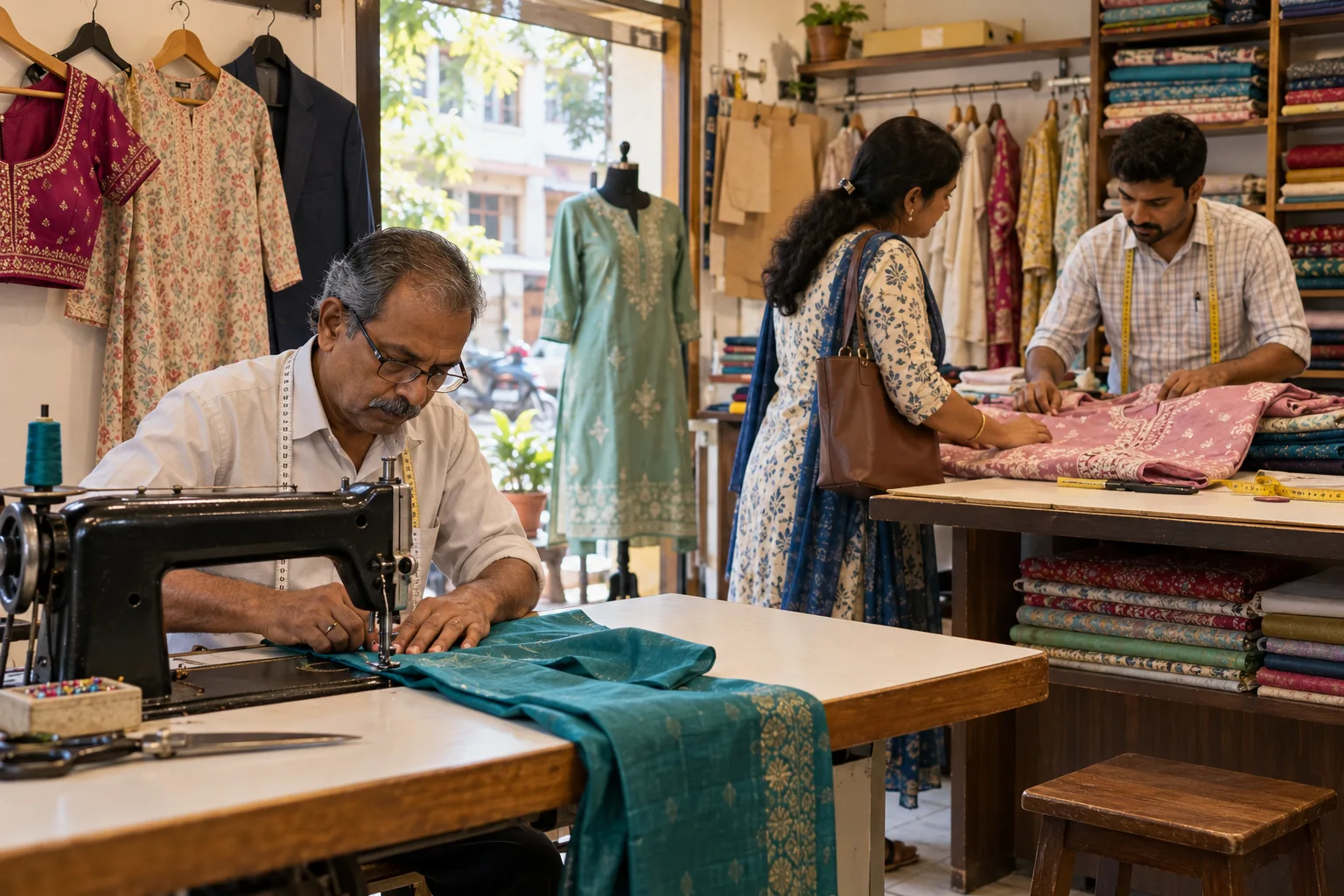
A profile with a dark shopfront photo and nothing else looks like every other. Pictures of the counter, the cutting table and finished blouses tell the customer what the shop stitches before any call is made.
“Reviews mention the fit and the date”
A review that says the blouse fitted on the first trial and was ready on the promised day is the line a new customer reads. A review that only says good has little to offer. Asking a delivered customer at the counter is the natural time.
What we do
What we deliver for tailoring shops.
The work available for this need. We agree the deliverables and responsibilities for your engagement in writing.
Business Profile set-up and clean-up
The correct name, address, pin, categories, hours and phone, with festival timings updated as they change.
Result: The profile shows what is true on the day.
Photo set for the profile
Shopfront, counter, trial area and finished garments, photographed with the customer's yes where a person is shown.
Result: A visitor sees the work before calling.
Review request message
A short WhatsApp message to send after delivery, asking for an honest review of the fit and the date.
Result: Reviews arrive from customers who were actually stitched for.
Reply guide for reviews
Plain replies for praise and for a complaint about a late or tight garment.
Result: Every review has a polite answer in the shop's voice.
Service list on the profile
The garments and alterations you stitch, listed in the customer's own words.
Result: The profile answers whether you stitch what is needed.
How the result is measured
- Map pack ranking
- Local search visibility
- Enquiries by locality
Recorded as a baseline before work starts, so every later report has an honest comparison.
Searches your buyers type
What a customer nearby types, and what the shop's listing should answer.
- tailor near me open now
- Correct opening hours, including Sundays and festival days. A wrong hour sends the customer to the next shop.
- ladies tailor in [your locality]
- A listing that names ladies, gents or both, with the locality in the description and a map pin on the right lane.
- blouse stitching shop reviews
- Reviews that name the garment and the fit. Ask at collection and reply to each, so a new customer reads proof.
- tailor with alteration service
- Alteration on the service list. Quick jobs bring walk-ins who place a stitching order later.
- uniform tailor near me
- A service entry for uniforms, aimed at school and office staff who look for a supplier on the map.
- boutique with bridal blouse stitching
- Photos of bridal blouses on the profile with the customer's consent, since the picture decides the click.
Who it is for
This is written for these tailoring shops.
- Ladies' tailoring shops for blouses, kurtas and salwar suits
- Boutiques with designer blouse and bridal stitching
- Gents' tailors for shirts, trousers and formal wear
- Suit, sherwani and wedding wear tailors
- Uniform tailoring for schools, hospitals and offices
- Children's clothing and school uniform stitching
- Home-based tailors working on WhatsApp orders
- Alteration-heavy shops near markets and railway stations
Before you decide
When this may not be the right fit.
- You are home-based and do not want customers at the door, and the profile is not set to hide the address.
- Your hours change without notice, so the listing would be wrong as much as right.
- Nobody will reply to reviews, and a complaint about a late delivery would stand alone.
Before you decide
Agree the work. Know how to judge it.
Local SEO for tailoring shops: use these checks to prepare, choose the scope, and review what changes.
Bring the right evidence
Confirm the real business address, service area, contact details, and who controls the business listings. Keep examples of calls that came from the wrong location or asked for a service you do not provide.
Make the scope clear
Choose the locations you actually serve and the information each needs. Agree who approves listing changes, responds to enquiries, and keeps opening hours accurate.
Check the work in use
Check the journey from a local search to a call or enquiry on a phone. The address, service area, and description should agree across your website and listings.
Know when to change course
Do not create an office claim for a place where you only serve customers remotely. Clear service coverage is more useful than a misleading local presence.
These are discussion points, not a fixed package. GullySales confirms the deliverables, responsibilities, fee, and term in writing after reading your brief and speaking with you.
Before we start
What to have ready before the work starts.
The records, access and decisions this work needs from tailoring shops. Anything missing is noted in the written scope, with who will supply it.
- A phone number the shop answers
- The profile publishes the number. Pick one the counter answers during opening hours, ideally the shop's own. A number on the cutting master's pocket during a trial loses the call.
- A signboard and shop photograph
- A clear picture of the front helps verification and helps a customer find the lane. Take it in daylight. If the signboard is old or the name differs from your registration, tell us before we enter the name.
- Your opening hours for the whole year
- State regular hours, the closing day of the week and the festival changes. Without this the profile shows the wrong time on the very days customers rely on it.
- Names of regular customers who may review
- Reviews that mention the fit and the date carry the weight. Provide a few regulars you are comfortable asking. We never write or buy reviews. A customer with a pending alteration is left alone until it is resolved.
- Permission lines for photographing garments
- A customer's garment is the customer's property, so ask before photographing it. Prepare a short slip or a verbal-consent note in the order book. Garments without permission stay out of the profile.
How it works
How the local SEO work runs
The work itself, in order. How an engagement starts, from your brief to a written scope, is set out on our method page.
- 1
Stand outside the shop and note the signboard
We start with the shop as a passer-by sees it. We record the signboard name, the floor, the lane, the nearest landmark and the way in from the main road. You tell us what customers say when they phone for directions. What exists afterwards is the exact name and address to be used everywhere.
- 2
Claim the Business Profile with the owner
Verification asks for a video of the shop or a code on a postcard. We do it beside you, so the right person answers. If a listing already exists, perhaps started by a customer, we claim it instead of starting a second. You choose the trade type and the days and hours.
- 3
Set Sunday and festival hours before anything else
Wrong hours lose the customer who comes on a holiday. You tell us how the shop really runs on Sundays, the week before a festival and on the day after. We enter regular and special hours and write who updates them when you close. The profile then shows what the door shows.
- 4
Photograph the counter, the rack and the trial room
Photos decide the click. With your permission we take pictures of the signboard, the cutting table, the finished rack and the trial room, plus a few garments with consent. Customer faces stay out. You choose the cover photograph. The set is loaded with the garment names in the captions.
- 5
List the garments you stitch as services
The profile has a service list. We enter blouses, kurtas, shirts, trousers, alterations and uniforms as you stitch them, with a short description of each in the words customers use. You remove any you do not want. Garments with a consent photograph carry it.
- 6
Match profile calls with the earlier tally
Against the calls and direction requests noted at the start, we read the profile's figures and ask the counter how many walk-ins mentioned the map. You decide whether to add photographs, change hours or ask a few regular customers for a review. The test is whether more people walked in, and the counter can tell you that better than any chart.
Where this fits
Three pieces of sales work, in this order.
This work sits inside sales process design, at stage 1, prospecting and lead generation. The audit comes before it, and sales management keeps it running.
Step 1
Sales audit
Find where deals are being lost and what to fix first.
Start here if you cannot say where orders are lost.
Step 2 · you are here
Sales process design
One written way to sell, from first enquiry to repeat order.
Start here if every salesperson sells differently.
Step 3
Sales management
A target, a review routine and someone who owns the number.
Start here if the team has targets and no routine.
FAQ
Questions owners ask before they call.
Not here? More answers, or ask on WhatsApp.
We are home-based. Should the address be public?
How should we respond to a review we think is unfair?
Does every branch need its own listing?
Which photos belong on the profile?
Can we show the shop on the map if the entrance is upstairs?
What if another tailor lists our shop name?
How much does it cost?
How long is the contract?
How soon will we see results?
Who will actually do the work?
More for tailoring shops
Related work to consider.
Closest to this: search and visibility
Also for tailoring shops
Or start from the overview: sales and marketing for tailoring shops.
Your next practical step
Tell us what you are trying to grow, and we will read it before we call.
Eight short steps, mostly taps. Skip anything you would rather answer on the call.