Tailoring shops · Website
Give the shop an address online where a customer can see the work and book a fitting.
A website for a tailoring shop is a short set of pages showing garments, the process, the location and a way to book. GullySales plans the pages, writes the words and sets out a gallery that loads on a phone.
Scope, fee, reporting and term are agreed in writing after we have read your brief and spoken to you.
What website means
A website is the page a customer lands on after searching, clicking an advert or scanning a code, and it decides whether they call or leave. GullySales builds and maintains sites that load quickly, explain the offer plainly and make the enquiry form or phone number easy to find.
Last updated 14 Nov 2026.
For tailoring shops
Where it usually goes wrong, and what we would do.
“Customers open it on a phone, in a hurry”
A visitor checks the site from a bus or a shop floor. If the gallery is slow or the phone number is hidden, they leave. A tailor's site must show the work and the contact at once.
“Gallery without detail does not sell”
A wall of pictures impresses and answers nothing. A customer wants to know the garment, the cloth, whether it can be made in their size and how to book. Captions and a clear booking route turn a view into an enquiry.
“The process page calms the first-time customer”
A new customer wonders how measurement works, when the trial happens and what if it does not fit. A page that explains this in plain words answers the worry before the call.
“An outdated site hurts more than none”
A site that shows last year's offers or a closed branch loses trust. The pages must be few enough that the shop can keep them current.
What we do
What we deliver for tailoring shops.
The work available for this need. We agree the deliverables and responsibilities for your engagement in writing.
Page plan
Home, garments, gallery, process, uniforms and contact, with the sections the shop needs and nothing more.
Result: The site covers what a customer asks and no extra.
Garment pages
One page for each major stitch with description, pictures and a booking button.
Result: A customer can find the exact garment they need.
Gallery with captions
Photographs sorted by garment and style, with consent recorded.
Result: The shop's work is shown without losing the customer's trust.
Booking and contact route
A click-to-call and a WhatsApp link on every page, plus a short booking form.
Result: The shop is one tap away from any visitor.
Uniform and bulk page
A page for institutions with sample, rate request and contact for the purchase desk.
Result: Schools and offices have somewhere to land.
How the result is measured
- Page load time
- Bounce rate
- Enquiries from the website
Recorded as a baseline before work starts, so every later report has an honest comparison.
Questions the site must answer
What a visitor wants to settle on a tailoring shop's site, and the page that settles it.
- Do you stitch what I want?
- Garment pages for blouses, kurtas, shirts, suits and uniforms, each naming the cloths and designs the master cuts.
- Can I see your work?
- A gallery with captions naming garment and cloth, shown with permission, since a plain photograph wins no trust.
- How does a first order work?
- A process page: bring cloth, measure, trial, collect. It calms a first-time customer who is wary of the fit.
- Where are you and when are you open?
- Address, hours, festival closures and a map pin on every page, because the visitor is deciding whether to walk in today.
- Can I book a fitting?
- A booking route by WhatsApp or call asking for garment, cloth and date, in place of a form few people fill in.
- Do you do uniforms in bulk?
- A page for schools, hospitals and offices with the sample process, sizes and a contact for the purchase desk.
Who it is for
This is written for these tailoring shops.
- Ladies' tailoring shops for blouses, kurtas and salwar suits
- Boutiques with designer blouse and bridal stitching
- Gents' tailors for shirts, trousers and formal wear
- Suit, sherwani and wedding wear tailors
- Uniform tailoring for schools, hospitals and offices
- Children's clothing and school uniform stitching
- Home-based tailors working on WhatsApp orders
- Alteration-heavy shops near markets and railway stations
Before you decide
When this may not be the right fit.
- Nobody can keep the hours and festival notices current, and a wrong notice sends customers to a shut door.
- You have no photographs of your own delivered garments, so the gallery would be stock images.
- Instagram and Maps already bring the orders you can handle, and a site would be one more thing to maintain.
Before you decide
Agree the work. Know how to judge it.
Website for tailoring shops: use these checks to prepare, choose the scope, and review what changes.
Bring the right evidence
List the pages that support a buying decision and the actions visitors must complete. Keep examples of failed forms, unclear product information, and questions your team answers repeatedly.
Make the scope clear
Agree the page list, content ownership, integrations, and who controls the domain and hosting. Include redirects and existing search traffic in a redesign brief, before changing addresses.
Check the work in use
Complete a real enquiry journey on a phone and a laptop. Check that the confirmation appears, the enquiry reaches the right person, and tracking records the action once.
Know when to change course
If visitors can enquire but the team does not follow up, start with the sales handover. A larger website will not resolve that delay.
These are discussion points, not a fixed package. GullySales confirms the deliverables, responsibilities, fee, and term in writing after reading your brief and speaking with you.
Before we start
What to have ready before the work starts.
The records, access and decisions this work needs from tailoring shops. Anything missing is noted in the written scope, with who will supply it.
- The domain name and its login
- If a domain exists, tell us who owns it. If not, choose a name customers can say aloud. A site cannot go live without the domain under your control.
- Photographs of the shop and delivered work
- Provide what you have: signboard, counter, racks and garments, with the customer's yes where a garment is shown. We shall plan a shoot for what is missing. Tell us if any image is of a customer.
- Your list of garments and what each needs
- Write what you stitch, the number of trials and what a customer brings. This is the text of the garment pages. Leave out what you do not stitch.
- A decision on uniforms and bulk work
- Say whether you take institution orders, in what quantity and with which sample. The page for uniforms is written only if you will answer such enquiries.
- The person who updates the site
- Name who changes opening hours, festival notices and garment photographs. A site with a stale notice harms trust. If nobody can, we keep the site very simple.
How it works
How the website work runs
The work itself, in order. How an engagement starts, from your brief to a written scope, is set out on our method page.
- 1
Open the site on a phone
We open your current site, or the Instagram page that stands in for one, on a phone with a weak signal. We note what loads, what a customer sees first and what is missing. You tell us what customers ask that the site does not answer. The step ends with a short list of what to keep and replace.
- 2
Decide the pages: garments, process, shop, uniforms
We agree a page plan: a page for each garment you stitch, a process page for the first-time customer, a page about the shop and its location, and a page for uniforms and bulk. You strike what you do not need. The plan stays small enough for the counter to keep current, and each page is linked from the home page by the word a customer would type. Uniform buyers and first-time customers are given separate doors on the home page.
- 3
Photograph the workshop and the finished racks
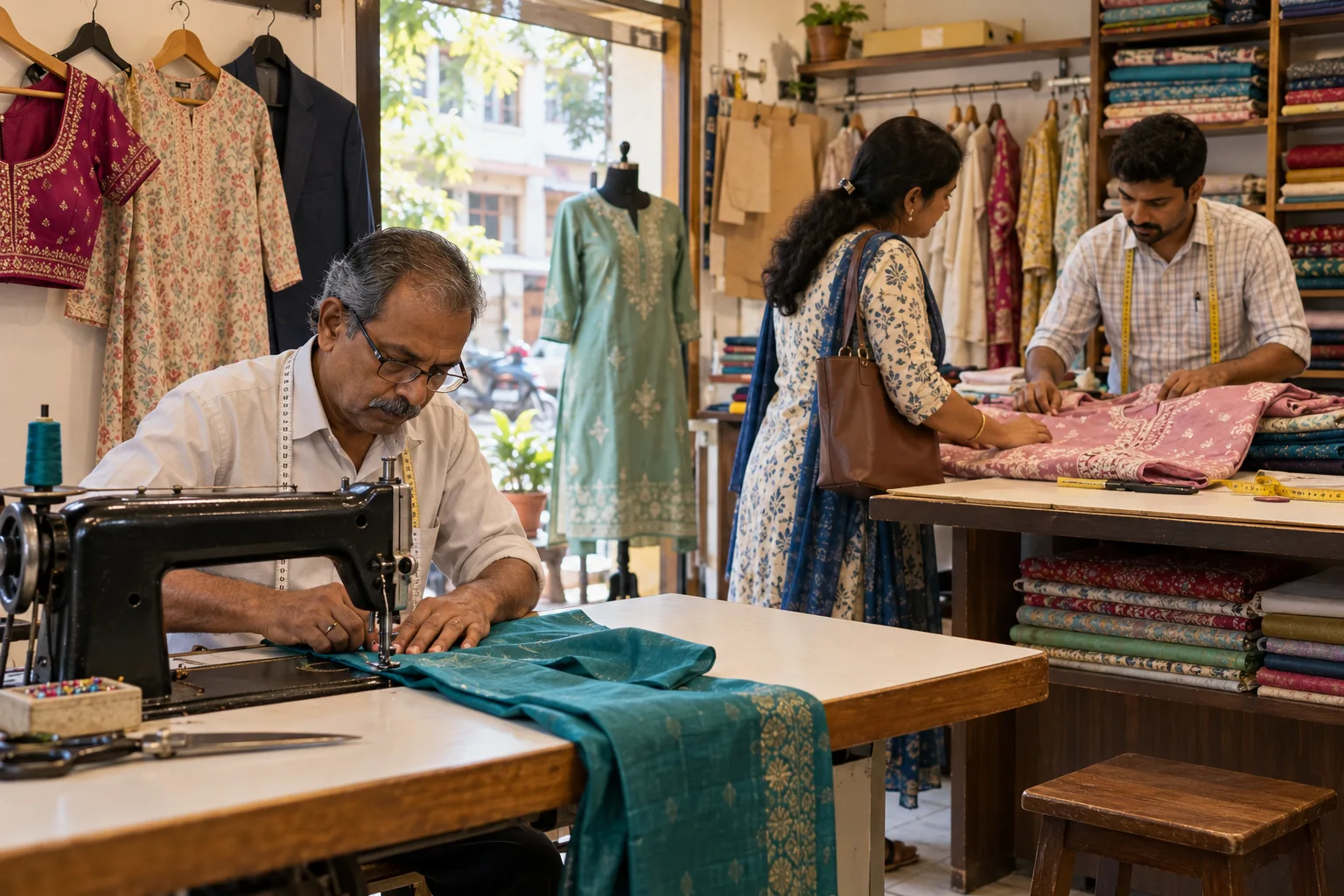
A process page is convincing with pictures of the cutting table, the machines and the trial room. With your permission and with no customers in frame, we photograph them. Delivered garments are used only with consent. Each picture carries a caption naming the garment, the cloth and the step shown, so the gallery explains itself.
- 4
Write each page with the cutting master reading
We write the garment pages, with cloth choices, the number of trials and what to bring. The cutting master reads each for accuracy. The process page walks a first-time customer from message to collection. You approve the words, and the counter staff test the page by reading it aloud as they would to a customer.
- 5
Set up booking by message and call
The main action is a message, a call or a visit. We add a button for WhatsApp, a call button and a map. The uniform page has a separate enquiry route. We test each from a phone. You decide who answers each route, and the uniform enquiry goes to the person who can quote a full set of sizes.
- 6
Go live and see who finds it
On your approval the site goes live, and we test speed and links on a phone. You receive the logins. Against the calls and messages noted at the start, we read the site's contacts and ask the counter how many customers mention it. You decide whether the next page is a garment, a guide or a festival notice.
Where this fits
Three pieces of sales work, in this order.
This work sits inside sales process design, at stage 1, prospecting and lead generation. The audit comes before it, and sales management keeps it running.
Step 1
Sales audit
Find where deals are being lost and what to fix first.
Start here if you cannot say where orders are lost.
Step 2 · you are here
Sales process design
One written way to sell, from first enquiry to repeat order.
Start here if every salesperson sells differently.
Step 3
Sales management
A target, a review routine and someone who owns the number.
Start here if the team has targets and no routine.
FAQ
Questions owners ask before they call.
Not here? More answers, or ask on WhatsApp.
Do we need an online shop to sell garments?
Who updates the site?
Is the site needed when we have Instagram?
Should the site show our workshop?
Should the site show the workshop?
Can customers pay or book through the site?
How much does it cost?
How long is the contract?
How soon will we see results?
Who will actually do the work?
More for tailoring shops
Related work to consider.
Closest to this: search and visibility
Also for tailoring shops
Or start from the overview: sales and marketing for tailoring shops.
Your next practical step
Tell us what you are trying to grow, and we will read it before we call.
Eight short steps, mostly taps. Skip anything you would rather answer on the call.