Temples · Branding
Present the deity and the temple's history the way a devotee explains it.
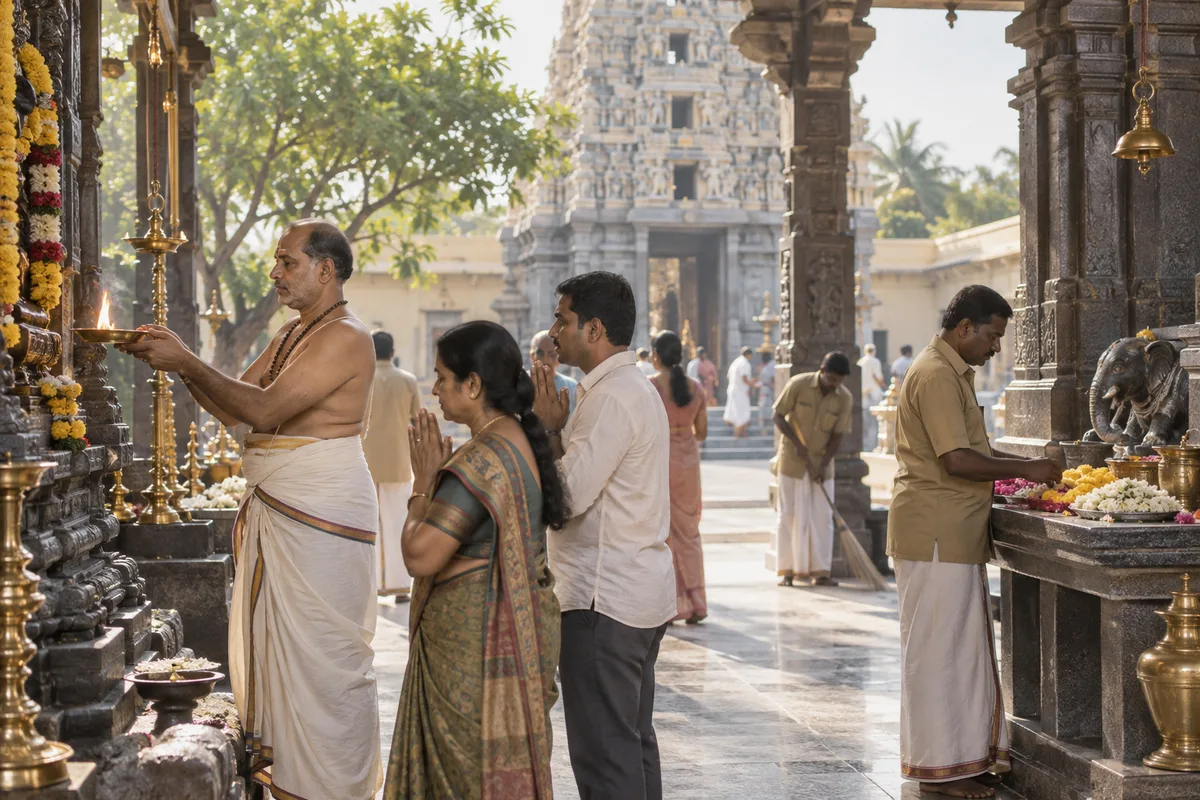
Branding for a temple means presenting the deity's name, founding story and known festival consistently online, built from the trust's own history. GullySales writes this from what the trust and priests tell us, then fixes the spelling and imagery inconsistencies across the site and profiles.
Scope, fee, reporting and term are agreed in writing after we have read your brief and spoken to you.
What branding means
Branding is what a customer remembers about your business beyond the product, including your name, colours, tone of voice and what you are known for locally. GullySales sets or corrects this once and applies it consistently across your website, signage and adverts so the business looks like one company everywhere.
Last updated 14 Nov 2026.
For temples
Where it usually goes wrong, and what we would do.
“The founding story is the identity”
The founding story and the deity's form are what devotees repeat to others, so the site leads with that.
“One name, spelled one way, everywhere”
Three spellings of the same temple name confuse search and devotees, so we fix it everywhere.
“The known festival leads the homepage”
A temple known regionally for one utsavam keeps that festival visible all year, not only the week before.
“Festival materials carry the same identity”
The banner, the invitation and the booking page for a brahmotsavam show the same name, spelling and image as the website, so a devotee knows the official source.
What we do
What we deliver for temples.
The work available for this need. We agree the deliverables and responsibilities for your engagement in writing.
One name, spelled the same way everywhere
A single agreed spelling of the temple's name and the deity's name, corrected across the website, Google profile and printed material.
Result: A devotee searching finds one temple, not three confusing entries.
The founding story confirmed by the trust
The temple's founding story and the deity's form written from what the trust and priests tell us, confirmed before it goes anywhere public.
Result: Devotees read the same story the temple itself would tell them.
The known festival kept visible all year
A section of the website and profile dedicated to the temple's known utsavam, visible outside festival week, not only just before it.
Result: The festival the temple is known for is never hard to find.
Photograph set of the deity and premises
A shoot list covering the deity's alankara, the mandapam and the temple grounds, replacing generic or borrowed imagery.
Result: A family planning a visit sees the real temple beforehand.
Consistency check across website and signage
A review of spelling, imagery and festival dates across the website, Google profile and any printed signage, with fixes agreed with the trust.
Result: Nothing a devotee reads about the temple contradicts something else.
A festival kit in the temple's identity
The festival banner, the WhatsApp invitation and the booking page headings set in one style, with the temple's name and the trust's registration line.
Result: A devotee can tell the trust's own invitation from a forwarded copy.
How the result is measured
- Recognition in customer feedback
- Consistency across channels
- Repeat enquiries by name
Recorded as a baseline before work starts, so every later report has an honest comparison.
Positioning in one sentence
This is the temple of this deity in this place, known for this festival, and here is what a devotee can read about it.
- Who it is for: the devotee searching
- Decide whether the first reader is a local family, a pilgrim travelling in or an NRI devotee abroad. Each needs the same facts, but the NRI wants seva booking and live darshan details first.
- What the temple is: deity, place and tradition
- Write the deity's name, the place and the tradition once, in the form the trust confirms, such as the sampradaya or agama followed. The trust and the priests, not a designer, decide this wording.
- What a devotee finds here that is specific
- Name the known festival, the unique seva or the story behind the sanctum, as the trust tells it. Do not borrow a legend from another temple, and do not add a claim the priests have not confirmed.
- What the trust can show
- The founding year in the trust's records, the trust registration, the festival calendar and darshan timings. Show real photographs the trust has cleared. Respect any rule on photography inside the sanctum.
- Names and spellings that must not drift
- List every spelling in use: the deity, the town, the trust and the festival. Choose one in English and one in the local script, and use them on the board, the booking page, the Maps listing and the receipt.
Who it is for
This is written for these temples.
- Ancient and heritage temples with high pilgrim footfall
- Neighbourhood and community temples
- Temple trusts managing more than one shrine
- Shrines with a strong NRI devotee base overseas
- A temple known for one festival or utsavam
- Temples running annadanam and community welfare programmes
Before you decide
When this may not be the right fit.
- The trust has not agreed who approves the wording about the deity and the history, so any new text would be disputed after it is printed.
- The trustees are still divided over the temple's name or its spelling, and a new logo would harden one side's view.
- You want a redesign to settle a dispute over ritual practice, which belongs to the priests and not to a brand exercise.
Before you decide
Agree the work. Know how to judge it.
Branding for temples: use these checks to prepare, choose the scope, and review what changes.
Bring the right evidence
Collect the sales presentation, website, quotations, and other material buyers actually see. Mark where the description of the business changes or where a claim has no supporting evidence.
Make the scope clear
Agree whether the work concerns the offer, the words, the visual identity, or all of them. List the formats that need updating and who owns the final approval.
Check the work in use
Test the proposed direction on a real sales page or proposal. A buyer should be able to tell who the offer is for, what is different, and what evidence supports it.
Know when to change course
A new identity will not fix an unresolved service problem. Put the delivery issue right before making a stronger public promise about it.
These are discussion points, not a fixed package. GullySales confirms the deliverables, responsibilities, fee, and term in writing after reading your brief and speaking with you.
Before we start
What to have ready before the work starts.
The records, access and decisions this work needs from temples. Anything missing is noted in the written scope, with who will supply it.
- The trust deed and history booklet
- The deed and any printed history are the only safe base for describing the deity and the founding. Photocopies are fine if readable. Without them we can describe only what the priests say in conversation, and the trustees would then have to approve every sentence line by line.
- A named person who approves the wording
- Branding for a temple needs one trustee or the head priest who can say yes or no to a line about the deity. This person need not be technical. If approval is spread across a committee, the naming sheet stalls and the old spellings stay in place.
- Permission rules for photographs
- Tell us where the temple permits cameras and where it does not, in writing if the trust has a policy. We cannot judge this ourselves. Without the rule we shoot only the exterior and the open courtyards, and the image set will be thinner.
- Every banner, receipt and board in use
- Gather a sample of the printed receipts, festival flex banners, donation boards and notice sheets. They show the name as devotees actually see it. If these are missing we audit only the online spellings, and printed inconsistencies remain until someone brings samples later.
- Access to existing online profiles
- We need owner or manager access to the temple's Maps listing, social pages and any donation page. A spelling cannot be corrected by someone without the login. If the old committee holds the passwords, tell us at the start so the trust can recover them first.
How it works
How the branding work runs
The work itself, in order. How an engagement starts, from your brief to a written scope, is set out on our method page.
- 1
Collect the trust's founding papers
We start with whatever the trust already holds: the sthala purana booklet, the plaque at the entrance, old festival notices and the trust deed's description of the deity. You tell us which of these the trustees consider the authoritative account. We leave with one reference folder, so every later line about the temple's origin comes from a document and not from memory.
- 2
Settle the name with the head priest
We sit with the head priest and a trustee and list every spelling of the deity, the temple and the town that appears anywhere. You decide which single form is correct, including honorifics and the Sanskrit or regional-language version. We write that down as a one-page naming sheet that the trust signs off before anything else is changed.
- 3
Walk the premises for photographs
We visit with the trust's permission and photograph only where the temple allows it: the gopuram, the prakaram, the tank, the festival chariot shed and the queue area. The priests tell us which spaces are never photographed. By the end you hold a set of approved images and a list of places we agreed to leave out.
- 4
Trace the name through every channel
We search for the temple on Maps, the website, social handles, donation pages, printed receipts and the flex banners outside. Each place where the spelling, the deity's title or the founding story differs from the naming sheet goes on a list. You see the list with screenshots, so the trustees can judge which mismatches matter to devotees first.
- 5
Rewrite the festival identity pages
We take the temple's best-known utsavam and write how it is presented online: its name, its rituals in the priests' own words and its place in the year. The priests read each paragraph and strike anything they would not say at the sanctum. What exists afterwards is a festival page and a short brief for banners and notices.
- 6
Compare bookings and calls to the start
Before changing anything we record the number of seva bookings, donation payments and phone queries the office logs in a normal period. Afterwards we sit with the same office register and compare. We look at whether devotees ask fewer questions about which temple is which and whether the booking records have moved, and we report what we see without claiming a cause.
Where this fits
Three pieces of sales work, in this order.
This work sits inside sales process design, at stage 1, prospecting and lead generation. The audit comes before it, and sales management keeps it running.
Step 1
Sales audit
Find where deals are being lost and what to fix first.
Start here if you cannot say where orders are lost.
Step 2 · you are here
Sales process design
One written way to sell, from first enquiry to repeat order.
Start here if every salesperson sells differently.
Step 3
Sales management
A target, a review routine and someone who owns the number.
Start here if the team has targets and no routine.
FAQ
Questions owners ask before they call.
Not here? More answers, or ask on WhatsApp.
Will this change anything about the rituals?
Do you write the temple's history for us?
Should the temple have a logo?
Who approves what we write about the deity and the history?
How do we make a temple look like the official source for online booking?
How should a temple present its festival identity online?
How much does it cost?
How long is the contract?
How soon will we see results?
Who will actually do the work?
From the blog
Further reading for temples.
 5 min read · 12 Oct 2026Tax receipts, FCRA and registrations: how an NGO should present credentials without overclaimingDonors look for registrations before they give. State what you hold in plain words, avoid implying more, and have your adviser confirm the wording.
- 5 min read · 14 Sept 2026Website for an NGO: the pages donors look for before they giveA first-time donor checks your website before paying. The pages and details they look for, in the order they look, and what a small NGO can leave out.
- 6 min read · 2 Jul 2026How an NGO builds a donor database it can actually useA donor database starts as one row per donor, a few columns and a named owner. The layout, the rules that keep it clean and when to move to a CRM.
More for temples
Related work to consider.
Or start from the overview: sales and marketing for temples.
Your next practical step
Tell us what you are trying to grow, and we will read it before we call.
Eight short steps, mostly taps. Skip anything you would rather answer on the call.