Temples · CRM
Know which devotee family booked what seva and when to remind them next.
The easiest way to track devotees, events and email lists for a temple is one shared sheet of families, sevas, donations and consent to be messaged, kept by a named coordinator. Software comes when several volunteers update together. GullySales sets up the sheet, a checklist for a rotating volunteer and the reminder dates.
Scope, fee, reporting and term are agreed in writing after we have read your brief and spoken to you.

What CRM means
A CRM is the record where every enquiry, call and quote is kept against a customer, replacing separate notebooks, spreadsheets and memory. GullySales sets up or cleans an existing CRM and reports from it by enquiry outcome rather than by activity logged.
Last updated 14 Nov 2026.
For temples
Where it usually goes wrong, and what we would do.
“Anniversaries bring devotees back”
A family that sponsored last year's kalyanotsavam returns when reminded a month ahead, not left to remember alone.
“NRI donor families need a different follow-up”
A family abroad booking a seva for a relative back home wants a photograph of the ritual, not a receipt.
“Volunteer handovers should not lose donor history”
Coordinators change from year to year. A shared record means the next one knows who gave what last year.
“Festival week fills the list at once”
New families reach the seva counter all together in festival week. Collect the name and the consent to message there, or the chance passes until next year.
What we do
What we deliver for temples.
The work available for this need. We agree the deliverables and responsibilities for your engagement in writing.
A shared record of devotee families and sevas
A record of which devotee family booked which seva or made a donation, kept as a shared sheet volunteers can update between handovers.
Result: The next volunteer coordinator knows the temple's donor history.
Anniversary reminders set a month ahead
A reminder set for a family that sponsored a kalyanotsavam or another seva last year, sent about a month before the date recurs.
Result: A family is reminded in time to plan a return visit.
A different follow-up routine for NRI donors
A routine for overseas donor families that includes a photograph of the ritual performed for them, instead of a plain receipt.
Result: A family abroad feels connected to a ritual they could not attend.
A digital copy alongside the paper register
Donations logged in a searchable digital record by name and date, kept alongside the trust's existing paper register.
Result: Finding a past donor's record no longer means searching a paper ledger.
A short checklist for a rotating volunteer
A simple, written checklist so a new volunteer coordinator can keep the record going without needing training from the last one.
Result: Donor history survives even as the volunteers looking after it change.
A festival-season collection sheet at the seva counter
A printed sheet or form at the counter for festival week: family name, seva, phone, and whether the family agrees to WhatsApp reminders.
Result: Families who visit once are on the list for next year's reminder.
How the result is measured
- Enquiries logged in the CRM
- Data completeness
- Reports generated from CRM data
Recorded as a baseline before work starts, so every later report has an honest comparison.
What to record, and when
What a temple should record about every devotee family and seva, and whether software is needed yet.
- The family, with gotra and nakshatra if offered
- Record the family head's name and phone number, and the gotra and nakshatra only if the family volunteers them. The seva booking form can collect these at the time.
- Seva, date and receipt number
- Log the seva, the date performed, the amount and the receipt number. The receipt number ties the record to the paper donation register the temple already keeps.
- How the family counts the date
- Note whether the family keeps the seva date by tithi or by the calendar date. A date by tithi moves each year, so the reminder must follow the almanac.
- Overseas families and time zone
- For NRI families record the country, the time zone and whether they want a photograph or a video of the seva. A reminder that arrives at night in their country gets ignored.
- Permission to message
- Record whether the family agreed to WhatsApp reminders. A temple message that arrives uninvited reflects on the temple.
- Do you need software yet?
- A shared sheet is enough for a temple with a modest donor list and one or two coordinators. Think about software when several volunteers update together, or a trust runs several shrines from one donor list.
Who it is for
This is written for these temples.
- Ancient and heritage temples with high pilgrim footfall
- Neighbourhood and community temples
- Temple trusts managing more than one shrine
- Shrines with a strong NRI devotee base overseas
- A temple known for one festival or utsavam
- Temples running annadanam and community welfare programmes
Before you decide
When this may not be the right fit.
- The donor and seva register is on paper in one person's keeping, and that person does not wish to share or move it.
- Volunteers come and go and nobody is asked to enter a booking, so the record would be empty by the next festival.
- You wish to track devotees' income or personal beliefs, which a temple has no reason to hold.
Before you decide
Agree the work. Know how to judge it.
CRM for temples: use these checks to prepare, choose the scope, and review what changes.
Bring the right evidence
List the records your team uses and show how an enquiry becomes an order today. Bring examples of duplicate entries, missing owners, and reports that require manual correction.
Make the scope clear
Agree the stages, required fields, access roles, and integrations before configuring the system. Separate software subscriptions from setup, data work, and training.
Check the work in use
Ask the people who will use the CRM to complete a real handover and find the next action without help. Check that the management report can be traced back to individual records.
Know when to change course
If the process is unclear, buying a more complex CRM adds more places for confusion. Start with the minimum fields and rules the team can use consistently.
These are discussion points, not a fixed package. GullySales confirms the deliverables, responsibilities, fee, and term in writing after reading your brief and speaking with you.
Before we start
What to have ready before the work starts.
The records, access and decisions this work needs from temples. Anything missing is noted in the written scope, with who will supply it.
- The seva booking ledger and receipt books
- These are the source of truth for who gave what and when. Bring the latest volumes, even if untidy. Without them the system starts empty, and the first season of reminders will be sent to nobody.
- A trustee who owns devotee data
- One named person decides who may see phone numbers and what they are used for. The decision cannot sit with the vendor. Without this person the office clerks keep their own private lists and the shared record never fills.
- The office clerk's time at the counter
- The person who types the bookings must sit with us for the layout trial. We need real habits, not guesses. If the clerk cannot be spared, we design the form alone and it will be wrong in small ways that slow the counter.
- Language preferences the temple honours
- Tell us which languages the temple writes in and how names are spelt in each. A devotee's name in Telugu or Tamil script should remain readable. If this is not decided we store names in English only and fix them later.
- A decision on sharing with other shrines
- If the trust runs more than one shrine, decide whether a devotee record is shared or separate. It changes the whole layout. Left open, we keep each shrine apart, which is safer but means a family giving to both appears twice.
How it works
How the CRM work runs
The work itself, in order. How an engagement starts, from your brief to a written scope, is set out on our method page.
- 1
Copy out the donation and booking registers
We begin with the paper receipt books, the seva booking ledger and any spreadsheet the office keeps. You tell us which are reliable and which have gaps. We copy a sample into one sheet with the same columns so we can see what each record holds about a devotee: name, phone, gothram, seva and date.
- 2
Agree what the temple may keep
Devotee details are personal. With a trustee we decide which fields the temple records, who in the office may see them and what a devotee is told when giving their number. Your own adviser confirms the wording of the consent line. Nothing is entered into the system until the trust signs this one-page note.
- 3
Set up the record layout for devotees
We build the fields the temple really uses: the family name, the usual star or gothram where the devotee volunteers it, the seva history, the festival they come for and the language they prefer. The office clerk tries the form on five real records and tells us what is awkward. We change the layout until the clerk can fill it at the counter.
- 4
Bring in the old registers carefully
The records we agreed to keep are typed into the system, duplicates are merged by phone number and anything with no contact is left on paper. Your clerk checks a sample against the receipt book. What exists afterwards is a single list of devotees with their seva history, and a note of what was not imported and why.
- 5
Train the counter staff on entry habits
We sit at the counter during a normal working session and show the clerk and one volunteer how to add a booking, find a devotee by phone and mark an enquiry as answered. You decide who has edit rights and who can only view. The result is a short card of steps that stays at the desk.
- 6
Read the record against the starting count
Before any of this we noted how many repeat devotees the registers showed and how many seva bookings were made by returning families. Once the system has been in use through a festival, we compare the repeat names and the reminders sent with those first numbers and tell you where the data is still incomplete.
Where this fits
Three pieces of sales work, in this order.
This work sits inside sales management. A target, a review routine and someone who owns the number.
Step 1
Sales audit
Find where deals are being lost and what to fix first.
Start here if you cannot say where orders are lost.
Step 2
Sales process design
One written way to sell, from first enquiry to repeat order.
Start here if every salesperson sells differently.
Step 3 · you are here
Sales management
A target, a review routine and someone who owns the number.
Start here if the team has targets and no routine.
FAQ
Questions owners ask before they call.
Not here? More answers, or ask on WhatsApp.
Is this hard to maintain with volunteer staff?
Does this replace the paper donation register?
Can we record tax receipt details of donors?
Volunteers keep everything in their own phone contacts. How do we gather it?
What is the easiest software to track devotees, events and email lists for a temple?
How do we record online donations and sevas in the same list?
How much does it cost?
How long is the contract?
How soon will we see results?
Who will actually do the work?
From the blog
Further reading for temples.
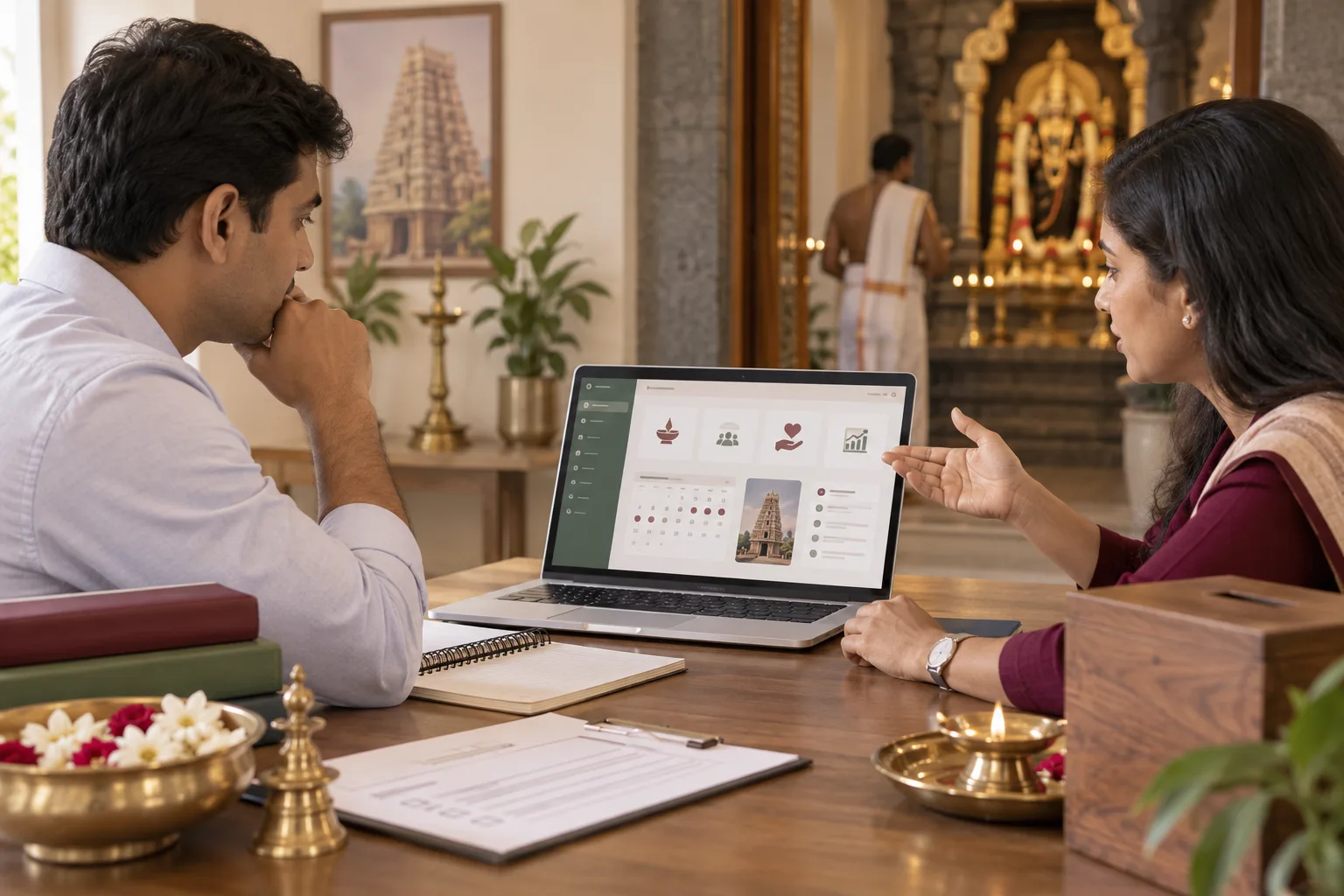 6 min read · 6 May 2026Temple management software and online seva booking: what to check before you buyWhat temple management software must handle, from seva booking and donation receipts to hundi records, and the questions to ask vendors before you buy.
 5 min read · 12 Oct 2026Tax receipts, FCRA and registrations: how an NGO should present credentials without overclaimingDonors look for registrations before they give. State what you hold in plain words, avoid implying more, and have your adviser confirm the wording.
- 5 min read · 14 Sept 2026Website for an NGO: the pages donors look for before they giveA first-time donor checks your website before paying. The pages and details they look for, in the order they look, and what a small NGO can leave out.
More for temples
Related work to consider.
Closest to this: leads and follow-up
Also for temples
Or start from the overview: sales and marketing for temples.
Your next practical step
Tell us what you are trying to grow, and we will read it before we call.
Eight short steps, mostly taps. Skip anything you would rather answer on the call.