Jewellery retailers · Buyer journey
A bridal purchase starts on a phone in month one and ends at your counter in month five.
The buyer journey for a jewellery retailer is the long path from a saved design to a booked order: screenshots, family opinions, a shortlist of showrooms, a price question on WhatsApp, then two visits. GullySales maps where your buyers fall away and puts a named action at each of those points.
Scope, fee, reporting and term are agreed in writing after we have read your brief and spoken to you.
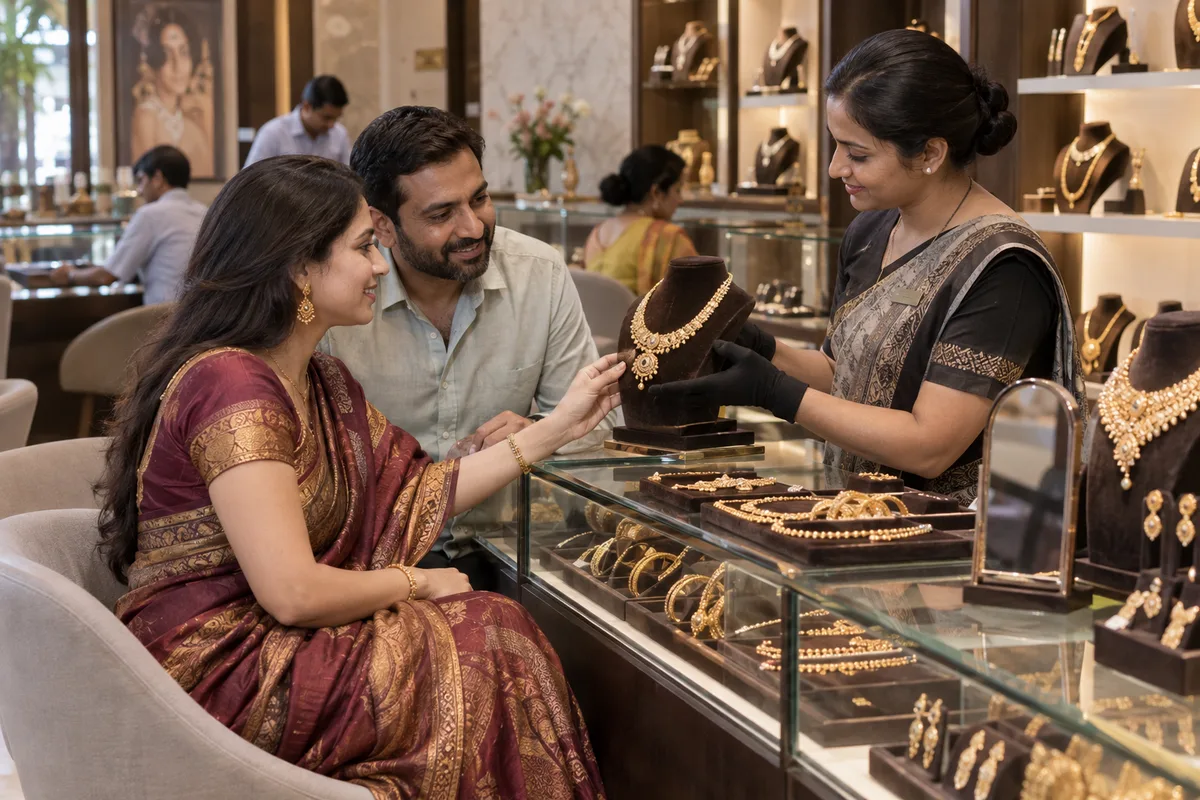
What buyer journey means
The buyer journey is the sequence of steps a customer actually takes, from first hearing about you to deciding to buy, which is rarely a single visit or call. GullySales maps this sequence for your business and checks that something useful happens at each step instead of only at the final call.
Also for jewellery retailers
- Sales and marketing strategy for jewellery retailers
- Buyer persona for jewellery stores
- Digital marketing for jewellery stores
- Cinema advertising for jewellery retailers
- Google Ads for jewellery retailers
- Newspaper advertising for jewellery retailers
- Outdoor advertising for jewellery retailers
- Radio advertising for jewellery retailers
Sales and marketing for jewellery retailers, the overview.
Last updated 5 Oct 2026.
For jewellery retailers
Where it usually goes wrong, and what we would do.
“They arrive with a screenshot, not with a blank mind”
By the first visit the buyer has saved designs from Instagram and decided their weight and budget band. The salesperson who asks what they are looking for, instead of asking to see the picture, restarts a journey that was nearly finished.
“The family joins between the first visit and the second”
The first visit is often the bride and the bride's mother. The second brings the father or the in-laws, because the amount is settled at home. Nothing is designed for that second audience, and that is where the order is lost.
“The gold rate sets the date, not your campaign”
A family that has decided on a set waits for a dip in the rate or for an auspicious date. Knowing the wedding date lets you call in the week that matters instead of the week your offer runs.
What we do
What we deliver for jewellery retailers.
Every deliverable, what it covers for you, and the result it is there to produce. Nothing here is an extra.
The journey mapped from saved design to delivery
Each stage written down for your own store, from the first search or Instagram save through the enquiry, the shortlist, the visits, the booking and the final fitting.
Result: You can point to the exact stage where buyers stop.
Drop-off points identified with a named owner
The unanswered evening message, the visit that ended without a name taken, the booking that stalled at the balance payment, each with a person responsible.
Result: A leak has somebody accountable for closing it.
Counter capture of the occasion and the date
A short form the salesperson fills for every serious enquiry, recording the occasion, the date, the budget band and the designs shown.
Result: The follow-up call knows what they came in for.
Content built for the second visit
Pages and printed sheets that answer the questions the father and the in-laws ask: hallmarking, the HUID, the exchange terms and how making is worked out.
Result: The family decision is made with your answers in the room.
Enquiry sources traced to the showroom visit
Tracking that connects a search, an Instagram message or a call to the visit and the order it became.
Result: You can see which stage of the journey your spending actually helps.
How the result is measured
- Drop-off rate by step
- Time from first contact to sale
- Steps with no content
Recorded as a baseline before work starts, so every later report has an honest comparison.
Stages of the buyer's journey
A jewellery buyer takes weeks over a bridal set, and the decision runs through the gold rate, the family and two visits.
- An occasion and a date
- A wedding or a festival sets the timeline. Ask for the occasion and the date at the counter and on WhatsApp, and write them against the enquiry.
- Screenshot and shortlist
- They arrive with a saved design. Reply with the closest stock design, or explain how a custom piece is made and how long the design stage takes.
- The price question
- The first WhatsApp asks about gold rate and making charges. Quote the weight, the day's rate, making charge and GST as separate lines, and mention hallmarking.
- First visit
- They try pieces and look at others. Note the pieces tried, who came and what they said about each one on a card.
- Second visit with family
- Parents or in-laws join and ask about purity and exchange. Prepare the shortlisted pieces before they arrive and seat everyone comfortably.
- Order and delivery
- A custom order needs a written slip. Record the weight range, the sketch, the delivery date and how any old gold will be valued.
Who it is for
This is written for these jewellery retailers.
- Bridal and wedding jewellery showrooms
- Gold and diamond jewellery retail chains
- Silver and artificial jewellery stores
- Certified diamond and solitaire retailers
- Traditional and antique jewellery stores
- Single-showroom family jewellers
Not for
It is not the right fit if.
- You have no record of how past buyers first heard of the showroom, so the journey would be drawn from guesses.
- The showroom sells mostly to the same few families, who already know each step of the process.
How it works
How the buyer journey work runs
The work itself, in order. How an engagement starts, from your brief to a written scope, is set out on our method page.
- 1
Understand the sales process
We walk through how a sale happens today, from the person who first answers an enquiry to the one who closes it.
- 2
Audit the data
Website analytics, call logs and CRM records are put together to see where people drop out. Where records are thin, we say so and mark the gap rather than guess.
- 3
Interview buyers and staff
Recent customers, and some who did not buy, plus the team who speak to them, explain the reasons behind the numbers.
- 4
Build the map
Stages, touchpoints, decision-makers and drop-off points are set out in one document everyone reads the same way.
- 5
Fix and measure
Each fix is made against the stage it addresses, and the drop-off at that stage is compared with the baseline afterwards.
Where this fits
Three pieces of sales work, in this order.
This work sits inside sales process design, at stage 1, prospecting and lead generation. The audit comes before it, and sales management keeps it running.
Step 1
Sales audit
Find where deals are being lost and what to fix first.
Start here if you cannot say where orders are lost.
Step 2 · you are here
Sales process design
One written way to sell, from first enquiry to repeat order.
Start here if every salesperson sells differently.
Step 3
Sales management
A target, a review routine and someone who owns the number.
Start here if the team has targets and no routine.
FAQ
Questions owners ask before they call.
Not here? More answers, or ask on WhatsApp.
How long does a bridal jewellery decision really take?
Where do we lose most buyers?
A buyer asked the gold rate and the making charge on WhatsApp and nothing more. Is the buyer lost?
Should we follow up after the first visit or wait for the family to call?
How long is the contract?
Who will actually do the work?
What do you need from us?
What if we are not happy with the work?
From the blog
Further reading for jewellery retailers.
 8 min read · 21 Sept 2026Tamil advertising creative: what actually changesTamil is written one way and spoken another, and its script cannot tell b from p. What that means for your line, voice artist and brand spelling.
 8 min read · 21 Sept 2026Radio advertising in BengaluruWho is actually listening in this city, and where. The evening crawl, the auto driver's choice, the shop counter with FM on all day, and a signal that reaches past the city limits.
 8 min read · 21 Sept 2026Premium audience advertising strategyNo platform in India sells you verified income. Everything offered as affluence targeting is inference, and the cheapest filter you own is putting the price in the first frame.
More for jewellery retailers
Everything else we would do for you.
Closest to this: strategy and research
Also for jewellery retailers
Or start from the overview: sales and marketing for jewellery retailers.
Your next practical step
Tell us what you are trying to grow, and we will read it before we call.
Eight short steps, mostly taps. Skip anything you would rather answer on the call.