Retailers · Promotional offer copywriting
Write the sale so a shopper knows the deal before reaching the door.
For a retailer, this is the writing of the words that present one sale or festival offer: the headline, the saving, the condition, the closing date and how to claim it at the counter. GullySales writes the master text and a version for each place it appears, checked against your real terms.
Scope, fee, reporting and term are agreed in writing after we have read your brief and spoken to you.

What promotional offer copywriting means
Promotional offer copywriting is the writing of the words that present one offer: its headline, what the buyer gets, the condition, the deadline and the next step. GullySales turns your approved offer into clear copy, with versions for each place it appears, and hands you text that your team has checked against the real terms.
Also for retailers
- Social media marketing for retailers
- Content marketing for retailers
- Product category page writing for retailers
- Media pitch writing for retailers
- Corporate announcement writing for retailers
- Online review response writing for retailers
- Data chart, dashboard and timeline graphic design for retailers
- Animated logo design for retailers
Sales and marketing for retailers, the overview.
Last updated 14 Nov 2026.
For retailers
Where it usually goes wrong, and what we would do.
“The shopper decides while standing on the pavement”
A banner outside the shop, a window poster or a message on the phone is read in a glance by someone already walking past. The offer has to be understood at that speed. A line that needs three readings to decode the saving loses the shopper before they reach the door, however good the underlying deal may be.
“Festival and clearance offers collide with each other”
Retail runs several offers at once: a festival promotion, an exchange offer, a clearance rack and a card discount from a bank. When each is written by whoever is free that afternoon, shoppers cannot tell which applies to what. Copy for this trade must say how offers combine and which excludes which.
“The counter pays for vague wording”
If the poster says up to a large reduction and the item is not included, the person at billing absorbs the argument. Staff end up improvising answers, giving different ones to different shoppers. Clear conditions placed beside the benefit stop the dispute before anyone reaches the till.
“One offer appears in several places in several forms”
The window, the shop's messaging list, the Maps listing, the website banner and the staff script each carry a slightly different version. A shopper who sees two of them wonders which is true. Retailers need one approved master text and a version cut from it for every place.
What we do
What we deliver for retailers.
The work available for this need. We agree the deliverables and responsibilities for your engagement in writing.
Offer fact sheet
A single page that records the offer exactly as you have decided it: which items, what the shopper gains, the conditions, the closing date, whether it combines with other offers and how the counter handles a claim. Every version we write is checked against this sheet.
Result: One page states the offer, and every version agrees with it.
Headline options
A set of headlines for the offer, each built on a different angle: the item, the saving, the occasion or the closing date. You choose the one that fits the shop. We name no headline as the winner because we cannot know how shoppers will respond.
Result: You have picked a headline from several that all match the fact sheet.
Window and in-store wording
The text for the poster, the shelf talker, the billing-counter card and the staff line. Each is short enough to read at a glance and says the same thing about the saving and its condition. Your designer or printer sets the artwork from our approved words.
Result: The poster, the shelf card and the staff line carry the same terms.
Message and listing versions
The offer fitted to a message for past shoppers, a post on your Maps listing and the website banner. Each stays within the platform's current rules and carries the closing date, so an offer that has ended never lingers as a promise.
Result: Every online version states the same terms and the same closing date.
Terms and exclusions wording
A plain statement of what is excluded, how returns and exchanges work on discounted stock and what happens when stock runs out. It is drafted for your approval and passed to your own adviser where the law requires particular wording.
Result: Your adviser or owner has approved the terms before any version goes out.
Counter script for staff
A short briefing sheet that tells the floor team what the offer is, which questions to expect and the agreed answers. Staff then speak with one voice, and a shopper who asks the same question at two tills hears the same reply.
Result: Each person at billing can state the offer without reading the poster.
How the result is measured
- Enquiries or visits that quote the offer
- Redemptions recorded against the offer
- Questions asked about the conditions
Recorded as a baseline before work starts, so every later report has an honest comparison.
Who it is for
This is written for these retailers.
- Apparel and footwear stores
- Electronics and appliance retailers
- Grocery and kirana stores
- Home decor and furnishing stores
- Jewellery and gifting retailers
- Multi-brand outlet stores
Before you decide
Agree the work. Know how to judge it.
Promotional offer copywriting for retailers: use these checks to prepare, choose the scope, and review what changes.
Bring the right evidence
Bring questions from sales calls and examples of objections that delay a decision. Choose a subject expert who can check the substance, and identify evidence that can be published.
Make the scope clear
Agree the reader, buying question, format, and distribution route for each piece. Set the approval process and distinguish new research from rewriting material you already have.
Check the work in use
Ask a colleague to use the draft in a real buyer conversation. It should answer the question, support its claims, and make the next step clear without requiring a sales pitch to explain it.
Know when to change course
If the same unanswered question appears in several articles, improve the strongest page before commissioning another. More words are not a substitute for missing evidence.
These are discussion points, not a fixed package. GullySales confirms the deliverables, responsibilities, fee, and term in writing after reading your brief and speaking with you.
Before we start
What to have ready before the work starts.
The records, access and decisions this work needs from retailers. Anything missing is noted in the written scope, with who will supply it.
- The decided offer in writing
- The items, the saving, the dates and any exclusions, written down by the owner. Without it we would be guessing at terms, and a guessed term printed on a poster becomes a dispute at the counter. If undecided, the pricing decision comes before the copy.
- Your list of other running offers
- Any bank offers, exchange offers, loyalty terms and supplier-funded promotions that overlap with this one. Without this list, shoppers cannot tell what combines with what, and staff will invent answers that differ from till to till.
- Photographs of the places it will appear
- The window, the shelf end, the billing area and the exterior board. We use them to write to the real space and to see what competes for the shopper's eye. Without them, a line may be too long for the card it must fit.
- Your returns and exchange rules for sale stock
- Some shops treat discounted items differently from full-price ones. If the rule is unwritten, we cannot state it, and the poster stays silent on the question shoppers care about. Write it down, even in a few plain sentences.
- A person who approves the final text
- One named owner or manager who can say yes. Offer copy goes stale fast, and a draft waiting for a second opinion misses the day the shop needs it. Without a named approver, versions end up edited separately and drift apart.
How it works
How the promotional offer copywriting work runs
The work itself, in order. How an engagement starts, from your brief to a written scope, is set out on our method page.
- 1
Settling the offer and its limits
We begin with the decision you have already made: which stock, what the shopper gets, the dates and what the offer cannot be combined with. We do not set discounts. If the terms are still undecided, we stop and wait, because copy cannot repair a deal that has no clear edge.
- 2
Walking the shop with the offer in mind
We ask where the shopper will meet the offer: the window, the rack, the counter, the phone. We note the size and light of each place and any rule your landlord, mall or platform imposes on signs. The wording is then written to the space it must fit, not to a blank page.
- 3
Writing the master text
We draft the central statement of the offer in the order a shopper needs it: what they get, who it is for, the condition, the closing date and how to claim it. Every other version is cut from this text, so the facts cannot drift between window and screen.
- 4
Cutting versions for each place
From the master text we write the shorter poster line, the shelf card, the message, the listing post and the website banner. Each is checked against the fact sheet so a short version never drops a condition that the longer one states.
- 5
Checking terms with your team and adviser
The owner and the person who runs billing read the draft against how the offer will really be handled at the till. Where the law or a platform requires particular wording, your adviser or the platform's current rules decide it. Nothing leaves the shop without your sign-off.
- 6
Reading the offer against the record
We took a note of shop visits, billing counts and messages before the offer began. When it closes, we read the same figures against that record and tell you what moved and what did not. The result is a comparison, not a promise of a better response next time.
Proof
Published examples of our work.
Real clients and the work recorded for each engagement. These examples may cover related services or industries. They show the method, not a guaranteed result.
Bon Millette
- Situation
- A new food brand has to look trustworthy before anyone will try it, and Bon Millette had nothing online for a first-time buyer to weigh up.
- What we did
- A site that matches the food
- The story in a trust-building order
- Product sections with full disclosure
- A short path from reading to buying
- Result
- No numbers were recorded for this engagement. The work is described in full in the case study.
Also worked with
Chord Road Hospital · Curtain Label · Difesa Security Services · Felicity Inn · Hands On CSR · Implevista · Kambar Group · Kalessi · Kerur Pain Clinic · LL Trust · Lucky Deals · Natural Gases · NavaShakthi Souhardha · NewCom Logistics · Proton Technical Services · SB Engineering · Shakthi Foundation · Shakthi Group · Urbanest · Insyde Studio · Venkateshwara Laser Tech · Vivara Studios
Where this fits
Three pieces of sales work, in this order.
This work sits inside sales process design, at stage 1, prospecting and lead generation. The audit comes before it, and sales management keeps it running.
Step 1
Sales audit
Find where deals are being lost and what to fix first.
Start here if you cannot say where orders are lost.
Step 2 · you are here
Sales process design
One written way to sell, from first enquiry to repeat order.
Start here if every salesperson sells differently.
Step 3
Sales management
A target, a review routine and someone who owns the number.
Start here if the team has targets and no routine.
FAQ
Questions owners ask before they call.
Not here? More answers, or ask on WhatsApp.
Do you decide the discount or the terms?
Can you write offers for a festival season?
Will the small print be readable?
Do you send the message to my customers?
Can the same offer run in two shops?
What if the offer changes after we have printed?
How much does it cost?
How long is the contract?
How soon will we see results?
Who will actually do the work?
From the blog
Further reading for retailers.
 7 min read · 21 Sept 2026NRI jewellery advertisingAn NRI jewellery buyer is two customers: one flying in for a wedding, one paying from abroad for a mother who collects. Timing and payment differ.
 7 min read · 21 Sept 2026Local audience targeting strategyThree people are local to you: the one who lives near, the one who works near and the one searching near. The settings that reach each differ.
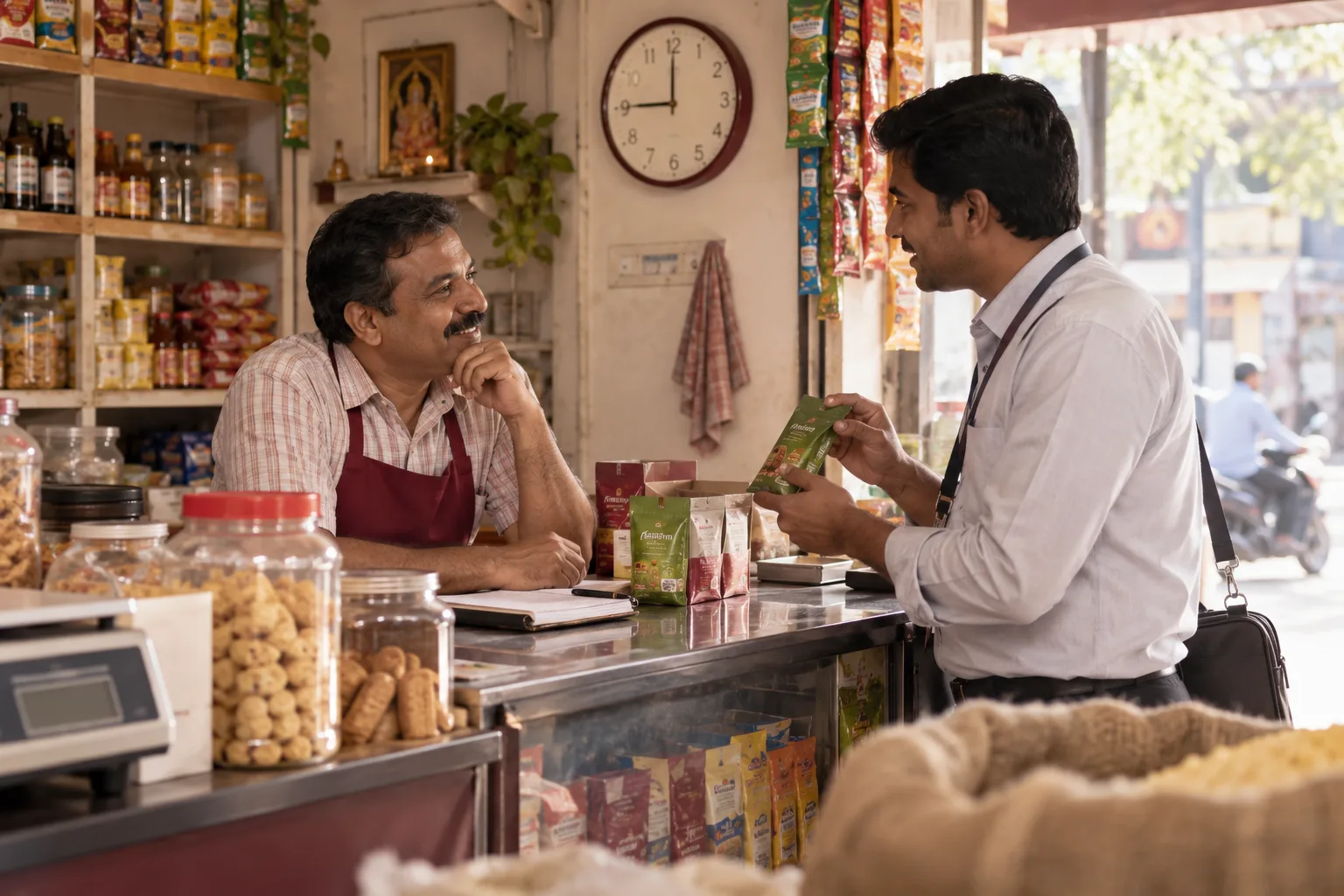 8 min read · 21 Sept 2026How to advertise to retail business ownersA shop owner cannot leave the counter from ten to nine. Reach them in the afternoon lull, through the distributor's salesman and on WhatsApp.
More for retailers
Related work to consider.
Closest to this: content and social
- Social media marketing for retailers
- Content marketing for retailers
- Product category page writing for retailers
- Media pitch writing for retailers
- Corporate announcement writing for retailers
- Online review response writing for retailers
- Data chart, dashboard and timeline graphic design for retailers
- Animated logo design for retailers
Also for retailers
Or start from the overview: sales and marketing for retailers.
Your next practical step
Tell us what you are trying to grow, and we will read it before we call.
Eight short steps, mostly taps. Skip anything you would rather answer on the call.