Roadshow marketing · Marketing
Your roadshow should leave every town with a follow-up list, not only photographs.
A vehicle launch, a tractor demonstration, a tile display on a truck or a health camp for a school all face the same problem. The team travels for days, crowds gather, and the notes from town four never reach the dealer in town four.
Scope, fee, reporting and term are agreed in writing after we have read your brief and spoken to you.
In one paragraph
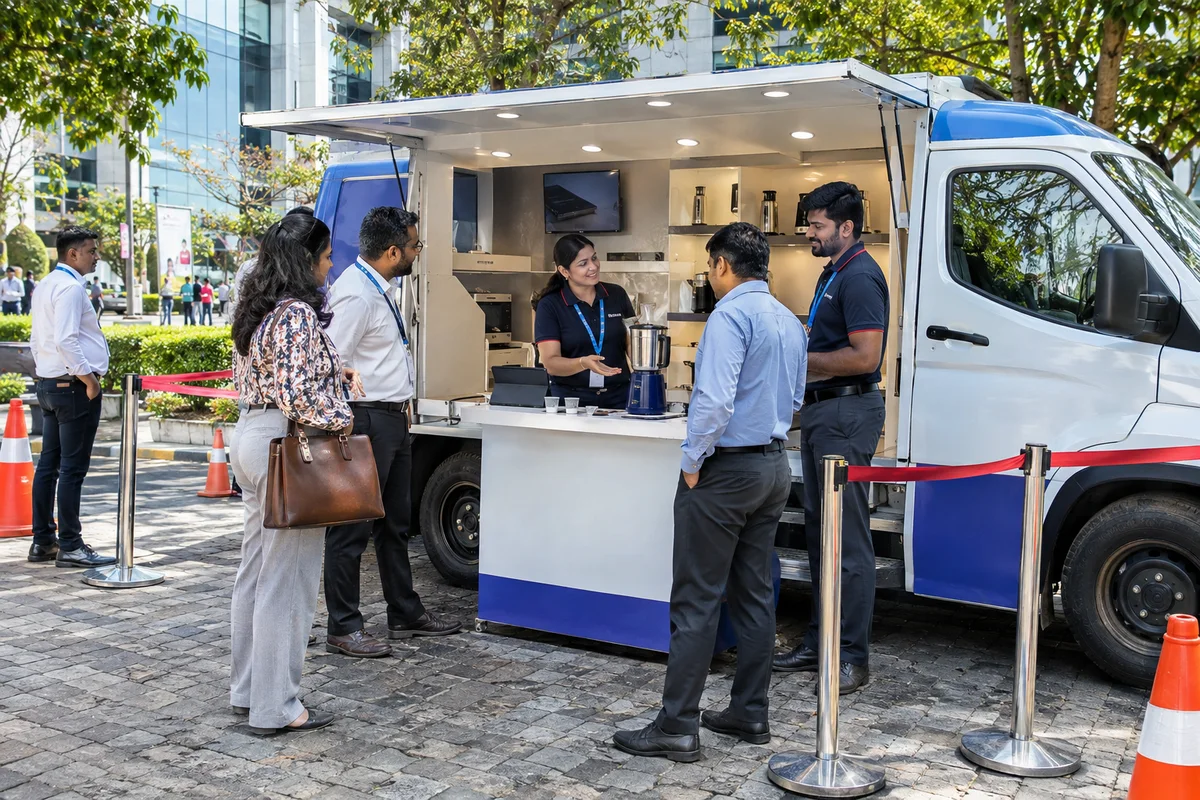
Roadshow marketing takes a product or service to a planned route of towns, with a venue, a local partner and a lead record for each stop. GullySales plans the route and town order, prepares the permission file and lead capture, and builds a follow-up list for each town.
A roadshow is a sequence, so the order of towns, the choice of venue and the local partner decide more than the stage does. Each stop needs a person at home who will take the calls once the vehicle has left.
A single hall or exhibition ground is a different job. Event and trade show marketing covers fixed-venue shows, and hyperlocal advertising covers advertising around one area. Hands-on experience design is covered by experiential marketing.
Who it is for
This is written for you if these sound familiar.
- Vehicle and two-wheeler makers taking test rides and displays to dealer towns
- Equipment and farm machinery brands running demonstrations in rural markets
- Building material and tile manufacturers visiting contractors, architects and dealers town by town
- Colleges and coaching institutes meeting students and parents in feeder towns
- Hospitals and diagnostic centres planning awareness or screening camps in nearby towns
Not for
It is not the right fit if.
- Your buyers are in one city and a single venue would reach them, so a route only adds travel
- No dealer, branch or salesperson in each town can take the calls after the team leaves
- You want a contractor to run the vehicle, staff and permissions, and your own product team will not attend
The problem
Does this sound like your business?
Common situations this work addresses.
“We visited ten towns and cannot say which mattered”
Towns were picked by convenience or a dealer's request. Nobody compared them by buyers reachable, partner strength or the date the market actually buys.
“The crowd came but our dealer was not ready”
The local partner heard of the date late. Stock, a demonstration unit and a person to answer enquiries were missing.
“The police asked for a letter we did not have”
Permission for the ground, the vehicle display and loudspeakers sits with different offices, and each town works differently. A missing paper can stop a stop.
“Visitors gave their numbers and then heard nothing”
Names sat in a notebook on the vehicle. By the time they reached a salesperson, the visitor had bought elsewhere.
What we do
The work we can include.
Each deliverable and the purpose it serves. Your written scope confirms what is included, who is responsible, and what it costs.
Town shortlist and route order
A shortlist of towns scored on buyers reachable, local partner readiness and buying season, then ordered to avoid doubling back. You approve the towns before any booking.
Venue and partner brief for each stop
One page per town naming the ground or hall, the dealer or branch host, the stock and demonstration unit needed, and who answers calls afterwards. The partner confirms it in writing.
Permission file
A list per town of the offices to approach, such as the venue owner, the municipal body and the police, with the applications drafted for your signature. Check each town's current rules; they differ.
Stop run sheet
The order of the day at each stop, staff roles, the script for the demonstration and what to do if rain or a refused permission stops the plan.
Lead capture form
A short phone form that records name, number, town, product of interest, purchase timing and the consent to be contacted. It works without a signal and is tested before the first stop.
Town follow-up list
A sheet per town sorted by timing and handed to the named dealer or salesperson, with a first message drafted for each visitor group.
How the result is measured
- Visitors who left a usable number against visitors who stopped by
- Registrations, test rides, camp slots or demonstration requests booked at each stop
- Reply time from the local partner to each captured visitor
- Quotations, admissions or appointments traced to each town
- Orders traced to each town and the full route cost per order
Recorded as a baseline before work starts, so every later report has an honest comparison.
Before you decide
Agree the work. Know how to judge it.
Roadshow marketing: use these checks to prepare, choose the scope, and review what changes.
Bring the right evidence
Bring a recent won order and an enquiry that went nowhere. Trace how each buyer found you, what they asked, and who handled the next step. A channel list alone will not explain the difference.
Make the scope clear
Choose one offer and one buyer group first. Agree which part needs attention: being found, getting a useful enquiry, or turning an enquiry into an order. Separate recommendations from the work required to carry them out.
Check the work in use
A useful plan names the first change, its owner, the evidence behind it, and the number that will show whether it worked. Ask what has deliberately been left out and why.
Know when to change course
If your team cannot answer the enquiries it already receives, improve that handover before buying more traffic. If the offer itself is unclear, test it with buyers before adding channels.
These are discussion points, not a fixed package. GullySales confirms the deliverables, responsibilities, fee, and term in writing after reading your brief and speaking with you.
How it works
How the roadshow marketing work runs
The work itself, in order. How an engagement starts, from your brief to a written scope, is set out on our method page.
- 1
Town and objective approval
You say who must be met and what a good stop produces, such as test rides booked, dealer enquiries or camp registrations. We propose the towns and you approve the route.
- 2
Partner and permission clearance
Each local partner confirms the date, stock and a person to answer calls. Applications go out for your signature through your own contacts or authorised agent.
- 3
Capture test and team briefing
Your staff rehearse the demonstration and fill the form with sample visitors. We agree who checks entries and how records reach the dealer.
- 4
Stop operation and nightly debrief
Your team runs the stop. Entries are checked the same evening, and the debrief note adjusts the next town's plan.
- 5
Town handover and route review
Each town list goes to its partner with an agreed next action. We then compare towns and recommend which to repeat, change or drop.
Before you hire anyone
Do this first yourself.
Work out which towns deserve a visit before anyone prices a vehicle or a stage.
- List last year's enquiries and orders by town, so the route starts from places where buyers already exist.
- Name the dealer, branch or salesperson in each candidate town and ask whether that person will take calls in the week after the visit.
- Write the one result you want from a stop, such as test rides booked, dealer enquiries or registrations.
- Ask each local partner which ground, hall or lane they would use, and who owns it.
- Find out from the venue owner and the local office which permissions that town asks for.
Judge any provider
What to ask any provider of this service.
Useful whoever you choose, including us.
- How will you choose and order the towns, and what records will you ask me for?
- Which permissions do you expect in each town, and who signs and submits them?
- What does the visitor form capture, and what consent does it record?
- How does a captured visitor reach the local dealer, and who checks that the dealer called?
- What goes into the debrief after each stop, and how does it change the next town?
Where this fits
Three pieces of sales work, in this order.
This work sits inside sales process design, at stage 0, foundation. The audit comes before it, and sales management keeps it running.
Step 1
Sales audit
Find where deals are being lost and what to fix first.
Start here if you cannot say where orders are lost.
Step 2 · you are here
Sales process design
One written way to sell, from first enquiry to repeat order.
Start here if every salesperson sells differently.
Step 3
Sales management
A target, a review routine and someone who owns the number.
Start here if the team has targets and no routine.
FAQ
Questions owners ask before they call.
Not here? More answers, or ask on WhatsApp.
How do you decide which towns to visit?
Do you get the permissions for us?
Can we use the numbers we collect for WhatsApp promotions?
Will GullySales drive the vehicle or staff the stalls?
Can this cover a health camp?
What will it cost, and what happens first?
How long is the contract?
How soon will we see results?
Who will actually do the work?
What do you need from us?
By industry
Roadshow marketing, written for your industry.
Related services
Often bought with this, or instead of it.
Your next practical step
Tell us what you are trying to grow, and we will read it before we call.
Eight short steps, mostly taps. Skip anything you would rather answer on the call.