Auto repair shops · Sales management
Track every enquiry so a quoted job does not vanish before it is booked.
Sales management for an auto repair shop means tracking every enquiry from first call to booked job to completed service. A customer who was quoted but never followed up often books elsewhere. GullySales sets up simple tracking sized to a small garage's daily pace.
Scope, fee, reporting and term are agreed in writing after we have read your brief and spoken to you.

What sales management means
Sales management is the ongoing work of reviewing a sales team's pipeline, calls and targets, and stepping in on deals that are stuck. GullySales sets the review rhythm and the reports a sales manager needs to run this without relying on gut feel.
Last updated 5 Oct 2026.
For auto repair shops
Where it usually goes wrong, and what we would do.
“A quoted job needs a follow-up, not just a number given”
A customer asking for a denting and painting quote often compares two or three garages. The one that follows up a day later often wins the job over one that just waits.
“Walk-ins and phone enquiries need the same record”
A customer who calls ahead and one who walks in should be tracked the same way, so no enquiry is missed simply because of how it arrived.
“Daily volume needs a simple system, not a complex one”
A small garage handling a dozen enquiries a day is better served by a simple, consistently used log than an elaborate system nobody has time to maintain.
What we do
What we deliver for auto repair shops.
Every deliverable, what it covers for you, and the result it is there to produce. Nothing here is an extra.
Enquiry log for calls and walk-ins
A simple, shared log tracking every call and walk-in enquiry the same way, from quote to booked job.
Result: No enquiry goes missing just because of how it arrived.
Quoted-job follow-up routine
A fixed follow-up point, such as the next day, for any customer given a quote who did not book immediately.
Result: Quoted jobs stop disappearing to a garage that followed up first.
Daily volume tracking sized to a small garage
A simple log designed for a dozen or so daily enquiries, consistently used rather than an elaborate system.
Result: Tracking actually gets maintained instead of being abandoned.
Counter staff routine for logging enquiries
A short routine for whoever answers calls and greets walk-ins, adding only a minute to each interaction.
Result: Every enquiry gets recorded without slowing down the counter.
Recovered-job report
A report showing quoted jobs that were followed up and won back after initially going quiet.
Result: You can see additional bookings that would otherwise have been missed.
How the result is measured
- Target achievement
- Pipeline coverage
- Stuck deals resolved
Recorded as a baseline before work starts, so every later report has an honest comparison.
What the service manager reviews
Read these six things in the enquiry log and job cards to see where jobs slip away.
- Calls and walk-ins logged
- Compare the enquiry log with the call history on the counter phone. A number that called and is not in the log is an enquiry lost at the counter, so ring it back and ask who was on the desk.
- Denting and painting estimates not booked
- List every estimate given for body work that has no job card yet. Call each one with the photo of the damage and ask whether the price or the delivery date held them back.
- Insurance claim jobs stuck with the surveyor
- Check claim jobs waiting on the surveyor's visit or the insurer's approval. A car parked for days with no update makes the owner move it, so have the advisor call with the current status.
- Extra work found but declined
- Read the job cards for extra work the mechanic found, such as brake pads or a clutch plate, that the customer declined. Note it on the vehicle's history and mention it at the next service.
- Service due reminders sent
- Pull old job cards by service date and odometer reading. Cars due for the next service with no reminder sent are the easiest repeat jobs to lose to a nearby garage.
- Why a quoted customer went elsewhere
- When a quoted customer says no, write the reason in the log in their words: price, pick-up time, or the brand service centre. Read these together before changing your labour rates.
Who it is for
This is written for these auto repair shops.
- Multi-brand service garages
- Authorised brand service centres
- Denting and painting specialists
- Two-wheeler service centres
- Fleet and commercial vehicle service providers
- Insurance-claim repair specialists
Not for
It is not the right fit if.
- The garage keeps no enquiry log and quotes are given by word of mouth, so there is nothing for a manager to read.
- Only the owner talks to customers, so a system for tracking a team would be tracking one person.
How it works
How the sales management work runs
The work itself, in order. How an engagement starts, from your brief to a written scope, is set out on our method page.
- 1
Look at what exists
We ask for the last few weeks of calendars, pipeline records and review notes, and find where the routine breaks.
- 2
Write the routine down
Slots, agendas, attendees and the records each meeting uses are agreed in writing before the first one.
- 3
Clean the pipeline first
Stage definitions are fixed and stale deals removed, so the first review is about real deals.
- 4
Run or coach
We lead the meetings, or sit in while your manager leads and give feedback afterwards.
- 5
Deal with problems as they appear
A slipping number is discussed at the next one-on-one with notes, not stored up for an appraisal.
- 6
Hand over
Your manager or owner takes the routine, with the templates and records, and we step back.
Where this fits
Three pieces of sales work, in this order.
This work sits inside sales management. A target, a review routine and someone who owns the number.
Step 1
Sales audit
Find where deals are being lost and what to fix first.
Start here if you cannot say where orders are lost.
Step 2
Sales process design
One written way to sell, from first enquiry to repeat order.
Start here if every salesperson sells differently.
Step 3 · you are here
Sales management
A target, a review routine and someone who owns the number.
Start here if the team has targets and no routine.
FAQ
Questions owners ask before they call.
Not here? More answers, or ask on WhatsApp.
Who should track this?
How does this help revenue?
Should my mechanics join the review, or only the counter staff?
What target should I give the service advisor when I have no figure to compare with?
How much does it cost?
How long is the contract?
How soon will we see results?
Who will actually do the work?
What do you need from us?
What if we are not happy with the work?
From the blog
Further reading for auto repair shops.
 5 min read · 11 Oct 2026Using due dates to bring vehicle owners back: service, insurance and pollution checksHow a workshop or dealer can record each vehicle's next service, insurance and pollution-check dates, then call owners with a real reason instead of a generic offer.
 6 min read · 6 Oct 2026How buyers choose a showroom, workshop or parts counterCar, bike, repair and parts buyers send one enquiry to several sellers and pick the first clear answer. This post lists what each buyer checks, and where a dealer or workshop quietly loses them.
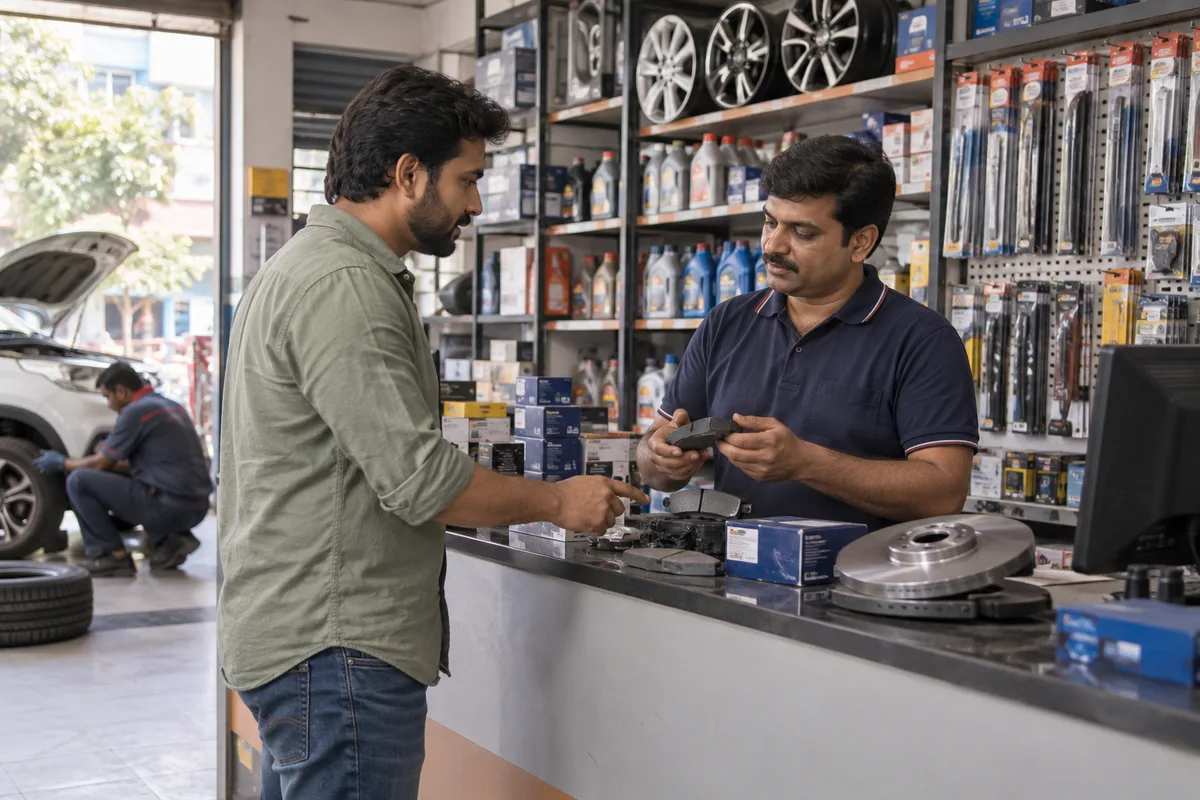 6 min read · 1 Oct 2026Serving the workshop trade and the walk-in buyer at the same parts counterHow an auto parts shop can run two lanes at one counter: an account lane for garages that buy on speed and credit, and a retail lane for walk-in owners who buy on price and advice.
More for auto repair shops
Everything else we would do for you.
Closest to this: sales craft
Also for auto repair shops
Or start from the overview: sales and marketing for auto repair shops.
Your next practical step
Tell us what you are trying to grow, and we will read it before we call.
Eight short steps, mostly taps. Skip anything you would rather answer on the call.