Car dealers · Lead generation
A shared lead rewards the first call and nothing else.
For a dealership the lead already sits with two other showrooms of your brand, so the contest is the first few minutes. GullySales names an owner for every source, writes what the first call asks and gives, and pulls the upgrade enquiries out of your own workshop.
Scope, fee, reporting and term are agreed in writing after we have read your brief and spoken to you.

What lead generation means
Lead generation is the combined work of every channel that brings in a new enquiry, whether from search, adverts, referrals or a stall at an exhibition. GullySales runs these channels together and reports the number of enquiries each one produced, not the activity behind it.
Last updated 5 Oct 2026.
For car dealers
Where it usually goes wrong, and what we would do.
“The first call has to carry a number”
A buyer who asked for the on-road price and gets a promise to send it later has already been given a figure by somebody else. Keep a current price sheet on the desk for every variant.
“The walk-in is the lead nobody records”
Portal leads are counted to the minute while a family who walked in on Sunday leaves nothing behind but a printed quotation. A walk-in register is the cheapest fix in the showroom.
“Your workshop is a lead source that costs nothing”
A seven-year-old car with rising bills comes in every few months and nobody offers an exchange valuation. Those enquiries never reach a portal at all.
“Leads live in a salesperson's phone until he leaves”
The pipeline walks out with him and nobody knows who was about to book. A lead belongs in the system the day it arrives, not the day it closes.
What we do
What we deliver for car dealers.
Every deliverable, what it covers for you, and the result it is there to produce. Nothing here is an extra.
An owner and a time for every source
Who calls a portal lead, a website form, a social lead, a walk-in and a service referral, and within how long, written up at the desk.
Result: No source waits for somebody to notice it.
A current on-road price sheet per variant
Ex-showroom, registration, insurance, accessories and this month's scheme for every variant, reissued when the scheme changes.
Result: The first call gives a number instead of a promise.
A walk-in register the floor actually keeps
Name, number, model, variant, the exchange car and the next step, filled in before the family leaves the showroom.
Result: Sunday's visitors can be followed up on Monday.
Upgrade enquiries pulled from the workshop
A monthly list of cars past a chosen age or mileage, one question for the service advisor, and an exchange valuation offered with the job card.
Result: New car enquiries come out of your own service bay.
Every lead in the system the day it arrives
Leads, visits, test drives and bookings recorded in the dealer management system rather than in personal phones, with a regular look at the lost ones.
Result: The pipeline stays when a salesperson goes.
A follow-up sequence after the test drive
Calls and messages covering the quotation, the finance approval, the exchange figure and the delivery date, on fixed days.
Result: The family hears from you while they are still deciding.
How the result is measured
- Enquiries generated
- Cost per enquiry
- Enquiries by source
Recorded as a baseline before work starts, so every later report has an honest comparison.
Where enquiries come from
The places a car enquiry reaches a dealership, and what to record at each.
- A manufacturer portal lead
- Record the model, the variant, the portal's name and the time the lead reached you. Call from the showroom line and write the outcome in the customer record.
- A website or Meta form
- Check that the form asks the model and the buying time. Assign it to one executive and record the source as ads or website.
- A walk-in showroom visitor
- Write down the model viewed, the budget and whether they plan an exchange. Enter the details before the customer leaves, not later in the evening.
- A service customer ready to upgrade
- Have the workshop advisor note the car's age and the customer's interest. Pass the entry to sales with the service history attached.
- A used-car or exchange enquiry
- Record the car, year, kilometres and the buyer's expectation. Offer an evaluation visit and note who valued it.
- A corporate or fleet buyer's call
- Record the company, the number of vehicles and the person who decides. Send the fleet price sheet and the financing terms in writing.
Who it is for
This is written for these car dealers.
- Authorised new car dealerships for mass-market brands
- Premium and luxury car dealerships
- Electric vehicle dealers and experience centres
- Multi-brand pre-owned car dealers
- Manufacturer-certified used car outlets
- Commercial vehicle and taxi fleet dealers
- Dealer groups with several showrooms and workshops
- Rural and semi-urban dealer outlets
How it works
From your first message to the first report.
No open-ended retainer. Every step gives you something in writing.
First
Your brief
You tell us what you need in a few short steps: your business, what you want, where enquiries come from and how they are handled.
After the brief
A conversation and a written scope
We read it, then talk with whoever handles your enquiries. If you want our help, the scope, the fee and the reporting come in writing, and nothing starts before you have read them.
Before work starts
Baseline recorded
The numbers this work is meant to move, such as enquiries, quotations, orders, visits or renewals, written down so every later report has an honest comparison.
After the baseline
The first fix goes live
The fix we agreed to start with is put in place and measured against the baseline, whether that is a reply, a follow-up, a page, a listing or the handover between marketing and sales.
As agreed
Report against the baseline
What moved, what did not, and what changes next, in plain words. How often you get it is set in writing before work starts.
At renewal
Renew on the numbers
The term ends and you decide whether to continue from the results. The length is agreed in writing before anything starts.
How the lead generation work runs
- 1
Understand your capacity
We agree how many enquiries your sales team can actually handle well, so the system is not built to overwhelm it.
- 2
Audit current sources
We check what already brings in enquiries today, even informally, before adding anything new.
- 3
Strategise the channel mix
Content, search and paid channels are chosen based on where your buyers already look.
- 4
Implement capture and follow-up
Pages, forms and a follow-up process are built and connected end to end.
- 5
Measure and optimise
We track enquiry volume and quality and adjust the channel mix to match.
Why us
Why owners pick GullySales over an agency.
Marketing and sales, as one job
Most agencies stop at the enquiry. We also fix what happens after it: the reply, the follow-up, the quote and the CRM.
The person on the first call does the work
No account managers in between. You are never handed to someone you have not met.
A baseline before anything starts
Your numbers are written down on day one, so every later report compares against something honest.
The fee in writing, split three ways
Our time, your media spend and production on separate lines. You always see what goes to us.
No guarantees we cannot keep
The term is agreed in writing and never a default twelve months. We never promise a ranking or a lead count, because nobody controls those.
One office, and we say so
Nagarbhavi, Bengaluru. We work across India by call and WhatsApp and travel when a session needs to be in person.
#257, 3rd floor, Sri Nanjundeshwara Complex, Nagarbhavi 8th Block, Outer Ring Road. How we work.
Your brief
Tell us what you need, and we will read it before we call.
Eight short steps about your business, what you want and who decides. Most questions are a tap, and you can skip any you would rather answer on the call.
FAQ
Questions owners ask before they call.
Not here? More answers, or ask on WhatsApp.
What should the first call actually say?
How do we get the workshop to hand over upgrade enquiries?
Our executives keep leads in their own phones. How do we change that?
How do we tell a serious buyer from a person collecting quotes?
How much does it cost?
How long is the contract?
How soon will we see results?
Who will actually do the work?
What do you need from us?
What if we are not happy with the work?
From the blog
Further reading for car dealers.
 6 min read · 6 Oct 2026How buyers choose a showroom, workshop or parts counterCar, bike, repair and parts buyers send one enquiry to several sellers and pick the first clear answer. This post lists what each buyer checks, and where a dealer or workshop quietly loses them.
 8 min read · 21 Sept 2026Tamil advertising creative: what actually changesTamil writes one way and speaks another, and the script cannot tell a b from a p. Both facts decide your line, your voice artist and the spelling of your own name.
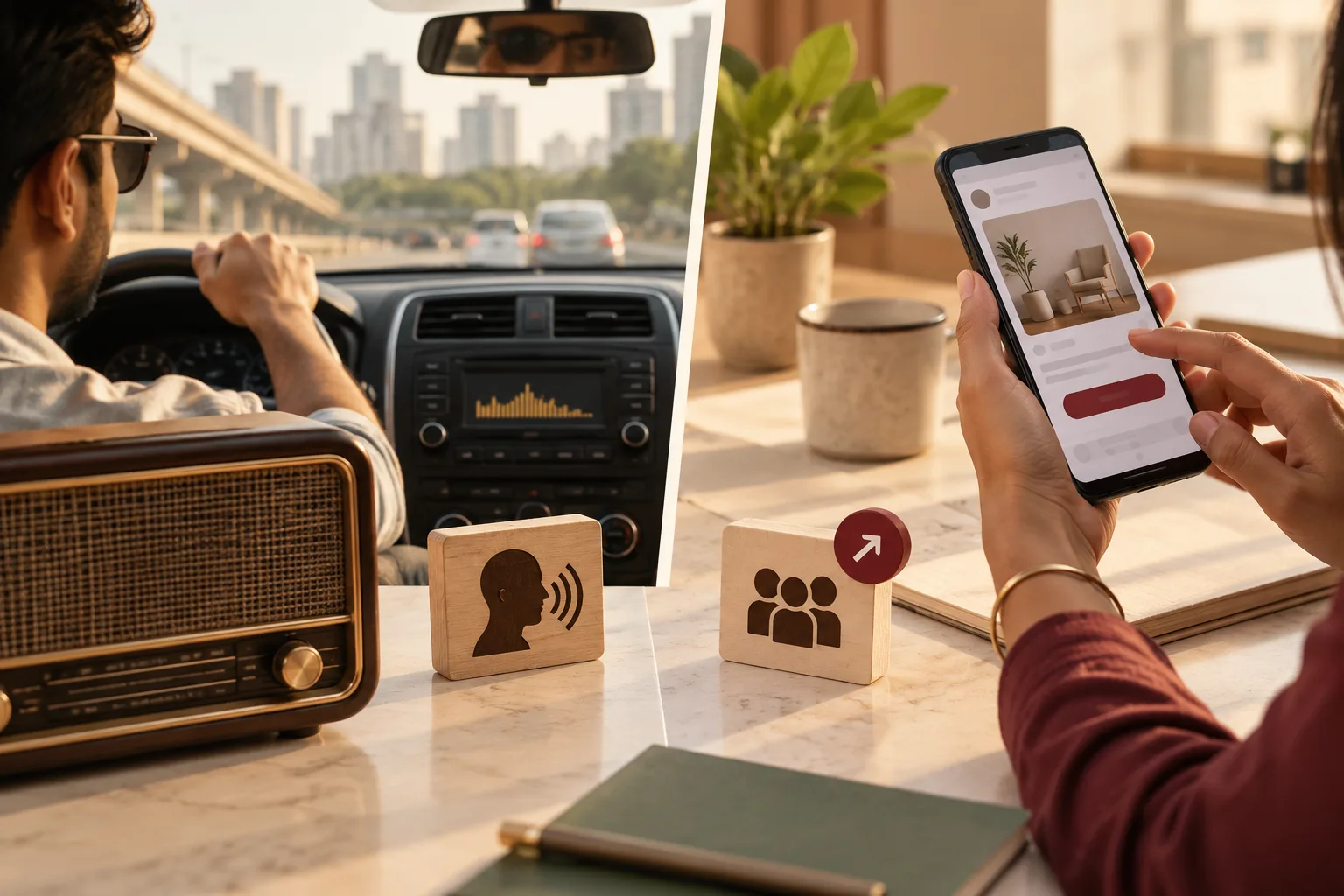 6 min read · 21 Sept 2026Radio advertising vs social media advertising: where should your money go?Radio reaches a driver who cannot click. Social reaches a thumb that can. One buys a name people remember, the other buys the enquiry itself.
More for car dealers
Everything else we would do for you.
Or start from the overview: sales and marketing for car dealers.
Your next practical step
Tell us what you are trying to grow, and we will read it before we call.
Eight short steps, mostly taps. Skip anything you would rather answer on the call.