Car dealers · Digital marketing
Three businesses under one roof compete for the same monthly budget.
A dealership is a new car showroom, a used car yard and a workshop, and each has a different buyer. GullySales sets what the month's budget does for each, times the campaigns to launches and delivery dates, and puts every enquiry into one report.
Scope, fee, reporting and term are agreed in writing after we have read your brief and spoken to you.

What digital marketing means
Digital marketing is the combined work of search, social media, advertising and website channels running together rather than as separate projects with separate people. GullySales runs these as one connected system so a change in one channel, such as a new offer, is reflected everywhere at once.
Last updated 5 Oct 2026.
For car dealers
Where it usually goes wrong, and what we would do.
“Festival spending has to stop before the festival”
If a booking cannot be delivered on the auspicious day, advertising in that week buys disappointment. Work backwards from the stock in the yard and the registration queue.
“The workshop pays the bills and gets no marketing”
Service brings steady revenue and the customers who will upgrade, yet the budget goes to new car campaigns. A service camp campaign costs little and feeds the showroom.
“Co-op money comes with paperwork”
Part of the spend can be claimed back when the creative, the disclaimers and the proof file follow the brand's rules. Claims are refused over the fine print far more often than over the idea.
“Used cars need a plan and usually get leftovers”
That buyer is comparing organised platforms with inspection reports and return windows. Photographs, listings and an inspection summary do more here than any campaign.
What we do
What we deliver for car dealers.
Every deliverable, what it covers for you, and the result it is there to produce. Nothing here is an extra.
A quarter plan across all three businesses
What the new car, used car and service sides each get in money and attention, set out month by month.
Result: The workshop stops being an afterthought.
Campaigns timed to delivery, not to the festival
The stock position, the registration queue and the delivery dates read before a festival campaign is booked.
Result: You sell only what can be delivered on the date.
Co-op claims prepared alongside the campaign
Creative approvals, disclaimers, invoices and proof files gathered as the campaign runs, in the format your regional office requires.
Result: The claim gets paid rather than refused.
A used car plan of its own
Photograph standards, inspection summaries, price reviews and the portals worth listing on.
Result: Cars move out of the yard faster.
A service camp calendar
Camps and reminders timed to the monsoon, the festival and each model's service intervals, with the upgrade question attached.
Result: Service work fills the bays and feeds the showroom.
One report across every enquiry
New car, used car and service enquiries by source, with time to first call, test drives, bookings and deliveries, against the baseline.
Result: The whole dealership is read on one page.
How the result is measured
- Enquiries across channels
- Cost per enquiry overall
- Channel mix by contribution
Recorded as a baseline before work starts, so every later report has an honest comparison.
Where a dealer starts
A car dealer starts with every enquiry in one record and a named person who calls it back.
- A single enquiry sheet
- Record each lead from the manufacturer portal, walk-ins, calls and your own site, with model, source and the salesperson who owns it.
- Call-back rule
- Name who calls each new lead, and how soon, in your own showroom rules. Track the leads no one has touched.
- Business Profile for each showroom
- Correct the brands, models on display, test-drive booking link and workshop hours. Count calls and direction requests.
- Used car listing
- Photograph each used car properly and list it on your site and the portals with the same details. Record the enquiries by car.
- Service-to-sales link
- Ask the workshop to pass on owners nearing an exchange, with consent. Log the exchanges that result.
- What to leave until later
- Leave extra paid campaigns until leads are called and recorded. Spending more on leads nobody follows up only wastes the budget.
Who it is for
This is written for these car dealers.
- Authorised new car dealerships for mass-market brands
- Premium and luxury car dealerships
- Electric vehicle dealers and experience centres
- Multi-brand pre-owned car dealers
- Manufacturer-certified used car outlets
- Commercial vehicle and taxi fleet dealers
- Dealer groups with several showrooms and workshops
- Rural and semi-urban dealer outlets
How it works
From your first message to the first report.
No open-ended retainer. Every step gives you something in writing.
First
Your brief
You tell us what you need in a few short steps: your business, what you want, where enquiries come from and how they are handled.
After the brief
A conversation and a written scope
We read it, then talk with whoever handles your enquiries. If you want our help, the scope, the fee and the reporting come in writing, and nothing starts before you have read them.
Before work starts
Baseline recorded
The numbers this work is meant to move, such as enquiries, quotations, orders, visits or renewals, written down so every later report has an honest comparison.
After the baseline
The first fix goes live
The fix we agreed to start with is put in place and measured against the baseline, whether that is a reply, a follow-up, a page, a listing or the handover between marketing and sales.
As agreed
Report against the baseline
What moved, what did not, and what changes next, in plain words. How often you get it is set in writing before work starts.
At renewal
Renew on the numbers
The term ends and you decide whether to continue from the results. The length is agreed in writing before anything starts.
How the digital marketing work runs
- 1
Understand the objective
We agree the one thing this campaign needs to achieve before choosing any channel.
- 2
Audit available channels
We assess which channels are realistic to run well within the budget and timeline.
- 3
Strategise the central idea
One message and offer is developed that will work across every planned channel.
- 4
Implement across channels
Each channel receives its own adapted version, launched on a shared timeline.
- 5
Measure as one campaign
Results from every channel are combined into a single report against the original objective.
Why us
Why owners pick GullySales over an agency.
Marketing and sales, as one job
Most agencies stop at the enquiry. We also fix what happens after it: the reply, the follow-up, the quote and the CRM.
The person on the first call does the work
No account managers in between. You are never handed to someone you have not met.
A baseline before anything starts
Your numbers are written down on day one, so every later report compares against something honest.
The fee in writing, split three ways
Our time, your media spend and production on separate lines. You always see what goes to us.
No guarantees we cannot keep
The term is agreed in writing and never a default twelve months. We never promise a ranking or a lead count, because nobody controls those.
One office, and we say so
Nagarbhavi, Bengaluru. We work across India by call and WhatsApp and travel when a session needs to be in person.
#257, 3rd floor, Sri Nanjundeshwara Complex, Nagarbhavi 8th Block, Outer Ring Road. How we work.
Your brief
Tell us what you need, and we will read it before we call.
Eight short steps about your business, what you want and who decides. Most questions are a tap, and you can skip any you would rather answer on the call.
FAQ
Questions owners ask before they call.
Not here? More answers, or ask on WhatsApp.
How should the budget split across new, used and service?
What is the biggest waste in a dealership's marketing?
The manufacturer already runs advertising. Why should we?
How do we get the sales team to use one system?
How long is the contract?
How soon will we see results?
Who will actually do the work?
What do you need from us?
What if we are not happy with the work?
From the blog
Further reading for car dealers.
 7 min read · 21 Sept 2026How to write a radio scriptA spot is heard once, by somebody at the wheel who cannot look at anything or write anything down. Time the words with a stopwatch, not on the page.
 8 min read · 21 Sept 2026How to adapt one campaign across mediaThe idea travels. The execution does not. Build the tightest piece first and let the roomier media expand from it, never the other way round.
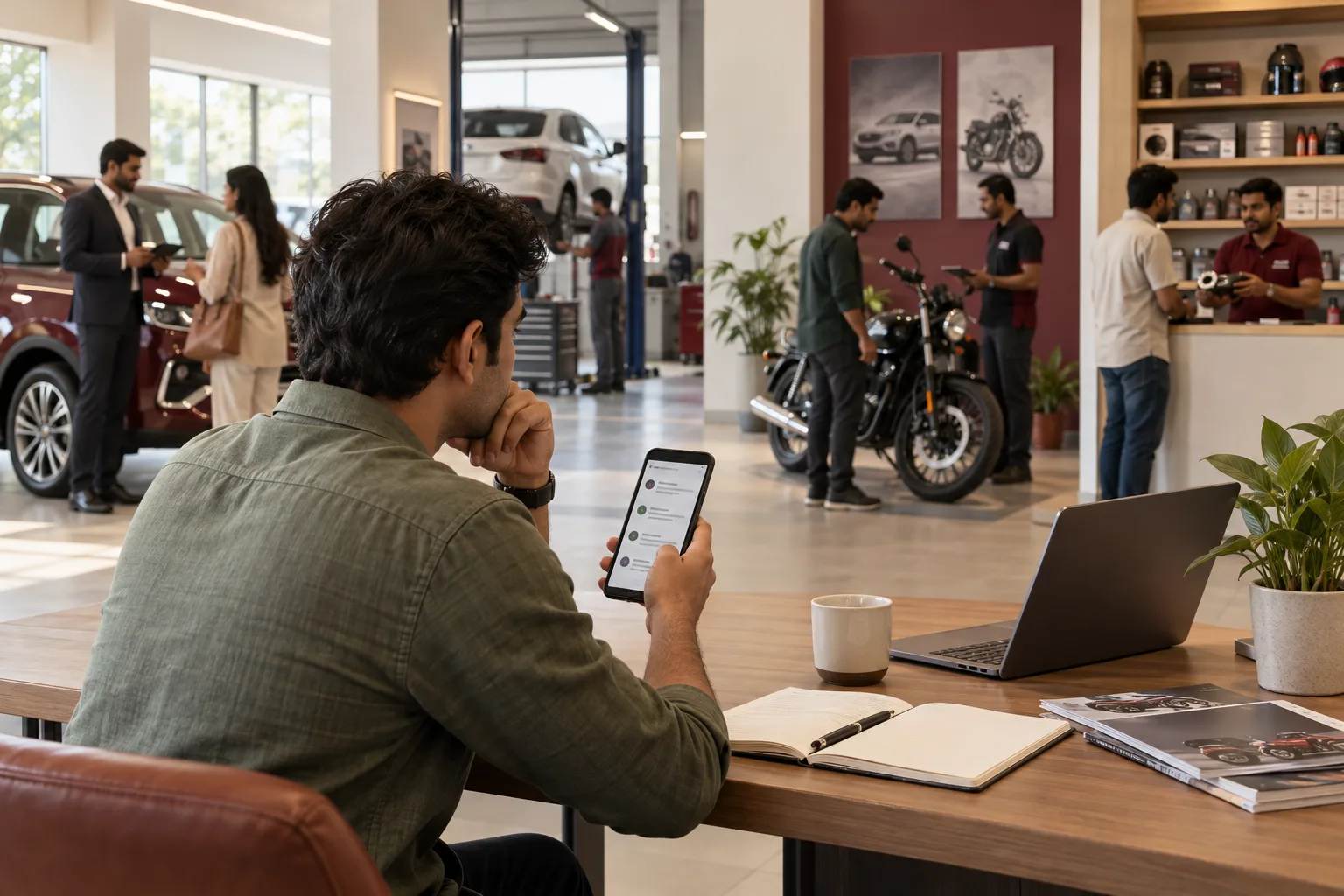 6 min read · 6 Oct 2026How buyers choose a showroom, workshop or parts counterCar, bike, repair and parts buyers send one enquiry to several sellers and pick the first clear answer. This post lists what each buyer checks, and where a dealer or workshop quietly loses them.
More for car dealers
Everything else we would do for you.
Or start from the overview: sales and marketing for car dealers.
Your next practical step
Tell us what you are trying to grow, and we will read it before we call.
Eight short steps, mostly taps. Skip anything you would rather answer on the call.